
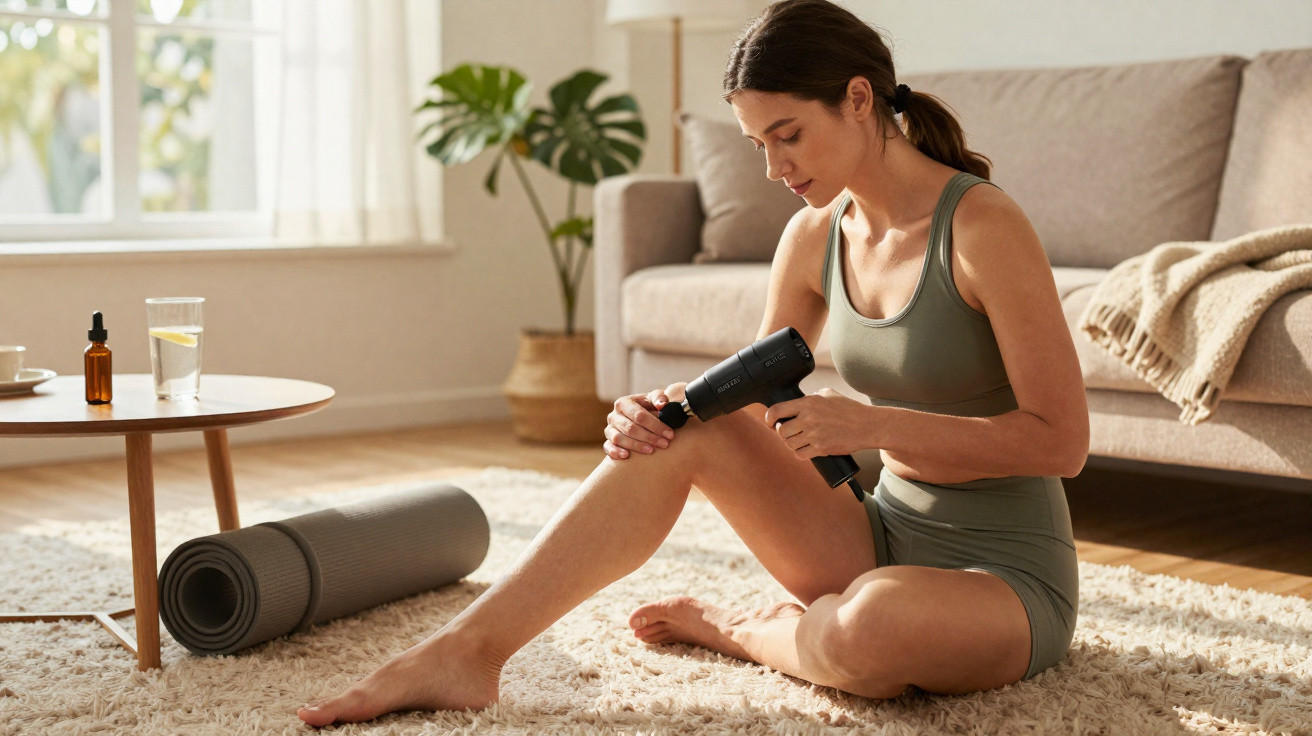
On Wednesday evening, at 21:13, in that awkward moment when you are torn between starting a series or simply collapsing onto the sofa, my shoulders made the choice for me.
They were stiff, as hard as wood. I had spent the day at the computer, followed by a lunchtime workout, and every turn of my head pulled at my neck like a quiet reminder: your body has had enough.
The Blackroll Fascia Gun had been sitting on the coffee table for three days. I had read the claims and watched the videos, but I was sceptical. Could this small device that vibrates so powerfully really compete with a proper masseur’s hands, or was it another gadget destined for a drawer beside forgotten resistance bands?
I picked it up, pressed the button, and its low hum filled the living room. Within a minute, the way I perceived my own muscles had already shifted. That was when the questions began.
Muscle fatigue: when the body speaks louder than we do
The first time I used the Blackroll Fascia Gun, I had just come back from a disappointing run. My legs felt heavy by the third kilometre, my stride was broken and my breathing shallow. Nothing serious, simply that creeping fatigue familiar to anyone balancing work, family, sport, a social life… and a few physical ambitions.
I placed the device’s round attachment on my right calf, at speed 1. At first, the muscle resisted, as if my body were saying, “no, not now”. After ten seconds, though, a gentle warmth began to spread. The sharp aches became a more diffuse pressure. I was not on a luxurious massage table; I was sitting on my mat in socks, with the hallway light accidentally left on. Even so, something was genuinely starting to loosen.
We often describe “muscle tension” as a local issue, when it is really part of a wider story. Screen posture, underlying stress, short nights and poorly managed exercise: the body absorbs it all in the same places. The Blackroll Fascia Gun fits precisely into that reality. It is designed to work not only on muscle, but also on the fascia, the tissues that surround everything and only become noticeable when they start to pull.
According to several studies mentioned by physiotherapists I spoke with, percussion therapy may temporarily increase blood flow and reduce the perception of post-exercise pain. This is not a magic wand; it is a clear mechanical helping hand. What stayed with me was not the marketing promise, but the consistency with which amateur athletes stick with this type of device once they have found their own routine.
A fitness instructor I met at a local gym told me he could see the difference in his clients. Those who use a fascia gun after a session recover “feeling lighter” and return less often with that concrete-leg sensation. With figures to support it, he had observed fewer dropouts from his most demanding programmes, simply because people felt less wrecked when they woke up. This is a long way from being a decorative gadget on the TV unit.
The principle behind the Blackroll Fascia Gun is fairly straightforward: it sends fast, controlled pulses into the tissues to release areas that are overly tight, much as you pat a cushion to restore its volume. The vibrations reach deeper than fingers can, without requiring you to press like mad. Its different attachments can be selected for particular areas: the ball head for large muscle groups, the flat head for more sensitive areas, and the pointed attachment to target the tension spot that can ruin an entire day.
It becomes especially interesting when it is part of everyday life. Not just for athletes, but also for someone finishing a day of home working with their upper back seized up. The device then becomes more of a tool for managing how your body feels than a simple relaxing massage.
How to use the Blackroll Fascia Gun without overthinking it
The question that always comes up is: how long, where and how? The thing is, the Blackroll Fascia Gun does not require a protocol worthy of a yoga retreat. Three areas, three minutes, in the evening: that is roughly what eventually worked for me. Calves, quadriceps and upper back. Spend 60 to 90 seconds on each area, beginning at a low speed and increasing it gradually.
I start by sweeping across the broad area, without stopping at one exact point. I simply let the vibrating head move slowly along the muscle. Once I find an area that “speaks”, I return to it for 10 to 15 seconds, no more. The aim is not to crush the pain, but to bring it down a notch. When the device, muscle and breathing fall into rhythm, you can clearly feel the difference: the body starts to cooperate.
Another approach that makes a real difference concerns the shoulders and neck. Rather than trying to reach the back of my neck with my arm stretched awkwardly, I use a chair with a low backrest and let my arm rest on it, so I do not have to strain. The device handles the rest. This small adjustment is easy to underestimate, but it prevents you from creating… new tension while trying to relieve old tension.
The most common mistakes with this type of device are nearly always the same. Setting the speed too high too quickly. Staying on a painful area for too long in the hope of forcing it to “release”. Going straight over joints. And, above all, giving up after a week because there is no instant miracle.
We have all had that moment when we buy a tool “to look after ourselves” and then leave it gathering dust. The Blackroll Fascia Gun is no exception to that risk. Let us be honest: nobody really does this every day for the entire year. What matters is less about perfection than building the reflex. On the evening when your neck is pulling, the morning when your thighs are burning after a long run, or on Sunday before another busy week begins.
Several physiotherapists I questioned repeated the same point: never replace medical advice with reckless percussion. Sharp, localised or unusual pain should be assessed by a professional. The Blackroll Fascia Gun is more suited to comfort and recovery. It is a little like a good massage roller, but more targeted and easier to handle after a tiring day, when you no longer want to make an effort just to relax.
A coach shared a line with me that sums up the reality rather well:
“A fascia gun is like a toothbrush for your muscles: if you use it regularly, everything feels better, but nobody boasts about it on Instagram.”
For clarity, here is a short practical guide without the jargon:
- Always begin at the lowest speed, particularly around the neck and upper back.
- Keep moving; do not hold the device over a joint or directly on the spine.
- Limit use to 1 to 2 minutes per muscle group, even if you return later.
- Avoid inflamed areas, wounds and visible varicose veins.
- Combine use with a few gentle stretches or simply a relaxed walk.
What the Blackroll Fascia Gun really brings to daily life
After three weeks of regular use of the Blackroll Fascia Gun, the changes do not show in the mirror. You notice them in tiny everyday movements. Bending down to pick up a bag of shopping without wincing. Climbing stairs after leg day while feeling that your muscles are working rather than protesting. Standing up after an hour-long video call without sensing your shoulders locked up around your ears.
Most surprising is how this object gradually becomes part of private routines. Some use it while watching a series, much as they might absent-mindedly massage their temples. Others reach for it after a shower, when their muscles are already slightly warm. I have even heard about two-person “recovery sessions”, where one person holds the device for the other, like a small end-of-day ritual. The technology almost becomes an excuse to care for each other, without grand speeches.
What remains is this quiet question: when did we decide that muscle fatigue was normal, almost deserved? The Blackroll Fascia Gun will not rebuild our schedules or fix chronic sleep deprivation. Instead, it suggests another idea: we are allowed to step in and communicate with our bodies in ways other than ignoring them or pushing them harder. A home massage, when used properly, is not a luxury. It is a language.
Many people will read these lines, recognise themselves vaguely, then move on. Others may feel like trying it, with curiosity and without expecting a revolution. Between those two reactions lies a subtle shift taking place in our living rooms, on our mats and beside a slightly worn sofa: rediscovering our muscles, their limits and their needs. If a small vibrating device can start that conversation, the real story begins there.
| Key point | Detail | Benefit for the reader |
|---|---|---|
| Targeted action on fascia | The Blackroll Fascia Gun works deep within the tissues through rapid percussion | Better understand why muscles genuinely loosen after use |
| Short but regular use | 1 to 2 minutes per muscle group is enough, a few evenings each week | Fit the device into a busy life without adding another “wellbeing chore” |
| A comfort tool, not a diagnostic tool | Suitable for recovery and mild tension, not acute or suspicious pain | Know when to use it… and when to consult a professional |
FAQ
- Does the Blackroll Fascia Gun replace a massage from a physiotherapist or osteopath? No, it is not the same profession. The Blackroll Fascia Gun is a comfort and recovery tool that is useful between appointments, but it replaces neither a diagnosis nor the hands of a healthcare professional.
- How many times a week can it be used safely? For a healthy adult, use 3 to 5 times a week, in short sessions, is generally reasonable. If you have any doubts or a medical condition, it is best to speak to a doctor or physiotherapist.
- Does it hurt during the massage? You may feel discomfort or intense pressure in very tight areas, but not sharp pain. If the pain is severe or increases as the seconds pass, reduce the intensity, move to another area or stop.
- Can it be used on the neck and lower back? Yes, but with great care. Avoid the spine itself and stay on the muscle mass on either side, using a low speed and slow movements.
- Is it worth the investment if I do not play sport? Yes, if your tension mainly comes from stress, desk work or repetitive movements. Many non-sporting users relieve their shoulders, trapezius muscles and lower back after long days in this way.



Comments
No comments yet. Be the first to comment!
Leave a Comment