
The woman facing the mirror repeats the same small movement: fingertips against her scalp, eyes squinting as she leans in to check whether her parting looks… fuller.
The bathroom lighting is harsh, revealing every baby hair and each visible gap. She is not quite losing her hair, yet it no longer feels like the hair of her youth. There are extra strands in the shower, her parting is broader, and her ponytail appears finer in photographs than it did last summer.
Half dressed, running late and quietly concerned, she scrolls through her phone. There are serums, laser helmets and supplements priced like a weekend break. Amid the extravagant claims and comments from everyday users, one recommendation keeps resurfacing: gentle, consistent scalp massage. No device or flattering filter, only hands and time.
She brings her fingers back to her head, this time with more care. Could this nearly overlooked little ritual be making a meaningful difference?
The understated strength in your fingertips
Hair thinning seldom feels sudden at the beginning. Instead, it arrives as a collection of little disappointments: more scalp showing in one place, a ponytail that feels less substantial in another. You spot your reflection in a lift or shop window and wonder, “Was my hair always this flat?” Gradually, those moments accumulate.
Some people immediately turn to costly shampoos or salon procedures. Others act as if nothing has changed and simply pull their hair back more tightly. What many of us miss is that the scalp itself may become tense, rigid and almost immobile under the strain of daily life. Taut skin is not an ideal setting for strong, healthy new hair growth.
This is where an extremely straightforward technique comes in, almost unnoticed.
Trichologists – specialists in hair and scalp science – have discussed circulation for years. Blood flow carries oxygen, nutrients and growth factors to the area where hair follicles sit. When the scalp is tight or seldom stimulated, that microcirculation can become a little sluggish.
In a small Japanese study, participants receiving regular, focused scalp massage over several months experienced greater hair thickness than a control group. This is not about instant, dramatic hair growth, but measurable differences in the diameter of individual hairs. In practical terms, it means hair may appear denser because every strand is marginally stronger and fuller.
It is less a “fairy-tale transformation” and more a “slow, quiet upgrade you only really notice when you look back at old photos.”
From a biological perspective, this is plausible. Mechanical stimulation – gently shifting the skin and underlying tissue – signals activity to the body in that area. It may prompt blood vessels to widen slightly, bringing more support to follicles in their prolonged resting phase. Across several months, this can help promote a healthier growth cycle, with more hairs in active growth and fewer remaining in a shedding state.
There is another factor rarely mentioned on product packaging: tension. Many people physically hold stress in their scalp muscles. Releasing that ongoing tightness does more than support circulation; it can improve the environment in which every hair root is held. The outcome is not immediate regrowth, but a visible improvement in how full and robust the hair looks.
That is the purpose of one particularly specific massage technique.
The “anchor and glide” scalp massage for your follicles
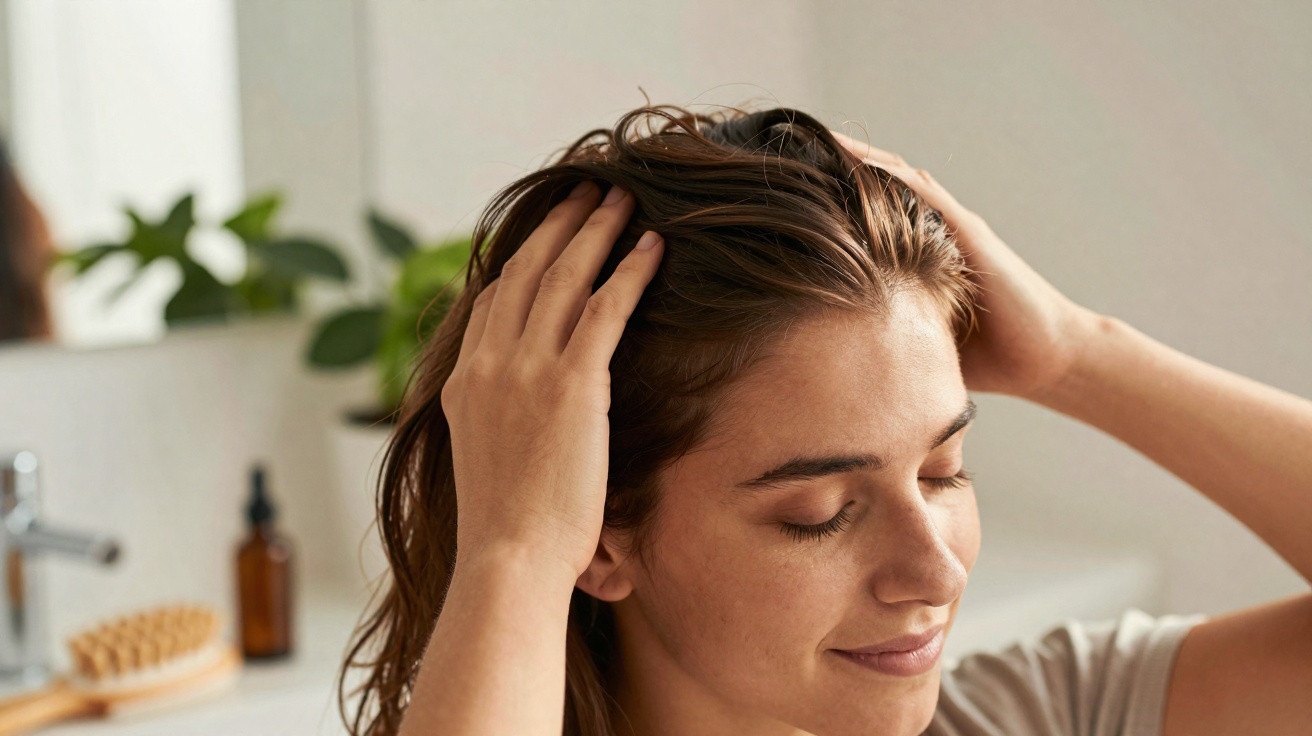
Do not simply rub your head as though you were shampooing. The approach most likely to make a genuine difference is slower and more purposeful. Think of it as “anchor and glide”. Set the pads of your fingers – never your nails – firmly on the scalp. Keep them anchored so they do not slip along the hair. Without lifting them, softly shift the skin beneath your fingertips using tiny circular or back-and-forth movements.
The aim is to move the scalp rather than the hair. Begin at the front hairline, where thinning is often first noticed. Cover small areas in turn: the temples, top of the head, crown and then the back. A realistic target is ten to fifteen minutes, three to four times a week. Let’s be honest: hardly anyone truly does it every day.
This controlled movement appears to encourage microcirculation while easing the firm, “helmet” sensation that some people do not realise they carry.
If you enjoy using a light oil or serum, add only a few drops to help your fingertips move comfortably. Some people insist they first saw real results after pairing the massage with a caffeine or rosemary-infused tonic. Others use no products at all and still report fuller-looking roots after three to six months. On a personal level, the massage can become a ritual in itself: a few peaceful minutes before sleep or while watching a series, when you reconnect with your body.
Most of us have had an evening when, after a demanding day, we catch ourselves rubbing our temples. This follows the same instinct, directed towards the top of your head with more purpose. It is neither glamorous nor especially suited to Instagram, but it is highly practical. When you repeat the same pattern week after week, your scalp begins to “remember”.
Consistency matters more than perfection.
Many people begin with far too much force. They scratch, pull and run their fingers through the hair rather than working on the skin below it. This may snap delicate hairs and aggravate a sensitive scalp. Use pressure similar to a good facial massage, not as if you are trying to scour away paint. If your scalp is red or sore afterwards, the pressure was too strong.
Another frequent mistake is doing it only in moments of alarm. You see a clump of hair in the shower or an unforgiving car selfie, then massage compulsively for three days… before forgetting entirely for three weeks. Hair growth does not respond to panic; it responds to a regular routine. A gentle 10-minute session every other evening is always more useful than an intense 40-minute scrub once a month.
Do not be hard on yourself if you skip a day. This is not a punishment; it is a favour for the future version of you looking in the mirror.
“After about four months of slow, firm scalp massage, I noticed my part line didn’t glare back at me in photos anymore,” explains Emma, 34, who started the routine after postpartum shedding. “No one else could put a finger on what changed. They just kept saying I looked ‘more like myself’ again.”
Experiences such as Emma’s are not unusual. They are simply less loud than the confident promises found in hair supplement advertisements. People mention fine new hairs – the well-known “baby hairs” – emerging around the front, or a fringe that appears less transparent when the light catches it. They also describe their scalp as warmer, livelier and almost gently tingling following a good session.
For a straightforward guide, this is what a realistic routine can look like in daily life:
- 3–4 sessions per week, 10–15 minutes each
- Use finger pads only, no nails, no scratching
- Focus on moving the scalp, not sliding across hair
- Work in small sections: front, temples, crown, nape
- Commit for at least 3–6 months to see visible density changes
How small scalp massage rituals transform the mirror
Scalp massage cannot change your genetics or resolve serious hormonal problems. What it may do is move your relationship with your hair from passive concern towards active care. There is a psychological burden that eases when you stop helplessly examining your parting and start doing something practical, free and quietly supported by science. Instead of endlessly refreshing miracle treatments on your phone, you begin to reconnect with your own skin.
As time passes, those minutes spent with your fingertips on your scalp become less about “fixing” something and more about care. You can still choose serums, shampoos or treatments, but the basis of your routine is now literally in your own hands. Many people say that committing to massage also helps them maintain other positive habits: going to bed a little earlier, drinking more water and noticing stress levels. It is as though this modest act of touch reminds them that their body is not merely a problem to solve, but somewhere to live.
If you begin today, nothing spectacular is likely to happen next week. Hair sheds and grows in cycles, quietly indifferent to impatience. Yet months from now, a future version of you might stand before that same bathroom mirror, tilt their head and see something subtle: a softer-looking parting, less exposed scalp and a slightly fuller outline. They may remember this uncomplicated technique that never drew attention to itself – it simply kept returning.
| Key point | Detail | Benefit for the reader |
|---|---|---|
| Targeted scalp stimulation | “Anchor and glide”: move the skin, not the hair | Supports microcirculation and an environment that may encourage denser-looking hair |
| Regularity rather than intensity | 3–4 weekly sessions of 10–15 minutes over several months | Makes the practice realistic and easier to fit into a genuinely busy life |
| Gentle pressure, never aggressive | Use the pads of the fingers, without scratching or pulling | Protects fragile lengths and helps avoid scalp irritation |
FAQ:
- How long does it take to see hair that looks denser? Most people require at least 3 months of regular scalp massage before noticing subtle differences, and 6 months for a clearly visible improvement in density or thickness.
- Can scalp massage regrow hair in bald patches? No. It may support healthier follicles where hair remains, but it cannot reverse advanced scarring or bald areas that have existed for a long time.
- Should I use oil, or can I massage a dry scalp? Either option is suitable. A few drops of a lightweight oil or tonic can make movement easier, but the main benefit comes from mechanically moving the scalp rather than from the product.
- Is it safe for dandruff or a sensitive scalp? Yes, provided that you remain very gentle and do not scratch. Stop and speak with a dermatologist or trichologist if you experience burning, severe redness or pain.
- Can scalp massage replace professional treatments? Massage can be valuable support, but it is not always an alternative. For substantial hair loss or sudden shedding, combine it with professional advice rather than relying on it alone.



Comments
No comments yet. Be the first to comment!
Leave a Comment