
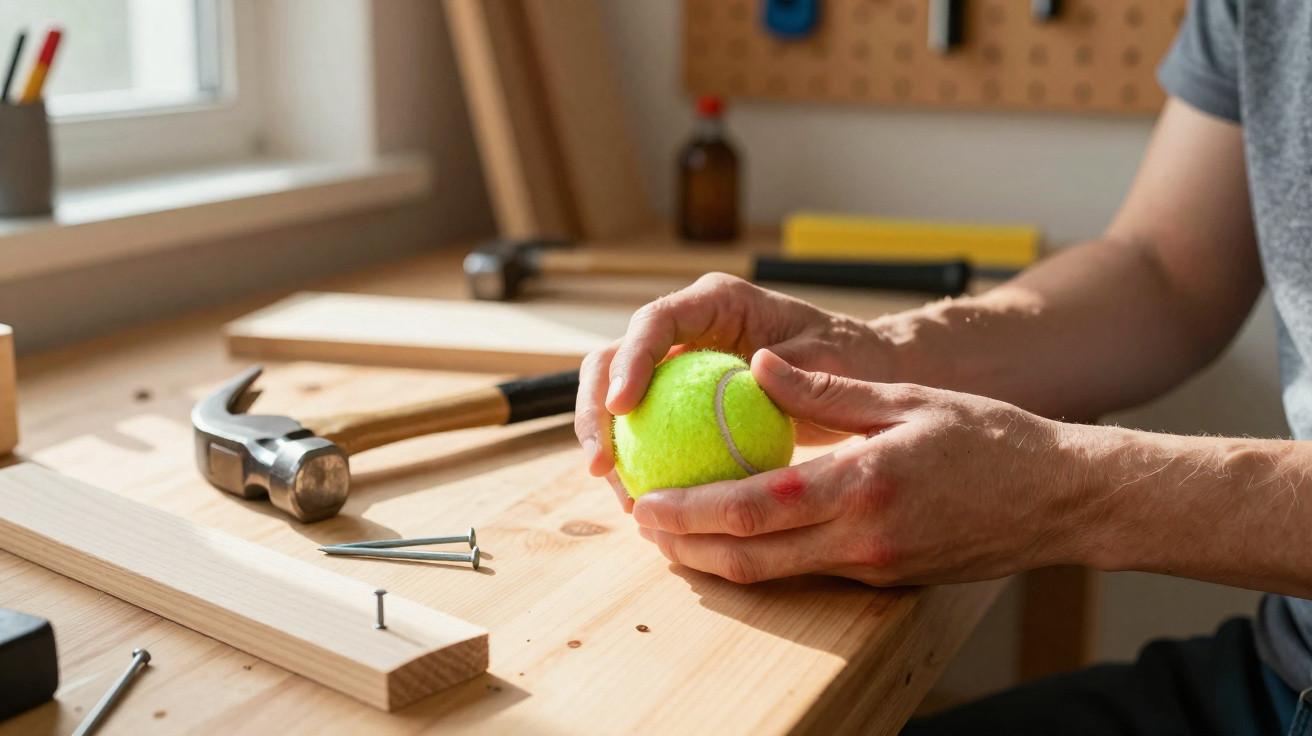
The blow landed before the swear word could even escape. One solid strike of the hammer, a brief slip, then that dull, fleshy sound every DIY enthusiast instantly recognises. The index finger is trapped between the hammer head and metal, and for a moment the whole world narrows to one piercing pain. Your breath catches, your knees weaken and your pulse races. Somewhere at the back of your mind, only one thought flashes up: please do not let it be broken.
We all know that moment when everything seems to move in slow motion while you think, “How could I be so stupid?” You shake your hand, whistle through clenched teeth and frantically look for ice, water or anything useful. Usually, there is nothing nearby except tools, dust and perhaps a grimy glove. In precisely this kind of situation, an ordinary household object can seem like a small miracle button.
A tennis ball.
Why a tennis ball can help your trapped fingers
Anyone who regularly works with their hands knows pain like an unwelcome colleague. Carpenters, fitters and DIY hobbyists all tell similar stories: trapped fingers, crushed nails and blue fingertips that throb for days. A hammer, a door frame or a box in the cellar - sometimes one careless second is enough. Yet this small yellow ball keeps appearing in these accounts, almost like a secret ally amid the chaos of the workbench.
It can occasionally be spotted at the edge of building sites, garages and old workshops. Not for playing sport, but as an improvised first-aid aid. It fits into any drawer, rolls beneath workbenches, gets forgotten and then reappears at exactly the right moment.
An electrician from Germany’s Ruhr region says he originally received the tip from an older colleague. “If you trap your fingers, reach for the tennis ball, not the freezer,” he said matter-of-factly. Everyone laughed at first, until the real test came. A length of copper pipe, a misplaced strike and a crushed middle finger. The ball happened to be lying on the floor. The injured worker pressed his aching fingers into its soft yet firm surface, kneading it while breathing rapidly. Within a few seconds, he noticed the sharp pain changing into a duller, more manageable ache.
There is no magic involved; it is a combination of pressure, distraction and circulation. The ball gives the hand something to do instead of allowing it to wave around in panic. The fingers meet an even opposing force that partly masks the pain signal. Some doctors refer to the “gate-control principle”: strong tactile stimuli, such as pressure and touch, may reduce the transmission of pain signals through the nervous system. For a brief moment, the body focuses on the pressure of the tennis ball rather than the hammer blow.
At the same time, the ball keeps the fingers in a partly bent, protected position. This makes it less likely that you will reflexively overextend them or knock them against something else. Anyone who has caught a freshly crushed finger on the edge of a door will know that this second wave can feel almost worse than the original accident.
The simple tennis ball method: how to use the trick in an emergency
The same scene unfolds in countless cellars and workshops: impact, pain, swear word. That is exactly where the tennis ball method comes in. Take the ball in your uninjured hand, place it against the fingers of the injured hand and close that hand around it as far as you comfortably can. There is no need to be heroic or simply “grin and bear it”; only squeeze as much as feels tolerable. Then slowly press and knead the ball. Hold briefly, release, then press again.
This rhythmic action does more than distract you; it also gently encourages circulation. Cold, rigid fingers begin to warm up and the initial shock starts to ease. Some people swear by rinsing the hand in cold water before reaching for the ball, while others use it immediately. What matters is giving the hand a task rather than leaving it passive in pain. As an added benefit, the rounded ball shields the sore area from further knocks.
Many people instinctively make a mistake that needlessly prolongs the pain. They keep the hand completely still, stare at the swelling and wait for it to “somehow be all right”. The finger remains tense, the muscles tighten and the only thought is whether the nail will fall off. Let us be honest: nobody calmly reaches for a perfectly organised first-aid kit in that situation.
The tennis ball works precisely because it is so unremarkable. Many households already have one lying around from the last attempt to take up sport again. It also subconsciously signals that this is not a medical drama but a manageable situation. Naturally, a ball is no substitute for a doctor if the finger is crooked, bleeding openly or becoming numb. If you can no longer move your hand properly, you need professional help, not sports equipment.
For the countless moderately minor mishaps that produce blue nails, throbbing fingertips and angry swearing, however, the ball is often enough as a first step to clear your head. The method is effective because it is easy to use. There are no technical terms and no worries about side effects. Just pressure, movement and a little control in a situation that initially feels completely out of control.
“I have learned to keep a tennis ball in my toolbox in the same way other people carry plasters in their pocket,” says a DIY enthusiast from Augsburg. “The ball takes the shock out of it. After that, the rest is half as bad.”
Conversations with tradespeople, physiotherapists and ordinary DIY enthusiasts suggest a short checklist for getting the most from a tennis ball in everyday situations:
- Keep a tennis ball within reach - in the toolbox, car or kitchen drawer.
- After the blow, take a brief breath, then press the fingers actively into the ball.
- Squeeze, release, breathe - keep up the rhythm for 30 seconds, until the first pain eases.
- Watch the swelling: if the finger becomes numb, severely crooked or black, seek medical advice.
- Use the ball again later that day to gently practise mobility.
More than first aid: what the tennis ball reveals about how we deal with pain
Behind this small trick lies a quiet truth about how we respond to pain. Many of us endure it silently, grit our teeth and perhaps tell the story later as an anecdote among friends. A trapped finger is not a catastrophe or a life-changing event. Even so, these ordinary moments reveal how well - or how poorly - we look after ourselves.
The tennis ball is a reminder that we do not simply have to “put up with it”; we can actively work with our bodies. Pain is not a silent enemy so much as an insistent signal that forces us to reconsider what we are doing. Someone who does more than swear in that moment and takes action instead experiences a small sense of agency. You are not merely the hammer’s victim, but a person who responds, creates order and breathes.
Perhaps that is the real appeal of this trick: it is so simple that you immediately want to pass it on. To the neighbour who is always working in the garden shed. To the friend who assembles their own furniture. To the father who has worked with his hands for decades and still simply “gets on with it”. Here, sharing is not a fashionable buzzword but a quiet promise: next time the hammer slips, you will not feel quite so helpless.
Pain will never be pleasant, and trapped fingers certainly will not be. Yet an inconspicuous yellow ball can turn a chaotic, swear-filled moment into one that feels manageable. Perhaps that is the real secret after all: the tennis ball does not relieve the burden on its own; it is the decision to use it at the right moment.
| Key point | Detail | Benefit for the reader |
|---|---|---|
| Tennis ball as a first-aid aid | Pressure, distraction and a protected finger position immediately after the impact | A method that can be used at once to subjectively reduce pain |
| Rhythmic movement after an accident | Kneading the ball supports circulation and prevents complete tensing-up | Faster relaxation and less fear of even the lightest touch |
| Everyday and inexpensive | A tennis ball is found in many households and fits into any toolbox | Low barrier, high usefulness - the tip is easy to remember and share |
FAQ:
- Does a tennis ball really help with pain after a hammer blow? It will not remove the pain entirely, but it often makes it noticeably more bearable. Pressure on the fingers and distraction of the nerve pathways can turn sharp pain into a duller pulling sensation.
- Does it have to be a tennis ball? No, but its size, springiness and slightly rough surface are ideal. A very hard ball or a soft sponge will usually not have the same effect.
- How long should you use the ball after an accident? During the first few minutes after the blow, gently kneading it for 2–5 minutes can be worthwhile. You can use the ball again later in the day to cautiously practise movement.
- When should you see a doctor rather than use a tennis ball? If the finger is severely crooked, bleeding heavily, swelling badly straight away, becoming numb or difficult to move, it needs medical attention - a tennis ball is not enough.
- Can a tennis ball help with other hand injuries? It may be useful for relaxation after minor bruising or prolonged manual work. For open wounds or a suspected fracture, it must not be used instead of a medical assessment.





Comments
No comments yet. Be the first to comment!
Leave a Comment