
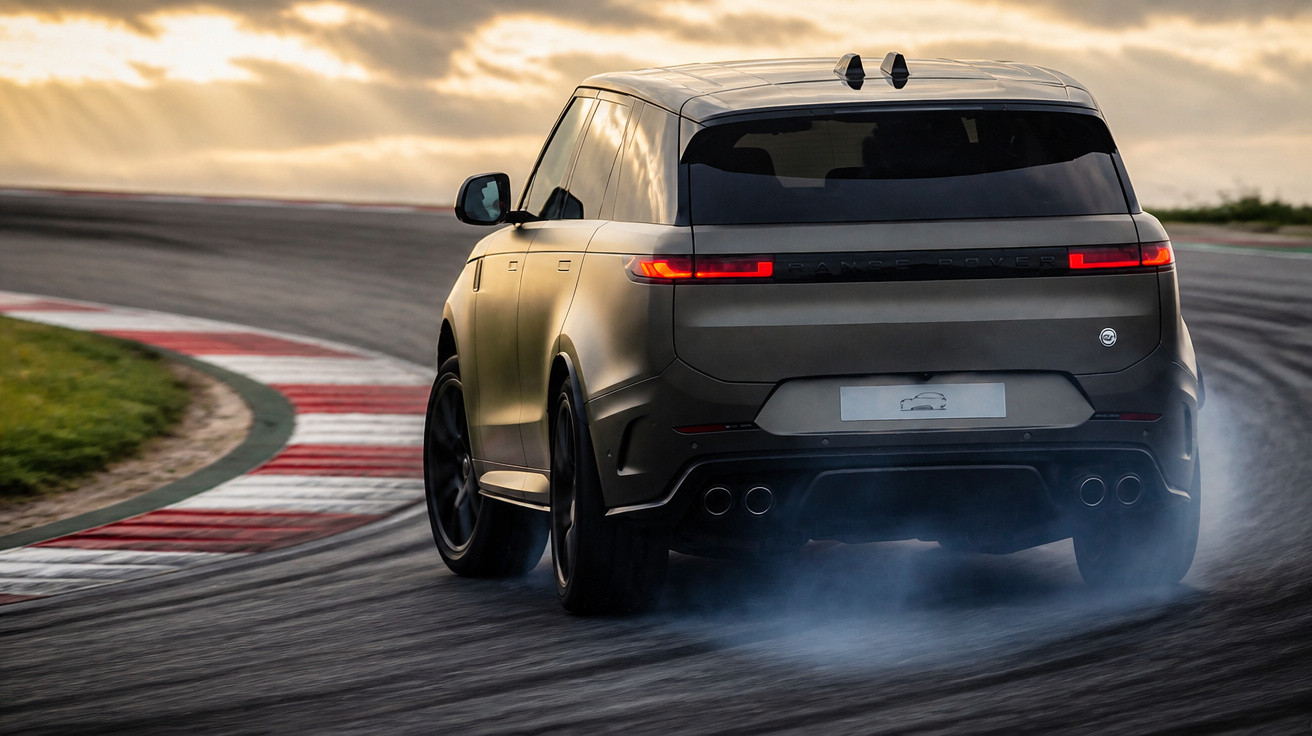
Range Rover Sport SV? Is the SVR due shortly?
No: this is the replacement. SV takes over from SVR, and dropping one letter has raised its image. The previous SVR was unmistakably a product of its era: loud, unapologetic and aimed at loud, unapologetic buyers. This new version offers curated wellness tracks. Its launch colour is discreet bronze rather than vivid blue. The exhaust tips have been visually toned down. Its handling has also received a technological overhaul. Put simply, the most potent Range Rover Sport has acquired some manners.
How convincing is that civilised exterior? Is it simply a luxury car now?
Not at all. That polished layer is chiefly there to divert attention from the more loutish aspects, both its own and those surrounding it. High-performance SUVs are difficult to justify in a climate-conscious market, particularly when Just Stop Oil protesters threaten to slash tyres and render cars uninsurable. Range Rover has therefore introduced a dose of sophistication, helping the SV conduct its business more discreetly. Beneath the surface, though, it has altered less than Land Rover would have you believe.
So, is it still fast?
Naturally, although perhaps not in the manner you might anticipate. For all the talk of quiet refinement and avoiding attention, there is no hybrid drivetrain or electrical assistance beneath the bonnet: instead, it has an enormous V8. The old supercharged 5.0-litre V8 was roughly as efficient as setting fire to an oil well, so Range Rover has gone cap in hand to BMW and returned with the M5’s twin-turbo 4.4-litre V8.
That means 626bhp and 590lb ft on overboost, reducing the 0-62mph time by almost a second to 3.8secs. Maximum speed is 180mph. It is worth noting at this stage that it weighs 2,560kg. Consider the momentum.
What allows it to keep itself under control?
Plenty of technology. Many tall, weighty SUVs rely on active anti-roll bars to remain level in bends, but the SV goes a stage further. Its system is called 6D Dynamics, using cross-linked hydraulic dampers that circulate fluid to counter not only body roll, but also compression during pitching and diving. In other words, throw it around as much as you wish and it remains flat. No other rapid SUV has chassis technology at this level.
Does the Range Rover Sport SV system work?
Range Rover says it can achieve 1.1g of lateral grip. It can do more than that: I recorded over 1.2g, plus 1.4g under braking. That is extraordinary. Yet bare figures do not really convey the experience, so here is how it drives: it feels convincing when worked hard. The system has sufficient bandwidth that rapid changes of direction do not overwhelm it, while enough subtle natural movement remains to prevent it feeling strange or synthetic. It is impressively composed and cohesive, seeming to dismiss much of its mass.
Its ride is peculiar, however. Although the system is excellent under heavy load, the dampers appear to lose focus at everyday road speeds, when they have less to do. With reduced system pressure, the ride becomes slightly unsettled. It is softly unsettled rather than harsh or crashy, though. This may compete with the Lamborghini Urus and the most expensive Porsche Cayennes, but it is not as relentlessly firm or uncompromising as either. Indeed, I found myself selecting Dynamic mode on the road, stiffening it to give the suspension greater control.
So is it rather soft?
It is more polished and comfortable than other extreme high-performance SUVs. I do not think it is any less pleasant over long distances than the standard Range Rover Sport, so it will cope perfectly well with passengers and luggage, while the less car-obsessed members of your household will not resent you for buying something so silly.
What are these wellness tracks?
Interestingly, this is rather good. Range Rover has equipped the SV with an additional massage system called BASS (Body And Soul Seat). Four transducers, resembling ice-hockey pucks, are mounted in the backrest of each front seat. Linked to the 29-speaker, 1,430-watt Meridian sound system, they vibrate in time with the music, allowing you to feel it as well as hear it. It is undoubtedly another gimmick, but this one genuinely works.
Range Rover then commissioned Coventry University to create Wellness tracks intended to “help promote mental and physiological wellbeing”. They are selectable via the touchscreen. You will try them once, then realise that the Foo Fighters make the parts tingle that Wellness cannot reach, while also pairing more harmoniously with the V8.
What is the interior like?
Virtually everything, including the heating controls, has been placed in the central touchscreen. Gah. The result is a cabin that appears minimalist but is anything but in use. There is an SV shortcut button on the steering wheel, but everything else requires a battle with either the touchscreen or the steering-wheel controls.
The driving position retains the customary Range Rover sense of command, while the seat is as substantial as the vehicle. It does not feel particularly sporting, which is a positive. Practicality and refinement have not been sacrificed either. More positives.
Will it be rewarding to drive?
Range Rover presents it as something of a track monster, so I headed to Portimao. It was impressive, with one caveat: for a 2.5-tonne off-roader. It lacks a 4WD system that can direct as much power as possible to the outer rear tyre to provoke oversteer. Consequently, it is not especially adept at skids unless conditions are wet, because its mass and the tenacious Michelin Pilot Sport 5S tyres - All Seasons are standard - prevent 626bhp from becoming too unruly. The 4WD system decides where the power goes, broadly attempting to send 70 per cent to the rear axle. It will slide in the wet, and looks hilarious doing so, but it is total hippo-on-an-ice-rink territory. It reminded me of spinning a racing truck onto wet grass. That still gives me shivers.
Once the PTSD episode is over, what is the SV like on country roads?
It is no faster along a country road, or around a circuit, than a well-sorted hot hatch, and it delivers nowhere near as much feedback or involvement. Its steering is good, though: the rack is far quicker, there is no vagueness around the straight-ahead, and it offers reasonable awareness of the available grip. The brakes are exceptionally powerful, easily capable of restraining the thunderous engine - more on those shortly. The eight-speed gearbox shifts promptly, too. It attacks far harder than it has any right to.
Knowing that an M5 heart beats within, that was the car I kept considering. It is not only considerably quicker than this, but rides and handles better, and has a remarkable 4WD system that lets you send everything to the rear axle. Discerning car enthusiasts should wait for the M5 Touring, or buy an RS6. The SV is for people who do not regard a sports SUV as a contradiction.
To be fair, it occupies something of a sweet spot, since it demands no compromise - apart from efficiency and the buying process, as we will come to - while still providing pace and performance. This is a fast car, it can control itself in a way the old version never truly could, and it produces a superb, if more restrained, sound.
What are the downsides?
Here is the complication. The SV is available with carbon wheels and carbon brakes, and I did not drive an example without them. As mentioned above, the 440mm brakes are enormously powerful, but their pedal feels entirely lifeless in most situations. There is no feedback at all, making it genuinely difficult to judge how much pressure is needed. For that reason alone, I would avoid them. Pedal feel matters more to me than outright stopping power or the 34kg weight saving. They can still overheat, too: after hard circuit running, flames were licking from the rear calipers.
Then there are the 23in wheels. I wanted to take the SV off road to establish whether it remained a genuine off-roader - Range Rover insists that it does and that it must pass the same tests as every other model in the range - but this car wore carbon wheels. Yes, really. They save another 35.6kg, but do not inflict them on yourself. I put a sizeable scratch in a wheel merely while turning around in a gravel lay-by. The kerbs outside the soft-play centre you take your children to will be even less forgiving. Carbon wheels are this car’s chocolate teapot.
Do not accept all the weight-saving rhetoric. Yes, the reduction comes from unsprung mass, which is important, but if Range Rover truly prioritised making the SV dynamic, it would have removed half a tonne. That would be expensive and difficult to sell to customers, however. Extra power is cheap, while extra carbon sells extremely well.
So, is carbon equipment standard?
Some of it is: the bonnet is carbon, as is the front badge. The brakes cost an additional £7,000 and the wheels another £6,900. Both are on top of the list price, because Land Rover believes it can charge £171,460 for an Edition One SV. In fact, it knows it can: all 550 allocated to the UK have already been sold. As a result, delivery-mileage examples are already available second hand for more than £200k. Other, less costly versions will arrive in time.
I am unsure what to make of it. I keep making strange comparisons with the Ferrari SF90 XX, another car whose engineering impressed me but whose wider proposition felt like an exercise in cynicism. Yes, this marks a substantial advance over the old SVR, with a wider bandwidth of ability and a less offensive image, but it is still likely to attract the same customers. They may leave the showroom in carbon bronze, but expect vehicle wrappers to remain busy.
What are the alternatives?
The Bentley Bentayga is probably the closest match for the SV’s mix of comfort and capability. The SV wants to be viewed as a direct rival for the Lambo Urus and Porsche Cayenne, but it is simply too heavy. That actually places it in an agreeable position: provided you can overlook sub-20mpg fuel economy - the brochure claims 24.1mpg, but do not be fooled - it is a better all-rounder than either.
Let’s sum it up.
The most dynamic Range Rover ever made.
Comments
No comments yet. Be the first to comment!
Leave a Comment