
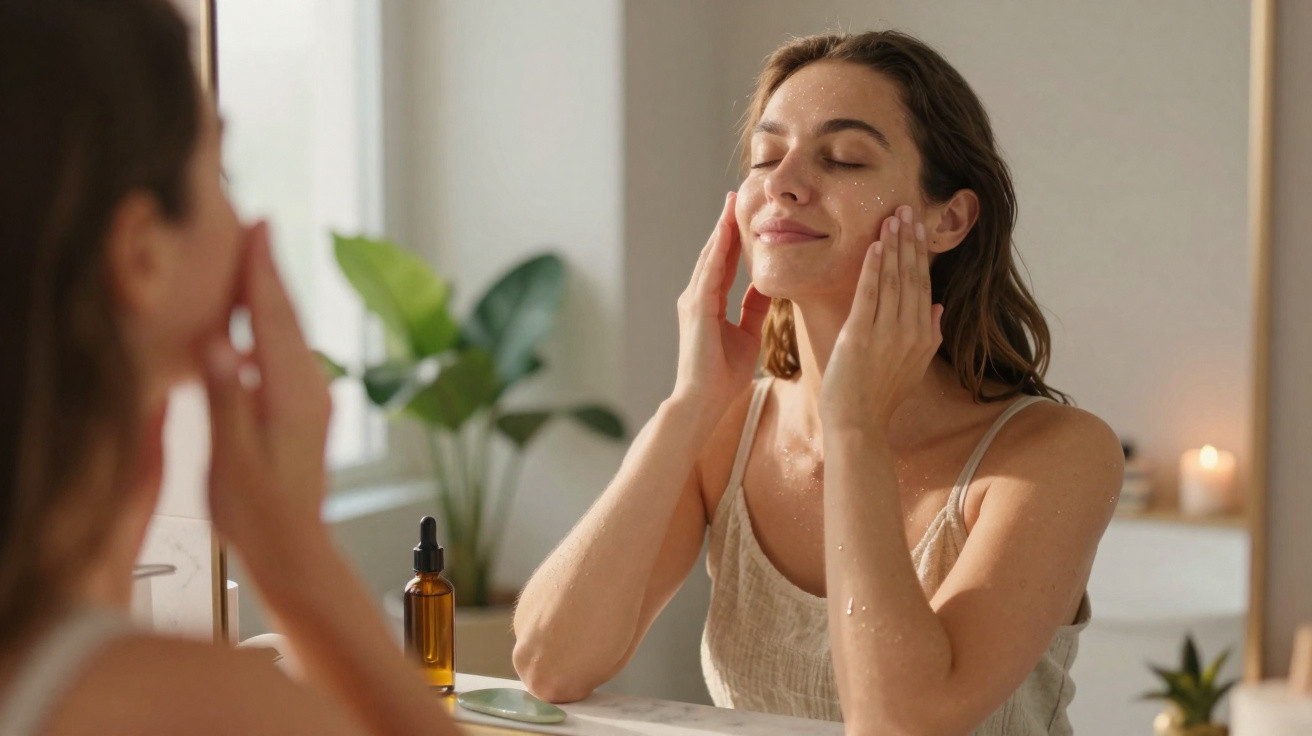
The woman staring back from the mirror looks exhausted, though a poor night’s sleep is not the reason.
Her jaw is tight and her phone, left on the basin, is still vibrating with unread messages. Absent-mindedly, almost impatiently, she rubs her cheeks before stopping. Her fingertips become slower. She makes small circles over her cheekbones, sweeps softly beneath her eyes and lightly taps her forehead. Two minutes later, there is a change. Her face has eased. Her eyes seem less severe and more “alive”. The radiance has not come from a serum. It comes from the way she has touched her face, almost as though making an apology to it.
She did not pick this up at a spa. Instead, she learnt it from a 30-second clip watched while half-asleep on her sofa.
This straightforward massage can seem almost too effortless to work.
A small ritual that subtly reshapes your face
When people first try this face massage, the glow is not usually what they notice first. Their expression simply appears… gentler. The forehead looks lighter, the mouth less strained and the jawline less prepared to snap.
We spend plenty of time discussing skincare routines, acids, serums and devices. Far less attention goes to the tension held in our faces like unseen armour: the slight frown that never quite disappears, or the jaw that remains clenched even when we believe we are “relaxed”.
This technique works with that underlying tension. It does not require a lifestyle overhaul; just your hands, two or three minutes and a little curiosity.
On TikTok, clips labelled “face massage” and “lymphatic drainage” have amassed hundreds of millions of views. The same comment repeatedly appears beneath them: “I swear my face looks lifted after just one time.” It may be called placebo, or it may be what happens when people finally reconnect with their own skin.
Consider Sara, 34, who began using the massage after watching a French facialist demonstrate it. For five days, she filmed herself before and after her evening routine. The change was slight but difficult to dismiss: reduced puffiness around her eyes, slightly softened nasolabial folds and a less pronounced typical “11” line between her brows.
She was not the only person to spot it. On the third day, a colleague asked whether she had “changed foundation” because her complexion seemed brighter. The product and lighting were unchanged. What differed were the muscles beneath the skin.
There is a straightforward reason this ritual can help. The face is threaded with small muscles that rarely relax completely. Each email, notification and moment of minor stress leaves its trace: raised shoulders, a tense jaw, pressed lips. Eventually, muscles can become fixed in those patterns. Blood and lymph then move less freely, meaning less oxygen, poorer circulation and the familiar dull, “tired” appearance.
Following particular lines with your fingers can gently encourage lymphatic drainage, the system that helps clear waste and fluid build-up. It can also give your nervous system a signal of safety: you are safe, you can soften now. As a result, features loosen and light begins to reflect differently from the skin.
Glow isn’t just about what you put on your face. It’s about what you release from it.
Face massage technique: a step-by-step guide without the pressure
Begin with clean hands and enough product to let your fingers glide: a few drops of facial oil or a nourishing cream will do. Sit comfortably, drop your shoulders and set your fingers in the middle of your forehead, immediately above your brows.
With gentle pressure, slowly sweep outwards towards the temples, as if smoothing a delicate piece of fabric. Do this three to five times. Next, rest your ring fingers at the inner corners of your eyes, beneath the brow bone. Draw a soft half-circle under the eyes towards the temples, again repeating three to five times. Keep the pace unhurried. If you rush, your brain remains in “go, go, go” mode.
Then move on to the cheeks. Position your knuckles by the corners of your mouth, then glide upwards towards the tops of your ears along the cheekbones. This movement can help “open” the mid-face, where so much expression-related fatigue sits. End at the jaw: place your thumbs below the chin and travel along the jawline to the ears, as though gently moving tension away.
Let’s be honest: hardly anyone does this every single day. That is absolutely fine. The danger of any ritual is making it one more obligation. This massage is more effective when it feels like a treat rather than a task.
The most usual mistake is applying excessive pressure. You are not trying to knead your face like bread. Deep pressure may irritate skin and worsen redness or sensitivity. Aim for “firm but kind”. If the skin catches or drags beneath your fingers, use more product for slip.
Rushing through it, or scrolling while massaging, is another common error. If your attention is divided between your phone and your face, the touch becomes automatic and mechanical. Your nervous system does not interpret it as soothing contact. On a difficult day, one fully present, slow minute can do more for your features than ten hurried minutes while watching Instagram with one eye.
“The moment your hands touch your own face with real intention, your brain registers it as care,” explains a London-based facialist I spoke to. “The glow isn’t magic. It’s circulation, lymph movement, and a tiny drop in stress hormones. That shows up on your skin.”
To make the ritual easy to remember, use this short framework:
- Begin at the forehead and work downwards: forehead → eyes → cheeks → jaw → neck
- Glide outwards and slightly downwards every time, following the natural drainage routes
- Complete 3–5 slow repetitions for each movement, rather than 20 rushed ones
- Stop if anything hurts, pulls or feels uncomfortable
- Combine the massage with slow breathing: breathe in through your nose and breathe out for longer through your mouth
Glow from the inside out that lasts
The most unexpected element is not the immediate radiance after your first attempt. It is what happens when the massage quietly becomes a small point of calm in your day. Some people use it before an important Zoom meeting, when their face feels as if it is setting into “professional mode”. Others do it at night as a boundary between screens and sleep.
We have all caught our reflection in a lift mirror and thought, “Do I really look that tense?” This ritual does not promise a different face. It returns the one hidden beneath daily armour. Over time, certain muscles may stop springing into action with every small stress. Your resting expression becomes softer. At that point, “looking fresh” no longer relies solely on eight hours’ sleep or an ideal skincare routine.
There is also something quietly radical about relying on your own hands at a time when beauty trends so often involve buying another tool. Gua sha, rollers and devices can be excellent, but none is necessary for the fundamental effect. Your fingers can sense what your skin needs in the moment: warmth in one area, tightness in another, puffiness below the eyes. Without conscious thought, they adapt.
Those who continue with this massage for several weeks often mention subtle, unexpected side effects: fewer headaches associated with jaw clenching, less urge to pick at their skin and a slightly gentler way of seeing themselves in the mirror. It is not therapy. Even so, the few minutes spent touching your face with care can alter the story you tell yourself about it.
And perhaps that is the most powerful kind of glow.
| Key point | Detail | Benefit for the reader |
|---|---|---|
| Simple, targeted movements | Glide from the centre of the face outwards, following the forehead, eyes, cheeks and jaw | A technique that is easy to remember and repeat without a video or tool |
| Tension versus glow | Massage relaxes facial muscles and stimulates circulation and drainage | Helps explain why features relax and the complexion can look brighter |
| Flexible ritual | 1 to 5 minutes, depending on available energy and time | Makes it possible to fit the massage into a genuinely busy life without pressure |
FAQ:
- How often should I do this face massage to see a difference? Two to three times a week is enough to notice softer features and a bit more glow. If you enjoy it, you can do it daily, but the key is regularity, not perfection.
- Can face massage really replace expensive skincare products? It won’t replace sunscreen or active ingredients, yet massage can boost the effect of what you already use by improving absorption and blood flow. Think of it as a powerful extra layer, not a substitute.
- Is this safe if I have acne or very sensitive skin? You can still massage, but keep the pressure extremely light and avoid inflamed areas. Work more on the neck, jawline and temples, and use a non-comedogenic oil or cream that your skin already tolerates.
- How long does the “post-massage glow” actually last? For most people, the immediate effect is visible for a few hours. With time, as your facial muscles learn to stay a bit more relaxed, the baseline state of your features can subtly improve.
- Do I really need to follow the exact steps, or can I improvise? The lines suggested here follow natural lymphatic paths, which helps with puffiness. That said, your hands will quickly find what feels good. Use the framework as a guide, then personalise it so it becomes your own ritual.





Comments
No comments yet. Be the first to comment!
Leave a Comment