
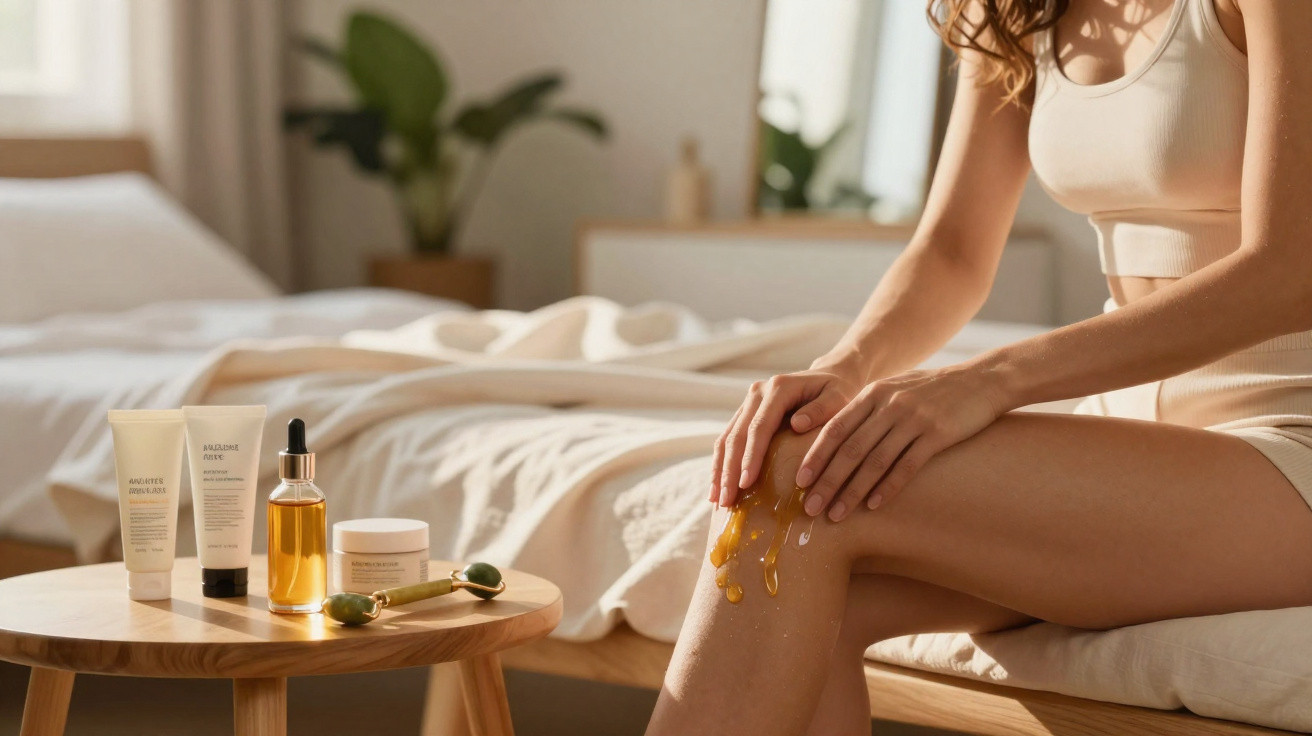
Cellulite creams, gels and oils flood the shelves, particularly as the swimming season approaches. Advertising claims are ambitious, while the disappointment after a few weeks is often greater still. A recent comparison by a well-known consumer magazine brings some order to the confusion – and places one particular body oil clearly ahead of the rest.
Nine slimming products put through a demanding test
The magazine examined nine so-called “slimming” or “anti-cellulite” products in total. The selection included creams, foams and oils from chemists, supermarkets, pharmacies and specialist cosmetic brands.
The assessment followed two strands: firstly, the formulations and ingredients were reviewed, including potential health and environmental risks. Secondly, the products had to prove their effectiveness on skin in everyday use.
For this purpose, around 30 women per product took part in a four-week practical trial. Each participant treated only one thigh, while the other was left untreated as a control.
- Duration of use: 28 days
- Number of participants: approximately 28 to 30 per product
- Measurement points: at the start, after 14 days, after 28 days
- Measurements: circumference at the upper and lower thigh, skin feel, firmness
Alongside this, the women completed questionnaires. How did their skin feel? Did it appear smoother, firmer and more cared for? And was the difference between the treated and untreated sides even noticeable in daily life?
“The overall verdict on the ‘slimming effect’ of the products tested is sobering: measurable changes generally remain very small.”
Most products produced, at best, slight improvements, which experts rated as “just about acceptable”. In these conditions, little remains of the dramatic before-and-after promises made in advertising.
Why a massage oil performed most convincingly
Despite the fairly restrained overall outcome, there was a clear winner: a plant-based massage oil from a natural cosmetics manufacturer came ahead of every other product. Its overall score sits in the middle of a traditional school grading scale, but that was still enough to take first place in this comparison.
The key difference was that laboratory testing showed a more measurable effect in the treated areas for this oil than for most rival products. Testers also rated the skin feel particularly highly, with legs appearing smoother and better moisturised.
“A small proportion of users lost up to two centimetres from their thigh circumference – many primarily reported visibly smoother and firmer skin.”
Its formula differs substantially from some conventionally formulated “slimming creams”. Rather than relying on lengthy ingredient lists of 20 or even 30 substances, the oil uses a comparatively short formulation:
- Plant-based carrier oils, including apricot kernel oil
- Jojoba oil as a nourishing ingredient
- Wheat germ oil containing natural vitamin E
- Botanical extracts from birch leaves, butcher’s broom and rosemary
Many competing products contain silicones, solvents and a wide range of synthetic additives. While these frequently provide an immediate smooth sensation, they are increasingly criticised for their environmental and health profile. The oil performed better in these categories in the test.
Other products on the podium
Two well-known branded creams followed the oil: a firming body lotion and a tightening cream from the premium market. Both received solid ratings, although their measured effect on circumference also remained moderate.
| Place | Product type | Strength in the test | Weakness in the test |
|---|---|---|---|
| 1 | Plant-based massage oil | Noticeably smoother-looking skin, good tolerability | Measurable loss of centimetres for only a few women |
| 2 | Firming body cream | Pleasant texture, nourished skin | Very slight reduction in circumference |
| 3 | Premium firming cream | Good skincare effect | High price, many ingredients |
How the anti-cellulite massage oil should be used
For the massage oil to have any chance of changing the appearance of the skin, the routine requires consistency. Users were expected to apply the product every day for four weeks – twice a day, in fact.
The instructions were to massage it into still-damp skin morning and evening, ideally straight after showering while the skin was slightly wet. According to the test description, this required firm, repeated massage movements.
“The testers found the effort tiring, but also regarded the massage as an important factor in the outcome.”
Recommended traditional anti-cellulite massage methods include:
- Using both hands to grasp the skin on the outside of the thigh and “roll” it upwards from the bottom
- Kneading movements from the knee towards the buttocks
- Circular, relatively firm strokes designed to stimulate the tissue
Laboratory measurements were only taken after four weeks. This demonstrates how long users need to persist before seeing any change at all. Anyone standing in front of the mirror after five days, desperately looking for a visible transformation, will inevitably be disappointed.
How much can creams and oils realistically achieve for cellulite?
In simple terms, cellulite develops when fat cells push through connective tissue while that tissue is also relatively inelastic. Hormones, genetics, weight fluctuations and a lack of physical activity all play a role. A topical product can only influence these factors to a very limited extent.
Experts stress that some of the observed effect probably comes from the massage itself. Those who spend ten minutes a day using firm movements on their legs and buttocks boost circulation, stimulate lymphatic flow and, incidentally, often pay more attention to diet and exercise too.
“No oil in the world can smooth away stubborn cellulite on its own – it only makes sense as part of a lifestyle that benefits connective tissue.”
What genuinely helps in everyday life
Anyone wishing to use the massage oil can support its effect with simple measures:
- Regular exercise that works the leg muscles, such as brisk walking, cycling or climbing stairs
- Alternating between exertion and recovery: squats, lunges and short home-workout exercises
- Drinking enough, ideally water or unsweetened tea
- Eating as few heavily processed foods high in sugar and salt as possible
Over the long term, all these factors affect connective tissue more than even the most expensive tube can. An oil or cream may improve the look of the skin, for example by increasing moisture and making its texture slightly more supple.
What buyers should consider when choosing anti-cellulite products
The test also draws attention to ingredients. Many products feature appealing terms such as “Slim”, “Shape” or “Body Perfect” in their names, yet offer a fairly ordinary formulation of standard emulsifiers, fragrances and synthetic fats.
Anyone trying to navigate the sheer number of options can use a few points as guidance:
- Short, easy-to-understand ingredient lists usually indicate clearer formulas.
- Plant oils often support the skin barrier better than silicone films.
- Highly fragranced products may be more likely to irritate sensitive skin.
- Major claims such as “visible after 7 days” should be read sceptically.
Price and how quickly a product is used up are another consideration. Massage oils are generally applied sparingly, but they usually cover larger areas of the body. Anyone massaging their legs and buttocks twice daily will need a replacement fairly quickly, depending on the bottle size. A very expensive brand is therefore hardly worthwhile if the routine is stopped after two weeks because of the cost.
Cellulite, body image and realistic expectations
Cellulite affects the majority of women, regardless of body weight. Even well-trained female athletes usually have dimples on their buttocks and thighs. Strictly speaking, it is not a disease but a variation in skin structure.
The test shows that skincare can improve its appearance to a limited extent, but it does not solve the issue. Anyone who sees every small dimple as a flaw risks becoming dependent on ever more miracle products. A more sensible approach appears to be a middle ground: care for the body, support connective tissue through exercise, but do not let glossy images define you.
An oil that feels good on the skin and has a respectable consumer rating can help people feel more comfortable – and may provide a reason to devote ten minutes each day to personal body care. Expectations should remain realistic: slightly smoother, slightly firmer, with a better skin feel. Even the most critical test promises no more than that.





Comments
No comments yet. Be the first to comment!
Leave a Comment