
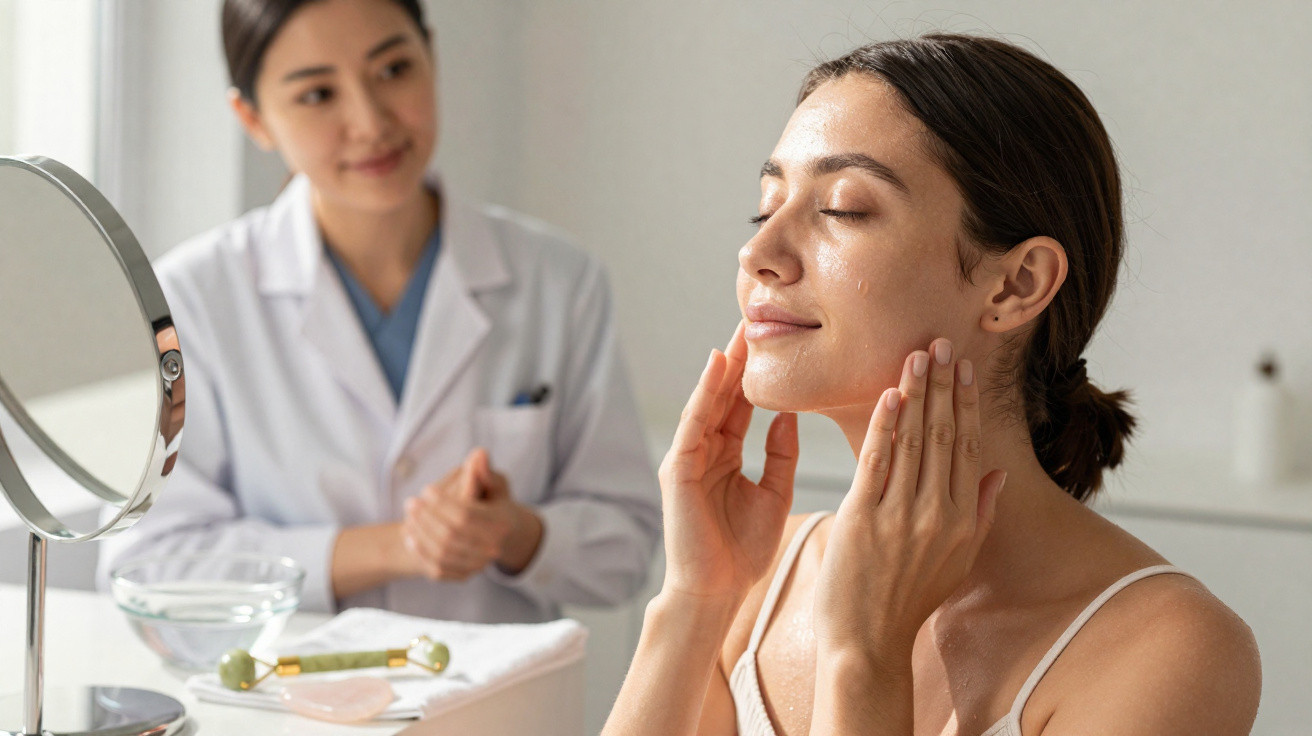
Some mornings, the reflection staring back appears slightly bloated, as though the night has settled beneath the eyes and around the jawline. It is tempting to pinch, rub, grab chilled spoons or rely on coffee. But a board-certified dermatologist explains that there is a gentler way to encourage fluid to drain-and potentially help skin regain its bounce over time.
Maya Chen uses a washable marker to draw directional lines across my cheek. They curve towards the ears before travelling down either side of the neck, stopping just above the collarbone, like an overlooked network of side roads. She rests two fingers against my jaw and applies almost no pressure, making slow, tidal movements. Sitting in the chair, I am struck by both the delicacy of her touch and the speed with which warmth spreads beneath my skin. Her hands move very little.
Why gentle touch changes the face
When people vigorously rub their faces, the result is often a flush of redness and not much more. Dr Chen’s approach can look almost effortless, but it follows the actual workings of the lymphatic system: fragile, surface-level vessels beneath the skin respond to stretching rather than force. A lighter touch can move more lymph. Rather than working the muscles, the aim is to direct fluid towards the areas where lymph nodes filter it, particularly around the ears, beneath the jaw and at the base of the neck.
One busy Tuesday, a patient called Lina arrives with puffiness across her lower face after a salty weekend and late-night screen use. Dr Chen spends three minutes moving fluid from Lina’s cheeks towards her ears, then down the neck, always ending at the collarbone. Afterwards, Lina’s jawline appears more defined and her complexion more even-a subtle change that looks “awake”. Small clinical studies support this observation, reporting measurable increases in superficial blood flow and short-term decreases in facial swelling after gentle massage performed in a clear direction.
Dermatologists also value this kind of touch for a more fundamental reason. Skin cells register mechanical signals, and light stretching seems to affect fibroblasts-the cells involved in producing collagen and elastin-via chemical signals associated with movement. It is neither magic nor a facelift, and it cannot take the place of sunscreen or retinoids. However, regular light massage may help support elasticity by boosting microcirculation, shifting stagnant fluid and keeping the tissue environment less congested, allowing nutrients to be delivered and waste to be removed more efficiently.
How to do a lymphatic facial massage without stretching your face
Begin with enough slip for your fingers to glide: use a few drops of a simple oil or a lightweight moisturiser. First, open the “drains” by sweeping down the sides of the neck towards the hollow above the collarbone, making five slow passes on each side. Next, use short, gentle strokes along the jaw from chin to ear; across the cheeks from nose to ear; beneath the eyes from the inner corner to the temple; and over the forehead from the centre towards the temples. Always end with the same downward sweeps along the neck. Your pressure should feel like the weight of a coin, rather than the mark of a thumb.
Common mistakes include pressing too firmly, ignoring the neck or scrubbing backwards and forwards as though cleaning a frying pan. Most of us have rushed through a routine before a video call, only to pull at skin that deserved kinder treatment. If you have active acne, inflamed rosacea, recently had filler or undergone a procedure, take a break or ask your doctor for approval first. Realistically, few people will do this daily. Even two or three brief sessions each week may leave mornings less puffy and evenings feeling less tight.
Dr Chen delivers one phrase to every patient with a hurried smile: “If it hurts, you’re not moving lymph-you’re fighting skin.” Her manner remains relaxed, but the method is precise and almost ceremonial, with results that are usually understated yet dependable.
“Lymph is like a slow river,” she says. “You don’t dam it with pressure; you guide it with gentle current. Elasticity is similar-consistency and small signals matter more than force.”
- Use an ultra-light gliding movement. Visible finger marks mean you are pressing too hard.
- Always end by sweeping down the neck towards the collarbone.
- Keep sessions to 2–5 minutes. Longer is not necessarily better.
- Steer clear of inflamed skin, fresh wounds and recent injectables.
- Combine it with SPF and your active skincare routine to support long-term firmness.
Where this leaves your skin
There is something reassuring about understanding the face’s “roads” and treating them carefully. It can draw you away from doomscrolling and back into your physical body-one that responds well to rhythm, breathing and a gentler hand. Properly performed touch can be therapeutic. You will not reshape bone or turn back time, but many people find they have less morning puffiness, a more settled complexion and a slight lift that looks “rested”. The point is not to force tissue into a new shape; it is to promote flow and flexibility through small, everyday acts of care that help skin function well. Try it for two weeks, note what you notice and share the changes. Consistency beats drama.
| Key point | Detail | Why it matters to the reader |
|---|---|---|
| Gentle pressure, clear direction | Coin-weight touch, strokes towards the ears, then down the neck to the collarbone | Reduces puffiness without pulling at skin or causing redness |
| Open the “drains” first | Begin with neck sweeps before working on the face | Improves results by giving fluid a route to drain |
| Consistency over intensity | 2–5 minutes, two to three times a week | A realistic habit that supports elasticity over time |
FAQ:
- How often should I do a lymphatic facial massage? Two to three times a week is enough for most people, with a few additional sweeps on especially puffy mornings.
- Will massage actually improve skin elasticity? It may support elasticity indirectly by improving microcirculation and tissue balance, particularly when combined with SPF and evidence-based active ingredients.
- Is a roller or gua sha better than fingers? Tools are not essential; technique is more important. Pick whichever option helps you maintain light pressure and a clear direction.
- Can I do this if I have acne or rosacea? If the skin is inflamed, avoid those sections or consult your dermatologist first. Brief, gentle sweeps over calm skin are the safer option.
- When will I see results? Puffiness may change within minutes, while tone and bounce develop gradually. Allow 2–4 weeks alongside your usual skincare routine.




Comments
No comments yet. Be the first to comment!
Leave a Comment