
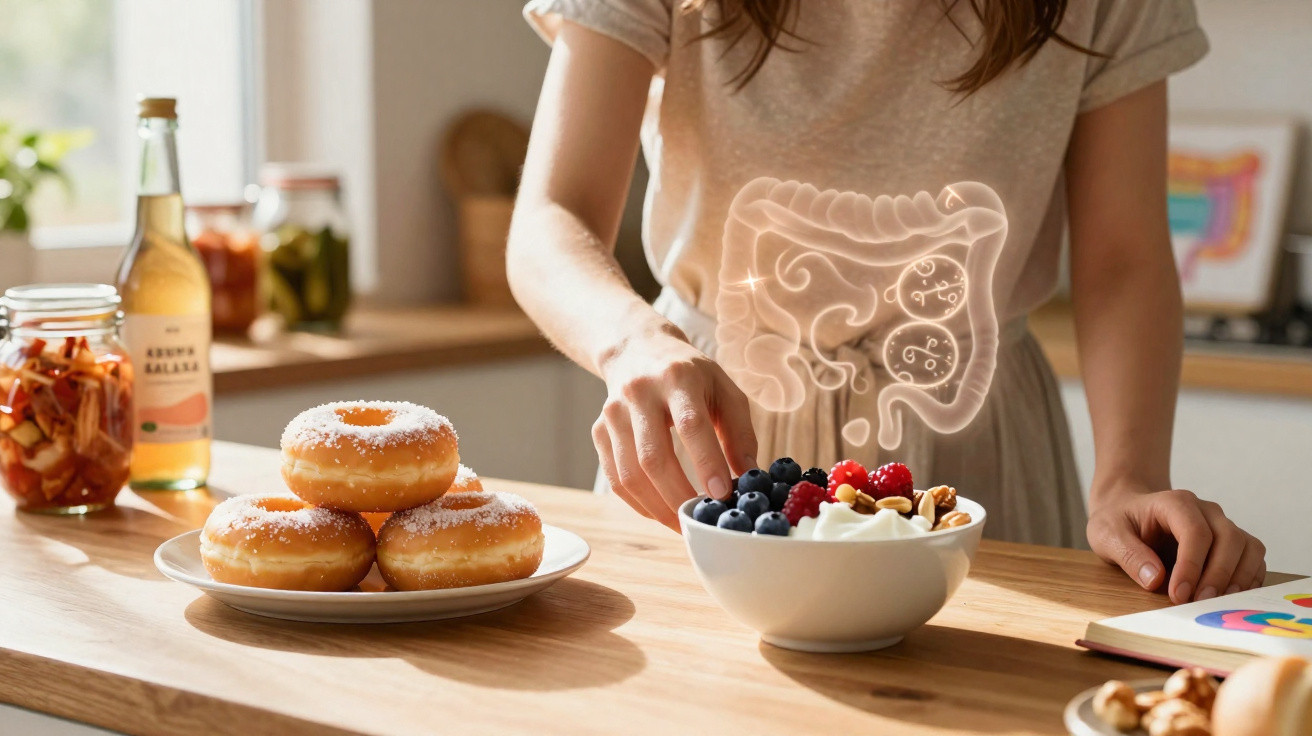
At 3:17 p.m., the office was hushed apart from tapping keyboards and the faint crinkle of snack packets. Mia fixed her gaze on the communal table, where somebody had left a box of glazed doughnuts. They were still warm, gleaming faintly beneath the fluorescent lighting. She had told herself that today would be different: no sugar before dinner. A clean start, a new version of herself, the usual promise.
Ten minutes later, half a doughnut lay on a napkin beside her mouse. Her stomach felt uncomfortably full, her mind slightly hazy. Beneath it all was an odd, almost bodily pull in her abdomen, as though something more fundamental than “willpower” had reached for the box before she had.
Mia glanced around the room to check whether anyone had seen.
Already, a small and unwanted question was murmuring inside her.
The subtle gut signal that overpowers the sugar roar
We tend to imagine cravings bursting from the brain like fireworks: vivid, noisy and impossible to ignore. The reality is less glamorous, and considerably stranger. Trillions of bacteria in the gut are quietly competing for their preferred fuel. Some prosper on fibre, others favour healthy fats and some, quite frankly, behave like miniature sugar addicts.
When the feeling hits that says, “I need chocolate now, or I’ll lose it”, part of that surge may originate in your microbiome. The gut-brain communication network - involving the vagus nerve and hormones - works less like a one-way command and more like an endlessly active group chat.
At times, the most insistent voice is not actually your own.
Research teams have begun charting this unseen conflict. In one frequently cited study, scientists found that particular gut microbes release compounds that alter appetite and mood, steering animals towards foods that support those microbes’ survival. It may sound like science fiction, but it is increasingly regarded as biology rather than fantasy.
Suppose you have spent years eating sugary cereal, white bread and sweetened coffee. You are not only nourishing yourself; you are also feeding a particular community of microbes that thrives in those conditions. Remove sugar abruptly, and those microbes “complain” by affecting hunger hormones, cravings and even your stress response.
You feel depleted and conclude that you have failed. At a microscopic level, though, it is more like a frantic bacterial lobbyist watching its contract disappear.
This gut-brain account starts to unsettle an old and sensitive argument. If microbes can nudge us towards sugar, how much of “gluttony” reflects character, and how much is chemistry?
Some people argue that labelling overeating a disease excuses individuals and removes responsibility. Others suggest that ignoring its biological drivers is like blaming someone with asthma for wheezing while running.
The developing science of the microbiome does not remove anyone’s capacity to choose. It simply broadens the picture. Hunger is not only about an open fridge and insufficient willpower. It is also shaped by the tiny residents of your gut and what they communicate to your nervous system throughout the day.
Feeding the gut microbiome that quietens sugar cravings
A practical approach to reducing sugar cravings is not to battle them directly, but to reshape the gut’s conversation instead. This involves nourishing bacteria that prefer gradual, steady energy while slowly depriving those that demand rapid sugar hits.
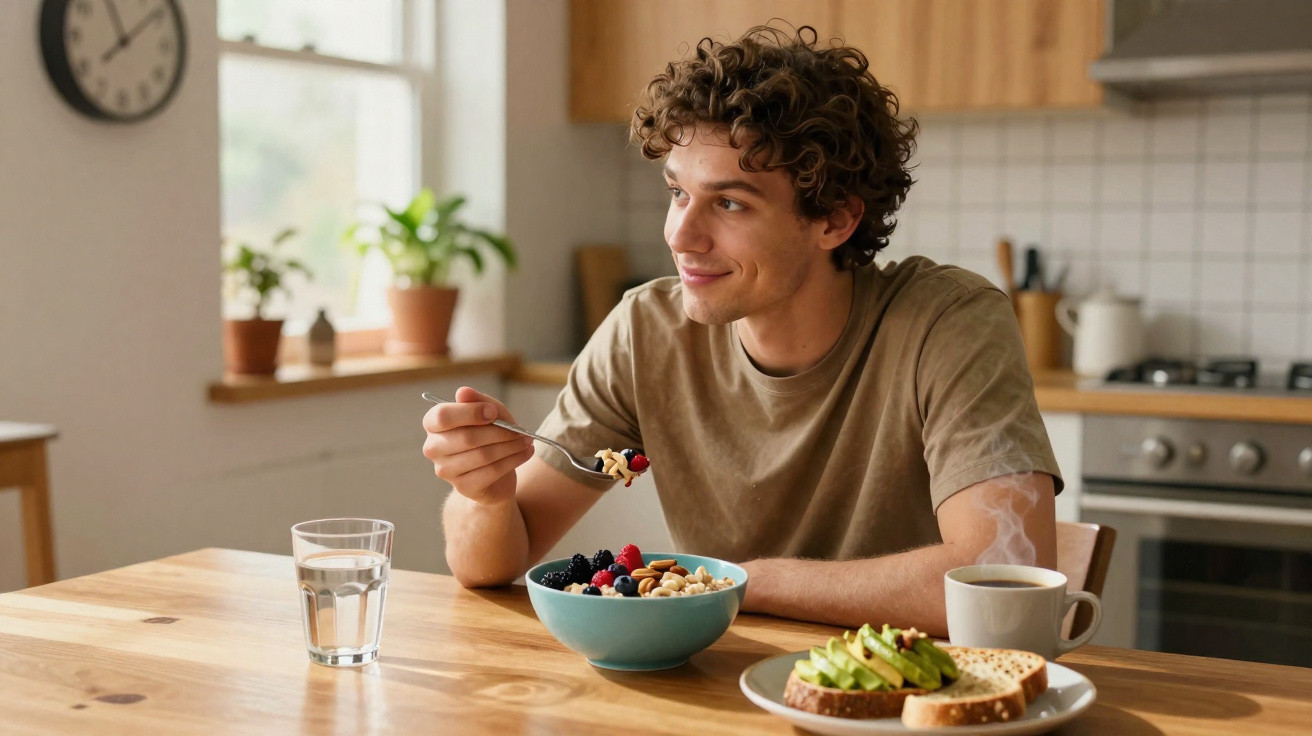
The approach is closer to gardening than warfare. Increase fibre a little each week. Replace an afternoon pastry with a handful of nuts and a piece of fruit. Add fermented foods to your meals, such as plain yoghurt, kefir, kimchi, sauerkraut and miso.
With time, the microbial balance changes. The messages from the gut take on a different tone. The urgent demand to “give me sugar now” drops to a grumble. Occasionally, it simply… fades away.
This is where many people struggle: they expect calm after just three days. Their sugar cravings intensify, their mood dips and they decide that this healthy-gut approach is a scam. Most of us know that moment: standing in front of the fridge at 10 p.m., attempting to bargain with a jar of Nutella.
What is not often acknowledged is that the early days of altering your microbiome can resemble withdrawal. Your established microbes are losing their preferred fuel. You may feel irritable, tired or a little low.
That is not a moral failing; it is biology happening in real time. The danger is interpreting temporary discomfort as a permanent identity: “I’m just weak”, “I’m a sugar person”, “I’m a glutton”.
In truth, nobody manages this perfectly every day without a setback. That is why people who genuinely change their relationship with sugar often follow an unexciting but effective principle: do not pursue purity; pursue momentum. Make one improvement on last week. Eat one more vegetable, have one less source of hidden sugar.
“Once I stopped calling myself greedy and started calling myself ‘a body in transition’, everything softened,” says Léa, 41, who spent two decades bouncing between diets. “The cravings weren’t proof I was broken. They were proof my gut was still wired for my past. That changed how I treated myself on the hard days.”
- Replace “I am gluttonous” with “My gut is still wired for sugar right now”.
- Maintain one straightforward habit for 30 days: a fibre-rich breakfast or one fermented food each day.
- Anticipate discomfort and prepare for it: have tea, call a friend or go for a walk, rather than simply gritting your teeth.
- Choose curiosity over shame: “What did I eat earlier that might be feeding this craving?”
- Recognise small successes: one fewer spoonful of sugar, one craving that passed or one evening without a binge.
Is gluttony a sin, a symptom or something more complicated?
Once you begin paying attention to the gut’s subtle signals, traditional moral language around food can start to feel rather… unstable. Describing someone as “gluttonous” compresses a complex reality into a single insult. Yet many people still feel that accusation when they take a second slice of cake, as though their entire value rests on the plate in front of them.
Biology does not eliminate ethics. You still inhabit a body that acts in the world. Food choices affect health services, family habits and your own future. But the perspective can move from blame to responsibility: not “I am bad”, but “I am in a complex tug-of-war, and I still have some say in the rope.”
For some people, seeing overeating as a disease brings relief. A medical diagnosis may provide access to treatment, compassion and even insurance cover. For others, it can feel like their agency has been taken away, as if their personal story has been reduced to a diagnostic code on a screen.
The truth is probably found in the murky space between those positions. There are evident biological influences: genetics, hormones, trauma, microbiome changes after antibiotics and ultra-processed food designed to encourage overconsumption. There is also culture, routine and the deeply human instinct to soothe ourselves in a difficult world.
Explaining everything through “willpower” dismisses the science. Explaining everything through “disease” can dismiss the person.
The next time a wave of sugar craving begins to rise, you can repeat the familiar script: “Here I go again, no control, typical me.” Or you can stop for half a breath and view it another way.
Imagine your gut as a busy town square after years of sweet-shop festivals. Naturally, the traders are shouting. Naturally, the streets smell of caramel. You begin bringing in different stalls - quieter ones offering lentils, yoghurt and apples. Initially, hardly anyone notices them. Over the months, the crowd gradually changes.
That is not sin. Nor is it solely disease. It is adaptation. It may be the most truthful description of what is taking place when the gut’s whisper finally becomes strong enough to compete with the sugar roar.
| Key point | Detail | Value for the reader |
|---|---|---|
| Gut microbes affect cravings | Certain bacteria encourage sugary foods by influencing hunger and mood signals | Lessens shame by showing that cravings are partly biological, not merely “weak will” |
| Feed the “calm” microbiome | More fibre, fermented foods and slow carbohydrates gradually alter gut signals | Provides a practical route to quieter sugar cravings over weeks and months |
| Reframe “gluttony” | Understand overeating as a combination of biology, habit and responsibility, rather than pure moral failure | Supports kinder self-talk and more sustainable behaviour change |
FAQ:
- Is sugar addiction a real thing or just an excuse? There is no universally accepted medical definition of “sugar addiction”, but research indicates that sugar can activate reward pathways resembling those associated with addictive substances for some people. Combined with gut microbes that favour sugar, the experience can feel very real, even when the label remains contested.
- How long does it take for gut changes to reduce cravings? Some people notice modest changes within 1–2 weeks of eating more fibre and fewer ultra-processed foods. More meaningful and stable changes commonly take 6–12 weeks, particularly when the previous diet contained a great deal of sugar.
- Can I ever eat dessert again if I want to “retrain” my gut? Yes. The aim is not a lifelong sentence without sugar. It is to create a gut environment and a set of habits in which dessert is a choice rather than a compulsion that overwhelms you every afternoon or late at night.
- How do I know if my cravings are emotional rather than biological? If cravings rise sharply with stress, loneliness or boredom, and occur even after a satisfying meal, there is probably an emotional element. Often, both factors are present: a microbiome conditioned towards sugar alongside learned comfort-seeking through sweet foods.
- Do probiotics alone fix sugar cravings? Probiotic supplements may benefit some people, but they are not magic bullets. They work best within a broader pattern that includes varied plant foods, sufficient sleep, some physical activity and less ultra-processed sugar in everyday life.




Comments
No comments yet. Be the first to comment!
Leave a Comment