
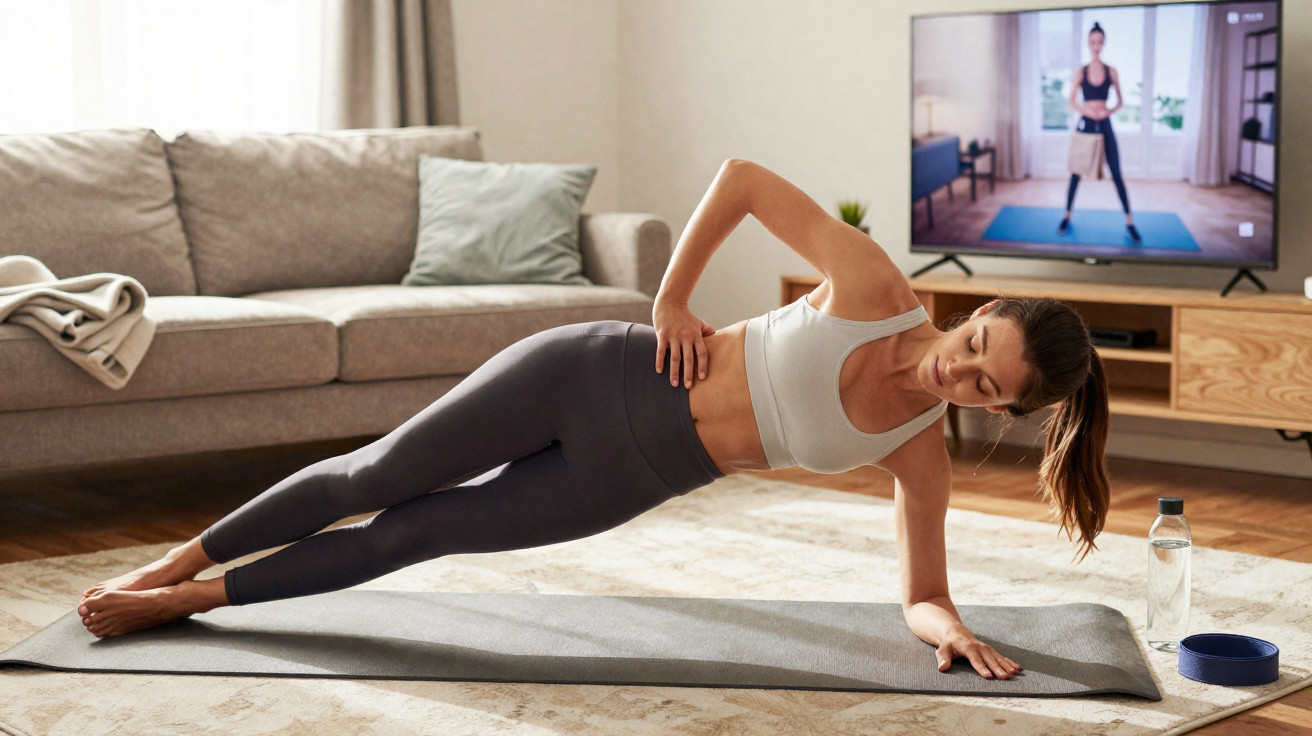
Your waistband is digging in, the day has been long, and your motivation is slipping away with the remote control in your hand. This is exactly where a useful opportunity lies: short, focused exercises in front of the television can strengthen your deep core, ease your back and activate the pelvic floor. No equipment, changing clothes or gym required.
Why television mini-sessions help your stomach
The deep abdominal muscles support the spine and refine your outline from within. Slow, accurate movements target these muscles instead of straining your neck with rushed crunches. Controlling your breathing lets you maintain core tension for longer and with greater control.
“Quality over quantity: calm repetitions, clean alignment and steady breathing shape the core more sustainably than rushed marathon sets.”
There is another benefit: your pelvic floor joins in when you gently draw it inwards and upwards as you breathe out. This supports the bladder and lower back, which can feel particularly beneficial from the age of 40 onwards.
Four exercises for a firmer core on the sofa
1. Side plank: from light to strong
- Starting position: Lie on your side with your forearm beneath your shoulder and your straight legs stacked on top of each other. Stack your feet.
- Movement: Lift your hips so that your body forms a straight line. Gently draw your navel in and tighten your glutes.
- Hold: 15–30 seconds. Change sides.
- Easier option: Bend your knees and support yourself on your knees and forearm.
- Harder option: Lift and lower the top leg without losing your alignment.
2. Seated abdominal pulls on the sofa
- Starting position: Sit tall, feel your sit bones, relax your shoulders away from your ears and place your hands on the edge of the sofa.
- Movement: Breathe out, flatten your stomach and lift one knee while keeping your pelvis steady. Breathe in as you lower it. Alternate sides.
- Rhythm: 2–3 sets of 10–12 repetitions per side.
- Easier option: Lift only the toes slightly from the floor.
- Harder option: Raise both knees at the same time while keeping your upper body upright.
3. Scissor kicks on the floor
- Starting position: Lie on your back with your arms beside your body. Gently draw your lower back towards the floor.
- Movement: Hold your straight legs just above the floor. Raise one leg to roughly 45 degrees, then switch legs.
- Pace: Stay slow and controlled, completing 8–12 changes per set.
- Easier option: Put your hands beneath your pelvis or keep your legs slightly higher.
- Harder option: Pause briefly at the top and do not rest your legs on the floor at the bottom.
4. Small, fast flutter kicks
- Starting position: Use the same position as for scissor kicks.
- Movement: Make small, quick alternating up-and-down movements with both legs, keeping your stomach flat.
- Duration: 20–30 seconds, for 2–3 rounds.
- Easier option: Rest your head on the floor and look towards the ceiling.
- Harder option: Keep your arms extended above your head.
“The breath leads and the core follows: breathing out builds tension, while breathing in keeps it stable. Keep the stomach flat rather than letting it bulge outwards.”
Rhythm, safety and noticeable results
Aim for two rounds of all four exercises during each episode. Rest for 30–45 seconds between sets. Feeling effort in your stomach? That is a good sign. Feeling pressure in your neck or a sharp pain in your back? Stop immediately, check your position and choose an easier variation.
| Exercise | Duration/repetitions | Make it easier | Make it harder | Common mistake |
|---|---|---|---|---|
| Side plank | 15–30 s x 2 | Lower knees | Lift leg | Shoulder drops forwards |
| Seated abdominal pulls | 10–12 per side x 2 | Tap toes | Lift both knees | Rounded back |
| Scissor kicks | 8–12 changes x 2 | Keep legs higher | Hold at the top | Over-arched lower back |
| Flutter kicks | 20–30 s x 2 | Rest head down | Arms above head | Stomach bulges outwards |
Breathing and the pelvic floor
- Breathe in through your nose, allowing your ribs to expand sideways.
- Breathe out through your mouth with your lips gently pursed. Draw your stomach flat and inwards while lightly lifting the pelvic floor.
- Breathe out when lifting or holding, and breathe in when lowering.
Plan for one episode (about 20 minutes)
- Warm-up for 3 minutes: Circle your shoulders, tilt your pelvis while seated and take deep breaths.
- Round 1: Perform all four exercises one after another at a comfortable pace.
- Short break: Rest for 60–90 seconds and drink some water.
- Round 2: Follow the same sequence, consciously holding the tension for longer.
- Cool-down for 2 minutes: Lie on your back, bring your knees to your chest and gently rock from side to side.
How your stomach really becomes slimmer
Every session helps to firm your muscles. Body fat is mainly reduced by increasing your everyday steps and improving the quality of your meals. Small adjustments can work quickly:
- Including protein with every meal, such as yoghurt, eggs or pulses, helps you feel full and protects muscle.
- Use only a little salt in the evening and choose fibre-rich vegetables, which can settle your stomach.
- A brisk 10–15-minute walk after eating smooths blood-sugar spikes.
- Keep a regular sleep window: people who rest for 7–8 hours regulate appetite hormones more effectively.
“A short walk plus 15 minutes on the sofa almost always beats the combination of ‘no movement + strict deprivation’.”
FAQ for the television stomach plan
How often each week?
Short training sessions three to five times a week create quickly noticeable core tension. On quieter days, one round is enough.
What if my back complains?
Choose an easier variation, position your legs higher and avoid arching your lower back. If the pain continues, seek medical advice.
Do I need any equipment?
No. A rug or folded towel is sufficient. A mini resistance band around the feet makes the seated pulls more challenging, but it is optional.
Definition: The transverse abdominal muscle (transversus abdominis) runs across the abdomen and acts like a natural corset. You engage it when you draw your stomach flat and inwards as you breathe out, without collapsing your ribs. The pelvic floor reinforces this tension and steadies the pelvis, making it ideal for prolonged sitting.
Example combination for the full effect: Before watching television, pick two exercises for the front chain - seated abdominal pulls and flutter kicks - plus one for side stability, the side plank. After the episode, add 8 minutes of easy walking around your home or in the stairwell. Over the course of a week, this adds up to noticeably less abdominal pressure and improved posture.




Comments
No comments yet. Be the first to comment!
Leave a Comment