
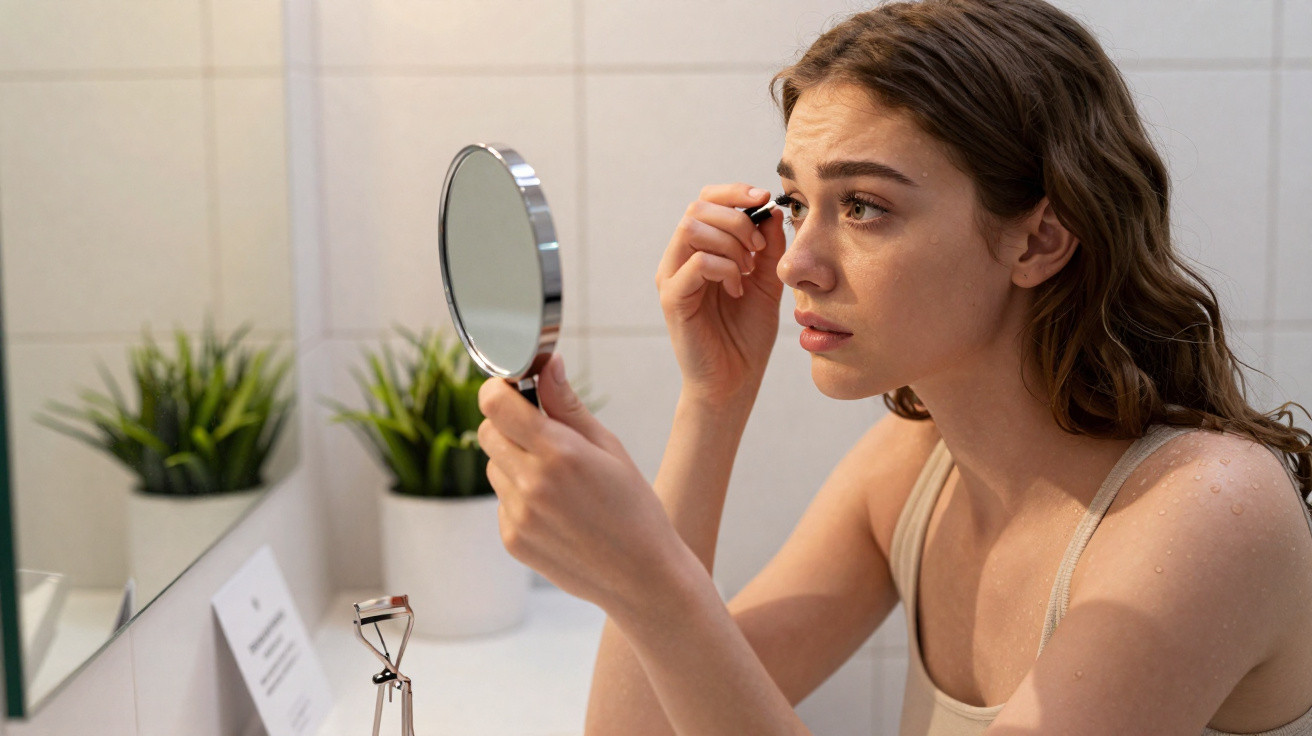
At first, everything looks perfect in the mirror. Your lashes sweep upwards in a fan shape, your eyes suddenly seem more awake, a little as though you have had eight hours of deep sleep and a seaside holiday. Your friend says, “Wow, what have you done to your eyes?” and you wonder: why did I not do this sooner? Then, two or three weeks later, comes the part hardly anyone shows on Instagram. Tiny broken lashes on the cotton pad, gaps along the lash line, mascara that suddenly applies strangely. And an uncomfortable question appears: is my lash lift to blame?
The hidden cost of the perfect curl
We rarely talk about what lashes truly feel like after a lash lift. At first, it all seems wonderfully effortless: you wake up with eyes that look ‘done’, need less make-up and spend less time in the bathroom. Convenience is delighted, and so is the mirror. Then, one day, you spot tiny hairs by the sink and start searching online to find out whether this is still normal. That is when the hype turns into uncertainty – and when the real story of your lashes begins.
Take Laura, 27, for instance, who called her first lash lift a “gamechanger”. She visited the salon every eight weeks, stopped wearing mascara and used only a little clear gel. Following her third treatment, the first gaps appeared; the outer lashes on her right eye suddenly looked uneven, almost as though they had been nibbled away. Her stylist said this was “completely normal” and that they would grow back. Months later, Laura’s selfies clearly showed that her lash line had become more irregular. It was not bare, but it was uneven – and, above all, prone to breakage. A little friction while removing her make-up was enough to make a few more lashes fall out.
There is no mystery behind this; it is chemistry combined with mechanics. A lash lift uses lotions that break down the internal structure of the lashes so they can be set into a new shape. In principle, the same thing happens to your lashes as happens to permed hair – only much closer to the eye and on far finer hairs. The lash cuticle is affected, making the lash itself more porous. If treatments are done too often or left on for too long, the lash simply loses elasticity. It then breaks more easily, especially where it has been bent most sharply: near the root or halfway along the hair shaft.
What you can do when your lashes suffer after a lash lift
The most important step is remarkably unglamorous: take a break. Do not have another lash lift, lash lifting treatment or tint until your full lash cycle has passed. On average, that takes 6–8 weeks, and occasionally longer. During that time, you can use conditioning serums or simple oils, such as castor or jojoba oil, applied in a very thin layer. Just like the hair on your head, lashes need periods when nothing ‘improving’ is being done to them. If you wish, use a very light, non-waterproof mascara during this period, one that can be removed without rubbing.
In this sensitive phase, many people make the same mistake: they try to disguise visible breakage with more products. More mascara, waterproof formulas and stronger cleansers because everything “sticks so much”. Fear of short lashes places even more strain on them. Let us be honest: nobody patiently massages in a conditioning serum every evening and gently removes mascara with lukewarm water for five minutes. In reality, it is quick make-up wipes and vigorous rubbing because you are tired. This is exactly when it is worth deliberately slowing down and establishing new micro-habits at the sink.
One sentence a lash artist once said to me in a salon has stayed with me:
“Lashes forgive a lot – but they have a memory. What you overdo today, you will see in the mirror in a few weeks.”
To prevent it getting that far, a small plan can help, particularly if you love your lash lift and do not want to give it up completely:
- Have a lash lift no more than every 8–10 weeks; do not book another earlier ‘just in case’.
- Give your lashes a complete 2–3-week ‘make-up diet’ in between, with no waterproof mascara.
- Never pull, twist or ‘test’ your lashes to see how strong they are – they remember it.
- Choose gentle, oil-based cleansers and pat with cotton pads rather than rubbing.
- If there are visible gaps or significant breakage, skip a treatment and ask another stylist for advice.
Between vanity, self-care and an honest look in the mirror
When lashes break more quickly after a lash lift, it is rarely only about cosmetics. There is also that quiet fear of losing brightness around the eyes or looking ‘bare’ once the curl has gone. Rationally, we know that nobody studies our lashes in everyday life as closely as we do in a magnifying mirror. Yet a brittle lash line can still feel like a small loss of control over your own face. It is in precisely this tension between vanity and common sense that the urge arises to ‘fix’ things immediately, rather than letting the problem recover.
It becomes interesting when you observe for a few weeks just how much your mood each day depends on supposedly minor details. A day with beautifully lifted lashes and flattering bathroom light can make a meeting feel less intimidating. A day with flaky lashes and smudged mascara, and you immediately feel a little less self-assured. Perhaps the real gamechanger is not the next chemical treatment at all, but a calmer attitude towards these small fluctuations. The thought: “Okay, my lashes are in recovery mode right now. I am still me.”
Anyone who shares the subject with friends soon notices that many have experienced lash breakage after a lash lift – they simply rarely discuss it because it does not suit a glossy aesthetic. There is the person who suddenly returned entirely to a natural look. Another now works only with highly experienced lash professionals and schedules strict breaks. And there is the one who has learnt to live with a simple lash comb and a light serum instead of maximising every curve. Perhaps that is the small, quiet luxury: knowing what your own lashes can genuinely withstand, and no longer demanding more of them than they can give.
| Key point | Detail | Benefit for the reader |
|---|---|---|
| Chemical strain on lashes | Lotions break down the lash structure, making lashes more porous and prone to breakage | Understands the real mechanism behind lash breakage and can choose treatments more consciously |
| Planning recovery periods | At least 6–8 weeks between lifts, plus conditioning serums and gentle make-up removal | Maintains lash-line density over the long term and lowers the risk of visible gaps |
| Adjusting everyday habits | No rubbing, no waterproof mascara during recovery, no fiddling with lashes | Protects sensitive lashes day to day without giving up a well-groomed appearance altogether |
FAQ:
- Question 1: Do lashes always break more easily after a lash lift?
- Answer 1: No, not necessarily. The risk rises with treatments that are too frequent, processing times that are too long, and lashes that are already weakened.
- Question 2: How long do lashes need to recover from a lash lift?
- Answer 2: A full lash cycle is roughly 6–8 weeks. During this time, weakened hairs may shed and new, healthy lashes can grow back.
- Question 3: Does lash serum help with lash breakage after treatment?
- Answer 3: A conditioning serum can support the hair structure and make lashes more supple, but it cannot replace a genuine break from chemical treatments.
- Question 4: Is a lash lift harmful after just one treatment?
- Answer 4: When carried out professionally on healthy lashes, most eyes tolerate a first lift well, provided it is not repeated too soon.
- Question 5: How can I tell that I should not have another lash lift?
- Answer 5: Clear gaps, lots of short stubble-like lashes, a tight feeling along the eyelid edge or increased hair loss are warning signs that make a break sensible.





Comments
No comments yet. Be the first to comment!
Leave a Comment