
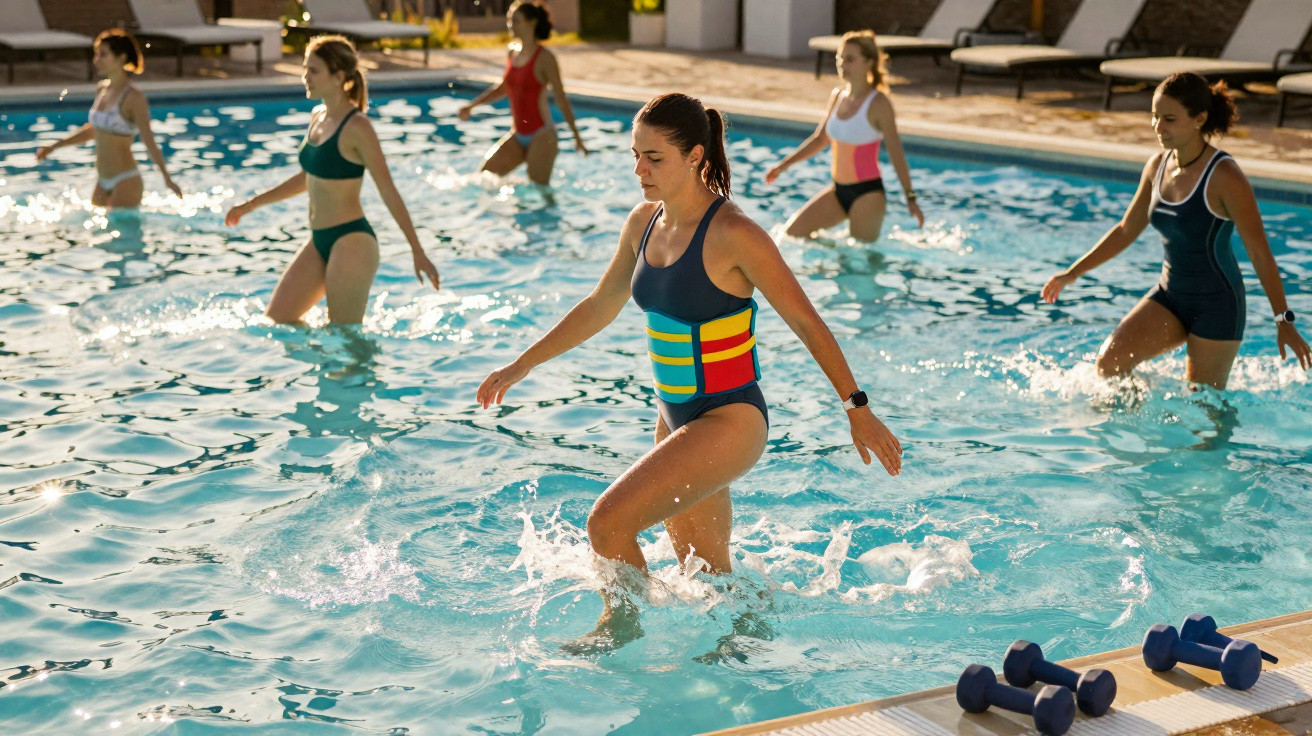
On the beach, it may look like a harmless class for older people – but this water workout is actually a demanding endurance session that can also shape your figure.
When people think of exercise for weight loss, jogging, the gym or HIIT classes usually come to mind. Yet, by the sea or at a lake, groups wearing wetsuits and swimming caps can be seen apparently strolling through the water. This often underestimated activity can, according to experts, do a surprising amount for body weight, muscles and cellulite.
What Aquawalking really involves
Known in the UK and elsewhere as coastal walking, Aquawalking or sea walking, the activity follows a similar principle in every form. Participants walk briskly through the sea, a lake or a large bathing lake, with water reaching somewhere between navel and armpit height. Groups often move against small waves and may sometimes use paddles or gloves to increase the water resistance.
Water buoyancy means the body carries only a fraction of its usual weight. This gives the knees, hips and back relief from the impact that can often cause problems when jogging. At the same time, the muscles must work against the resistance of the water, which is far greater than air resistance on land.
Aquawalking combines reduced joint strain with intensive muscle and endurance training – a mix many people only appreciate once the muscle soreness begins.
Because it remains easy on the joints, many classes are specifically aimed at older adults. Its reputation as a “pensioner sport” is therefore not entirely unfounded. However, anyone who has marched briskly through hip-deep water for 45 minutes will soon realise it has little in common with a leisurely walk along the beach.
How many calories walking through water burns
Specialist swimming and watersports schools estimate that brisk Aquawalking can burn between 500 and 550 kilocalories an hour for a person weighing around 70 kilograms. Actual calorie use depends on pace, water depth, waves, body weight and fitness level.
The key factor is the cardiovascular endurance zone, which generally sits at 60 to 70 per cent of maximum heart rate. Within this range, the body primarily draws on fat stores for energy.
- Moderate pace: Heart rate is slightly raised and conversation remains easy – carbohydrates are burned for the most part.
- Endurance zone: Breathing becomes faster; you can still speak but no longer chat comfortably – ideal for fat burning.
- Very high pace: You are gasping for breath and can barely talk – carbohydrate burning is considerably higher.
When walking in water, the endurance zone broadly equates to a speed of around 5 to 8 km/h. That may not sound like much, but it feels remarkably demanding when you are moving against a current or in deeper water.
Trainers advise warming up for 10 to 15 minutes first, perhaps by walking briskly along the beach or in shallower water. Then try to maintain the endurance zone as consistently as possible for 45 minutes. From this point onwards, the body relies more heavily on its fat reserves.
Why cellulite responds to water training
One major advantage of Aquawalking is its effect on connective tissue and skin. The movement of the water provides a continuous massage for the legs and buttocks. At the same time, the cold water stimulates circulation and exercises the blood vessels.
The combination of massage, cold and muscle work strengthens connective tissue – over time, cellulite dimples often appear less pronounced.
Cellulite develops when small fat deposits push outwards through weaker connective tissue. It is not a medical emergency, but it bothers many people. Aquawalking counters this through three factors:
- Improved circulation: Blood vessels repeatedly expand and contract in response to changes in temperature and movement.
- Gentle water pressure: Hydrostatic pressure acts as natural compression and may reduce fluid retention.
- Targeted muscle building: Stronger thigh and buttock muscles firm the body’s contours from within.
After several weeks, many female participants report less heavy-feeling legs, firmer-feeling skin and a more defined silhouette, even if the number on the scales has barely changed. The body can become more toned without necessarily losing a large amount of weight.
Who benefits most from this watersport?
Aquawalking is suitable for an unexpectedly wide range of people, from complete beginners to athletes looking to add another form of training.
| Group | Benefits |
|---|---|
| Exercise beginners | Low risk of injury, easy to learn and no complicated movement patterns. |
| People with joint problems | Hardly any impact loading, so the knees and hips are protected. |
| People who are overweight | Buoyancy relieves pressure on the body, making it easier to begin endurance training. |
| Runners and fitness enthusiasts | An ideal complementary workout, well suited to recovery and extra calorie expenditure. |
| Older people | Cardiovascular training without a risk of falling, while strengthening balance and muscles. |
Another benefit is that training usually takes place in groups, often with an instructor or guide. This can boost motivation, provide accountability and make those who feel uncertain less worried about unfamiliar surroundings.
Getting started with Aquawalking step by step
Anyone keen to try the activity should not simply enter unfamiliar water alone. A supervised class at the North Sea or Baltic Sea, at large inland lakes or in coastal holiday areas is the better option.
The right equipment
- A wetsuit or shorty wetsuit, depending on water temperature
- Non-slip footwear for shingle, stones and shells
- A close-fitting swimming cap or hat in windy conditions
- Gloves or paddles, if desired, for greater resistance
Safety and weather conditions should always be monitored closely in open water. Currents, high waves, hypothermia and sudden weather changes can all pose risks. This is why many organisers use clearly marked routes and set precise time slots.
Training frequency and pace
To start with, one or two sessions a week are enough to produce noticeable effects on body shape and wellbeing. For the first few sessions, 20 to 30 minutes in the water may be sufficient to help the body adapt to this unfamiliar type of effort.
Over time, this can be increased to 45 to 60 minutes. Combining the sessions with a reasonably balanced diet can create a sound calorie deficit without placing excessive strain on the body.
Combining Aquawalking with other sports
This watersport does not have to replace jogging, cycling or strength training. Many people use it as an addition, particularly on days when their joints feel tired or when the weather makes running on land less appealing.
One possible weekly schedule is:
- Monday: 30 minutes of easy running
- Wednesday: 45 minutes of Aquawalking in the endurance zone
- Friday: Strength exercises for the core and back at home
- Sunday: A 60-minute walk or gentle bike ride
This combination works the muscles, cardiovascular system and connective tissue alike, without overloading any one area.
What beginners should know before their first class
A few questions arise repeatedly: Can people with heart problems take part? Is ordinary swimming ability enough? How cold can the water be? The general advice is that anyone with pre-existing health conditions should discuss starting with their GP. However, many rehabilitation clinics and orthopaedic specialists regard watersports of this kind as a worthwhile option.
Being able to swim is a clear advantage because it helps participants feel safer. Many classes do, however, remain in shallow water where people can stand securely. Beforehand, instructors explain the route, water temperature and duration. Anyone who gets cold quickly should begin during the warmer months rather than attempting their first session in strong winds.
Notably, many people who have never enjoyed conventional endurance exercise stick with walking in water for surprisingly long periods. For many, the blend of being in nature, the feeling of group participation and the positive physical sensation afterwards is more motivating than staring at a wall while on a treadmill at the gym.



Comments
No comments yet. Be the first to comment!
Leave a Comment