
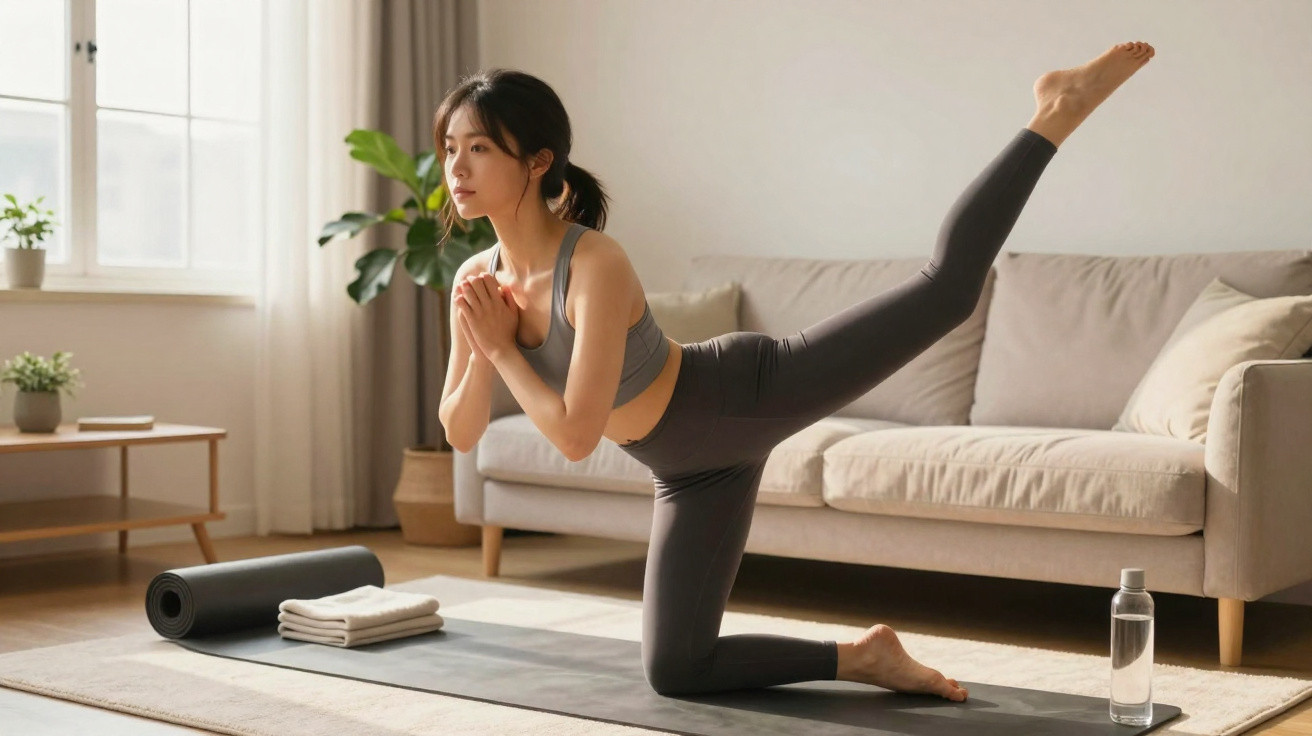
A flatter stomach without punishing sit-ups: a Pilates trainer shares a straightforward living-room routine that may bring visible changes within just a few weeks.
Many people will recognise the feeling: your trousers pinch, your stomach feels tight after a meal, and traditional crunches leave your neck aching rather than your abs. This is where a dedicated Pilates routine created by an experienced coach comes in. Five focused exercises, requiring only a mat and a few minutes, are designed to engage the deep abdominal muscles and make the waist look more defined week by week.
Why Pilates can make the stomach look flatter
When people think about abdominal training, they often picture visible muscles - the classic “six-pack”. Anatomically, however, another muscle layer is particularly important when it comes to a flatter-looking stomach: the deep abdominal muscles.
Sports scientists broadly distinguish between:
- Superficial abdominal muscles - chiefly the rectus abdominis and obliques, which bend and rotate the torso.
- Deep musculature - especially the transverse abdominal muscle, which acts rather like an internal corset.
This “internal corset” is the focus of many Pilates exercises. Trainers repeatedly emphasise the same sequence: exhale first, gently draw the abdomen inwards and engage the pelvic floor - then begin the movement. This approach recruits not only the visible muscles but also the supporting muscles beneath them.
Deliberately drawing the navel gently towards the spine as you exhale activates the deep abdominal muscles - that is at the heart of the Pilates effect for a flatter stomach.
There is another advantage: when the torso becomes more stable as a whole, the lower back is relieved. Many people say their posture improves and their lower-back arch becomes less pronounced. As a result, the entire silhouette can automatically appear longer and more elongated - even if the number on the scales stays the same.
The coach’s 5 favourite exercises for a toned core
From the wide range of Pilates movements, the coach has selected five favourites. They can all be done at home without equipment, ideally on a non-slip mat:
- Single Leg Stretch
- Double Leg Stretch
- Double Leg Lower Lifts
- Shoulder Bridge with Kick
- Scissors
Single Leg Stretch: an introduction to deep core engagement
Begin lying on your back. Draw both knees towards your chest, lift your head and shoulders slightly, and look towards your thighs. Extend one leg forwards while keeping the other knee drawn in, then switch legs smoothly.
- Activates: transverse and oblique abdominal muscles
- Training effect: maintains core engagement and improves body control
- Tip: keep the movement smaller if needed, while pressing the lower back firmly into the floor
Double Leg Stretch: a classic all-round Pilates move
For this exercise, lie on your back again with your head and shoulders slightly raised. Your arms and legs begin close to the body. As you inhale, lengthen the legs forwards and reach the arms back overhead; as you exhale, return both towards the centre.
The movement looks uncomplicated, yet it challenges the entire core because the arms and legs work as counterweights. With controlled breathing, you soon notice how hard the deep muscles have to work to keep the back stable.
Double Leg Lower Lifts: targeting the lower abs
This version noticeably works the area below the navel. From a supine position, lift both straight legs upwards into roughly a “V” shape. Lower them slowly towards the floor before lifting them again.
The more controlled the lowering of the legs, the harder the lower abs have to stabilise - making it clear why good technique matters more here than a large range of movement.
It is essential that your lower back remains heavy against the mat throughout. If it starts to arch away from the floor, reduce the range of movement or take a break.
Shoulder Bridge with Kick: a bridge for the glutes, back and abs
The traditional shoulder bridge works the glutes and the backs of the legs. Adding a kick in the Pilates variation demands even more core strength. Start on your back, with your feet hip-width apart and knees bent. Lift the pelvis until the thighs and upper body form one line.
Next, extend one leg upwards towards the ceiling and bring it back in a controlled “kick” to the height of the other knee. Keep the hips as steady as possible and avoid allowing them to drop to one side. Maintaining this stability works the whole core almost without you noticing.
Scissors: hip mobility and a strong core
The Scissors exercise introduces more movement. From lying on your back, raise both straight legs towards the ceiling. Lower one leg towards the floor while the other reaches upwards. With every switch, keep the abdomen actively drawn inwards.
Many Pilates instructors use small pulses here: the upper leg is assisted with two short pulling movements while the flow of breath is consciously controlled. Anyone with neck discomfort can leave their head and shoulders on the floor and concentrate fully on the core.
How to fit the routine realistically into everyday life
The coach recommends following a fixed order, so there is no need to spend time deciding what comes next:
- Single Leg Stretch
- Double Leg Stretch
- Double Leg Lower Lifts
- Shoulder Bridge with Kick
- Scissors
At the beginning, eight to ten repetitions of each exercise are enough. Keep the pace relatively slow, concentrating on breathing and control. If you are new to the routine, take a brief breather between exercises rather than trying to power through it as though it were a test of strength.
| Training level | Repetitions per exercise | Frequency per week |
|---|---|---|
| Beginner | 8–10 | 2–3 sessions |
| Advanced | 12–15 | 3–4 sessions |
Some users report noticeable changes after around three weeks: more firmness in the stomach, a lighter feeling in the morning and less pulling in the lower back. What matters is consistency and sound technique - not achieving the perfect figure in record time.
Living room instead of studio: turning home into a Pilates space
According to trainers, anyone who does not want to attend a class can manage perfectly well at home with a few basics. A non-slip surface, comfortable clothing and bare feet are all that is initially required. Everyday household items can also help with certain variations:
- Non-slip socks or small towels on a smooth floor for gentle sliding movements
- A folded towel to support the head or pelvis
- A yoga cushion or firm cushion for people with a sensitive back
If you exercise on parquet or tiles, make sure nothing can slide away. A firm surface with a little give is ideal. Also, if an unfamiliar sharp pain occurs, stop immediately and seek medical advice if in doubt.
When the first results show - and what affects them
Many personal accounts use about 21 days as a rough guide for when something begins to feel “different”: the stomach appears flatter in the morning, trousers fit more comfortably and everyday movements feel easier. However, this timeframe is not a promise.
Factors include:
- How often the exercises are actually completed
- How consistently breathing and technique are observed
- Sleep, stress levels and diet
- Pre-existing conditions or extended breaks from exercise
Anyone who trains mindfully three times a week, uses deep breathing and does not constantly exercise on a full stomach has a much better chance of visible changes.
Suitable after 60? What older adults should consider
Pilates is generally considered gentle on the joints and is therefore often recommended for people aged over 60. However, trainers set out a few clear rules for this age group:
- Keep the range of movement smaller; controlled movements are better than large ones
- Allow plenty of breaks and monitor pulse and breathing
- Seek medical clearance in advance if you have heart or back problems
- Stop if dizziness, shortness of breath or sharp pain occurs
Especially in later life, the combination of a stronger core and improved mobility may help to prevent falls. Many people also report feeling more secure when walking and climbing stairs.
What terms such as “deep abdominal muscles” and “Pilates breathing” mean
When starting Pilates, you will often hear terms that can initially seem abstract. Two of them appear particularly often in connection with a flatter stomach:
- Deep abdominal muscles: This mainly refers to the transverse abdominal muscle. It wraps around the torso like a broad band and helps support the organs and spine. When activated, it gently draws the stomach in visually.
- Pilates breathing: This describes a breathing pattern in which the ribs expand outwards and backwards while the abdomen stays relatively flat. As you exhale, the core actively contracts, increasing the training effect.
Anyone who understands and can feel these two concepts will get considerably more from each of the five exercises. The aim is not to exhaust yourself, but to consciously engage the “internal belt” with every repetition. That is precisely what makes this routine so appealing to anyone wanting to tone their stomach without overloading their back.
Comments
No comments yet. Be the first to comment!
Leave a Comment