
A Tuesday morning “senior abs” session at 9:15 a.m., with nobody under 60 anywhere in the room. The instructor called out repetitions and the music strained to sound youthful, but the expressions told a different story: people were working hard without much conviction. They had tried gyms, crunches and diets with the flavour of cardboard.
At the back, a woman in a washed-out green T-shirt simply observed. In four months at home, she had lost more belly fat than she had during five years of gym memberships. No burpees. No expensive equipment. Only a slow, determined routine that anybody could copy. As the session finished and the group drifted towards the changing rooms, she fastened her coat and smiled like a person with a private secret.
A secret that can make many gyms seem oddly unnecessary.
Why belly fat after 60 follows different rules
After 60, abdominal fat can act like the guest who will not leave the party. You eat less and walk more, but your waistband still disagrees with the mirror. Hormones change, muscle mass declines, sleep becomes lighter, and the body suddenly stops responding as it did at 40. The old advice to “do more crunches, sweat harder” begins to sound like a poor joke.
Fitness instructors regularly promote high-intensity circuits because that is what the industry markets. Yet your joints may disagree. Knees ache, shoulders click and lower backs grumble at night. Many people then stop altogether, not through laziness, but because the programme no longer suits the body they have. At that point, a gentle routine at home can seem less like settling for less and more like an act of defiance.
The figures help explain why. After 60, studies show that most people lose muscle mass at a consistent yearly rate, particularly if they spend much of the day seated. Less muscle leads to a slower metabolism. A slower metabolism means that more of what you eat is stored around the waist, especially the deep visceral fat associated with heart disease and diabetes.
However, when researchers gave older adults very gentle, regular strength exercises alongside daily low-intensity activity, waist measurements reduced without extreme diets or marathon training. One 68-year-old man I spoke with never went near a gym. He completed three five-minute strength “snacks” each day in his hallway and walked twice around the block. Within four months, he had moved his belt in by two notches. There was no miracle involved, only repetition that caused no pain.
There is a simple, quiet reasoning behind it. Hard but occasional exercise can batter a body that needs regularity more than a shock. Sitting for long stretches keeps blood sugar and insulin elevated, encouraging fat to remain around the middle. Brief bouts of activity throughout the day change that pattern. Abdominal fat after 60 depends less on intensity than on rhythm. When that rhythm works with real life rather than a gym leaflet, change can begin.
The home routine that makes gyms feel pointless
The approach some trainers dislike is not glamorous. It requires neither a membership nor a selfie wall. Instead, it divides the day into small, unremarkable actions that tackle belly fat from three directions: gentle strength work, regular movement and restful evenings. Think of it as a quiet programme operating throughout the day, rather than one intimidating workout.
Its basic framework is this. In the morning, spend 5–7 minutes doing straightforward strength exercises with a chair and wall. In late morning and the afternoon, take two or three 10-minute “walk loops” around your home, corridor or local block. In the evening, follow a 7-minute wind-down routine to settle stress hormones, with several deep breaths and one or two stretches. Nothing should leave you out of breath. Everything should be manageable even on a difficult day.
Let us be honest: nobody truly manages this every day. Life intervenes, grandchildren arrive and phones ring. Perfection is not the aim. The point is that, for four or five days out of seven, your body does not get the chance to settle completely into “storage mode”. Trainers dislike this routine because it shows that consistency matters more than spectacle. You need no machines, playlists or car parks: only a hallway, a chair and a promise to yourself that does not feel like a punishment.
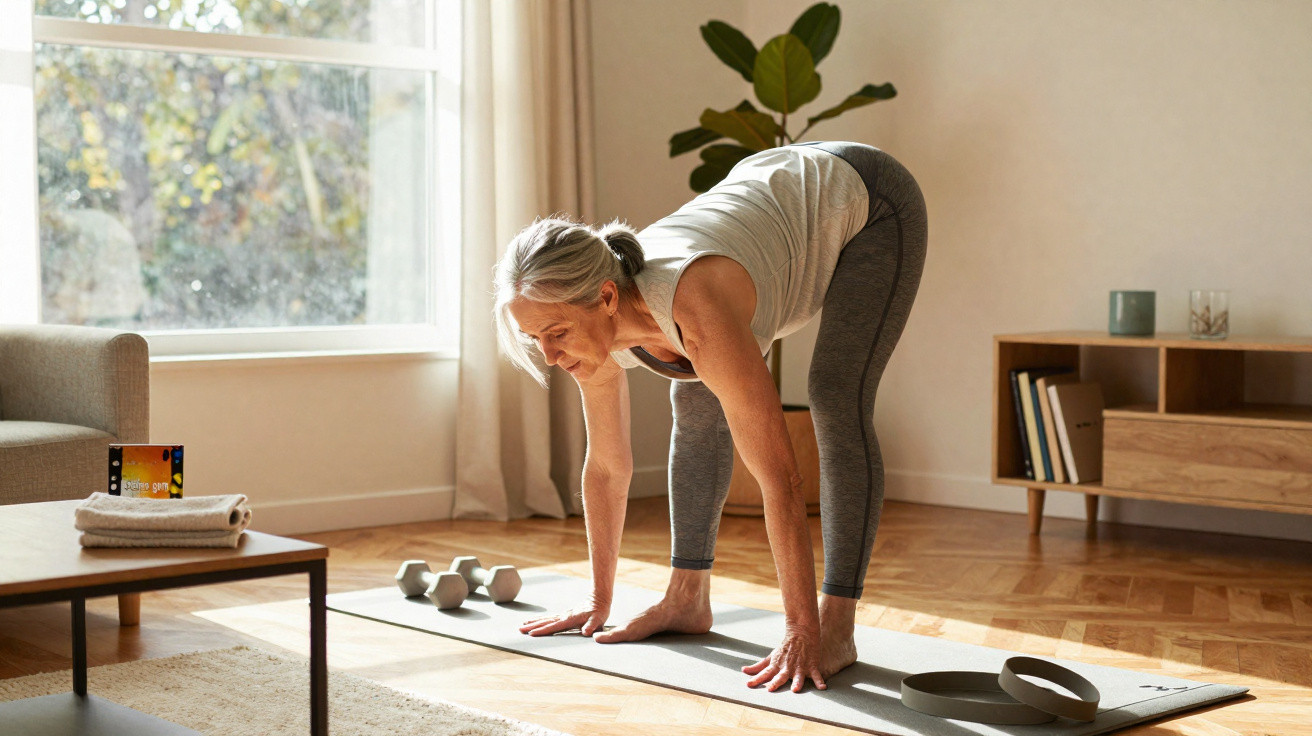
The quiet benefits begin with morning strength work. In your living room, place both hands on the back of a chair and perform 10 slow half-squats. Next, stand facing a wall, lean towards it and complete 10 wall push-ups. Finally, sit on the chair and slowly rise and sit back down 10 times with your arms folded, as though you were standing from a low sofa. That is all. Do one or two rounds, according to your energy levels.
These exercises activate large muscle groups in the legs, hips and upper body. Larger muscles use more energy even while you are resting. Over time, this can help shift fat away from the middle. The aim is not a six-pack; it is to make your whole body a more stable, calmer system. After a month, many people notice not only a less tight waistband, but also easier stair climbing and reduced fear of falling.
The pitfalls can be subtle. First, people may try to “make up for lost time” by lifting heavy weights or copying online routines designed for younger people. That frequently results in aching joints and a private feeling of defeat. Second, they may focus on the scales instead of measuring their waist. Body weight can fluctuate because of water and muscle, while abdominal fat tends to change more gradually, almost timidly.
On a deeply human level, shame is the largest obstacle. People over 60 have told me they feel scrutinised in gyms, as if their bodies need an apology. That pressure disappears at home. You can pause between sets, wear whatever you choose and take a break without somebody counting at you. On a low-energy day, two exercises will do. This small act of self-kindness keeps the routine going far longer than any bootcamp.
One retired nurse, aged 72, put it this way:
“I stopped trying to be the woman I was at 40. Once I started training the body I actually have, my belly finally began to let go. It’s strange - I’m softer and stronger at the same time.”
To make it easier, many people keep a small checklist on the fridge. There is no guilt attached, only a quick yes-or-no check of reality. When motivation fades, that sheet of paper is often enough to prompt one walk around the table or a single set of chair squats. That is sufficient.
- Morning: 5–7 minutes of chair + wall strength (legs, push, stand-ups)
- Daytime: 2–3 “walk loops” of 8–12 minutes each, indoors or outside
- Evening: 7-minute wind-down (slow breathing, light stretching, screen-free)
The steady strength of small, determined changes
Abdominal fat after 60 carries its own history: pregnancies, late shifts, stress and good food shared with loved ones. Reducing some of it does not remove those stories, but it may relieve pressure on your heart, joints and sleep. After following this home routine for several months, people often report an unexpected effect: they start trusting their bodies again.
There is no single perfect way to follow it. One person may walk along a hallway while counting doorframes, while another may circle the kitchen as the kettle boils. Some may stretch on a prayer mat; others may do so beside the bed before the evening news. What matters is that the day is no longer divided into “exercise” and “not exercise”. Movement instead becomes part of daily life, like a plant on the windowsill that you water almost automatically.
We have all stood before a mirror, pinched the soft band around the waist and murmured a promise to change that sounds more like a threat. The routine that makes gyms feel pointless succeeds because it takes the opposite approach. It treats your body after 60 as a partner rather than a project. When that partner feels respected, it often comes halfway to meet you.
| Key point | Detail | Benefit for the reader |
|---|---|---|
| Rhythm rather than intensity | Small daily sessions of gentle strength work + walking | Reduces abdominal fat without exhaustion or injury |
| Home environment | A routine possible with a chair, wall and hallway | Removes the gym barrier and makes regularity easier |
| Stress and a calmer evening | 7 minutes of breathing and light stretches in the evening | Lowers cortisol, a quiet ally in tackling belly fat |
FAQ:
- How many weeks before I see changes in my belly? Most people notice subtle changes in 4–6 weeks, like looser clothes or a softer waistband, with clearer results around 3 months.
- Can I really skip the gym and still lose abdominal fat after 60? Yes, if you combine gentle strength, frequent light walking, and calmer evenings, you can shrink belly fat at home without machines.
- Do I need special equipment or weights? No. A solid chair, a clear bit of wall, and a safe walking space are enough to start; small water bottles can act as light weights later.
- What if I have knee or back pain? Shorter ranges of motion, slower tempo, and chair-based moves often help; speak with your doctor or physio before changing habits if pain is significant.
- Is it too late to change my belly at my age? Research and real-world stories show improvements well into the 70s and 80s; your body still adapts, just more slowly and gently.





Comments
No comments yet. Be the first to comment!
Leave a Comment