
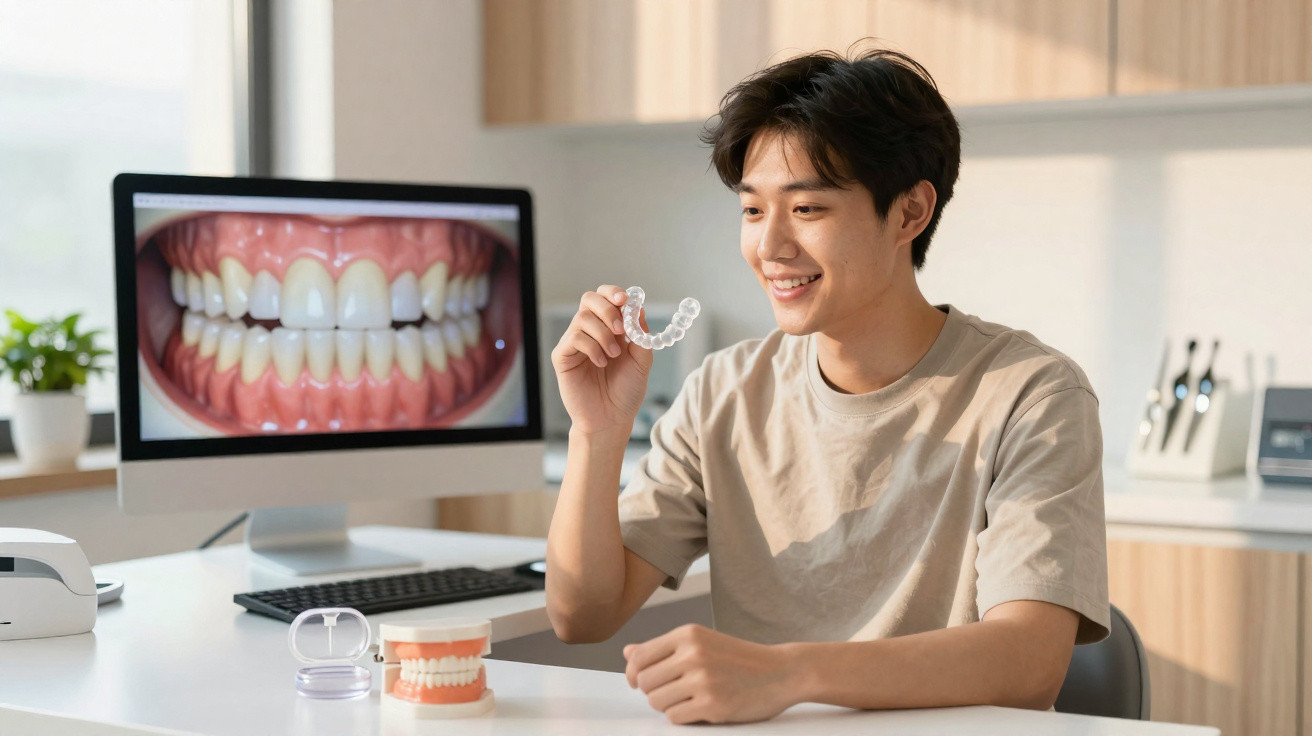
But how does this treatment work, step by step?
Straight teeth without visible wires, while still speaking, eating and working normally: the promise of “invisible” correction is appealing. Behind this trend are highly precise digital processes, bespoke plastic aligners and a clearly structured treatment plan. Anyone considering it should understand what actually happens in practice, how long it takes and how much discipline is required.
Initial consultation: are invisible aligners right for me?
Everything begins with a detailed discussion at an orthodontic practice. The orthodontist assesses whether treatment with clear aligners is appropriate or whether conventional fixed braces would be the better option.
- clinical examination of the teeth, jaw and gums
- X-rays to assess the roots and bone
- photographs of the face and teeth for documentation
- discussion of expectations: merely a “cosmetic correction” or a complex misalignment?
Using this information, the orthodontist explains which changes are realistic, the approximate duration of treatment and the likely costs. For adults in particular, work also matters: people who speak frequently or appear before an audience usually want an especially discreet solution.
The initial consultation determines whether invisible aligners genuinely suit your teeth and everyday life.
Digital scan instead of a plaster impression
In the past, an “impression” meant a bulky tray, a gag reflex and a plaster model. Modern systems generally use a 3D scanner instead. A small handheld device is guided across the rows of teeth to create a digital model.
The process often takes only a few minutes and is normally painless. Many patients find scanning considerably more comfortable than traditional impressions. Its key advantage is that the data can be checked immediately on screen and added to if necessary, without having to put another unpleasant impression material in the mouth.
The clinician can use the monitor to show exactly where teeth are tilted, gaps are present or the bite does not meet correctly. Initial simulations can often illustrate what the eventual result may look like, which many patients find highly motivating.
Computer planning: how the aligners are created
The orthodontist uses the digital model to plan the actual tooth movement. Special software calculates, in small stages, how each individual tooth should move towards its target position. Each intermediate stage has its own aligner.
How virtual treatment planning works
For every tooth, the following is determined precisely:
- the direction in which it needs to move
- how far it may be tilted or rotated
- the speed at which the change can happen without placing excessive strain on the root
This calculation produces a kind of treatment “film”. The laboratory uses it to determine the required number of aligners. The greater the correction needed, the more aligners are required. Minor corrections may sometimes need only ten to twelve sets, while pronounced misalignments can require substantially more.
Production of clear aligners
Once the digital plan is complete, a specialist laboratory makes a bespoke plastic aligner for every stage of treatment. It is transparent, smooth and fits closely over the teeth. Small irregularities are intentional, as they apply the gentle pressure that moves the teeth.
Each individual aligner shifts the teeth only minimally – together, they create a completely new bite.
Once all aligners have been produced, the patient will usually receive several sets at once, together with clear instructions on when to use each one.
Starting everyday life with aligners: wear time and check-ups
At the first fitting, the orthodontist explains how the aligners should fit, how to insert and remove them, and what to consider in daily life. One rule of thumb applies almost everywhere: aligners should be worn for around 20 to 22 hours a day.
They should only be removed for eating, drinking strongly coloured drinks and brushing the teeth. Anyone who regularly wears them for less time risks their teeth not tracking as planned, meaning later aligners may fit poorly or not at all.
Check-up appointments usually take place every four to eight weeks. At these visits, the clinician checks whether the teeth have reached their planned positions, whether pressure points or pain are occurring, and whether adjustments are required. In some cases, intermediate stages can also be changed if the teeth respond differently than expected.
Retention phase: why treatment does not end after correction
Once the desired position has been achieved, teeth tend to drift back towards their original positions. To prevent this, a stabilisation stage known as retention is needed.
Retention: retainers and fixed wires
Many practices use a combination of:
- a fixed retainer wire behind the front teeth in the upper and/or lower jaw
- an additional night-time aligner that works like a thin retainer
The retainer wire is discreetly bonded to the inside of the teeth, so it cannot be seen from the outside. The removable aligner is worn mainly at night. How long this phase lasts depends on the initial condition. Many specialists advise leaving the retainer in place long term to protect the result permanently.
Oral hygiene during treatment
Because aligners fit tightly, hygiene needs to be particularly rigorous. Otherwise, food debris and plaque can collect between the teeth and plastic, encouraging tooth decay.
- rinse aligners with cold water first to remove larger particles
- clean them with lukewarm water and a mild, non-abrasive cleaner or soap
- use a soft toothbrush to avoid scratches
- avoid harsh cleaning products and alcohol, as these can cloud the plastic
At the same time, thorough brushing after every meal and daily flossing remain essential. This is the only way to keep the plastic clear and the teeth healthy.
Beautiful, straight teeth are of little use if tooth decay develops beneath the aligner – hygiene is the true foundation of success.
Who are invisible aligners suitable for – and what are their limits?
Clear aligners are well suited to many adults and teenagers with mild to moderate misalignments. Common reasons for treatment include crowded teeth, small gaps or displaced front teeth that are cosmetically distracting and harder to clean.
For very complex bite problems, severely rotated teeth or children whose jaws are still growing, orthodontists more often favour conventional braces. People who know they struggle to follow instructions may also be better served by a fixed system that cannot be removed independently.
Risks, discomfort and daily life: realistic expectations for patients
A slight feeling of pressure during the first few days with each new aligner is normal. It indicates that the teeth are starting to move. Severe pain or sore areas, however, should be raised with the practice promptly; small modifications to the aligner often help.
One benefit of this approach is that, when eating, you can have anything your own teeth can tolerate – there is no wire in the way. Daily life can occasionally involve minor changes to speech, especially at the beginning, but these usually settle after a few days. Anyone who spends a great deal of time on the phone or presenting should allow for this adjustment period.
Problems arise when wear time is significantly reduced or aligners are lost without being reported. In that case, the plan and the actual tooth movement no longer match. Some practices therefore use apps or digital reminders to support compliance.
Costs, duration and practical examples
Costs vary considerably: a minor correction of individual front teeth may fall into the lower four-figure range, while more extensive treatment costs significantly more. State healthcare does not normally cover treatment for adults; private insurance and dental insurance policies may contribute depending on the policy, so it is worth checking the terms carefully.
Treatment can last from a few months for minor movements to one and a half years or more for more extensive cases. Typically, each aligner is worn for one to two weeks before moving on to the next. Those who follow the plan consistently often notice the first visible changes in the mirror after just a few weeks.
A typical example: a 30-year-old patient with crowded lower incisors and an uneven midline in the upper jaw receives a plan involving 20 pairs of aligners. With consistent wear and stabilising retention, she achieves a noticeably more harmonious smile within around twelve months – without anyone in the office noticing the treatment.
Anyone interested in invisible teeth straightening should not rely solely on advertising promises, but should seek a personal consultation at a qualified practice. Only there can it be assessed reliably whether this gentle, almost invisible method truly suits their teeth, daily routine and budget.






Comments
No comments yet. Be the first to comment!
Leave a Comment