
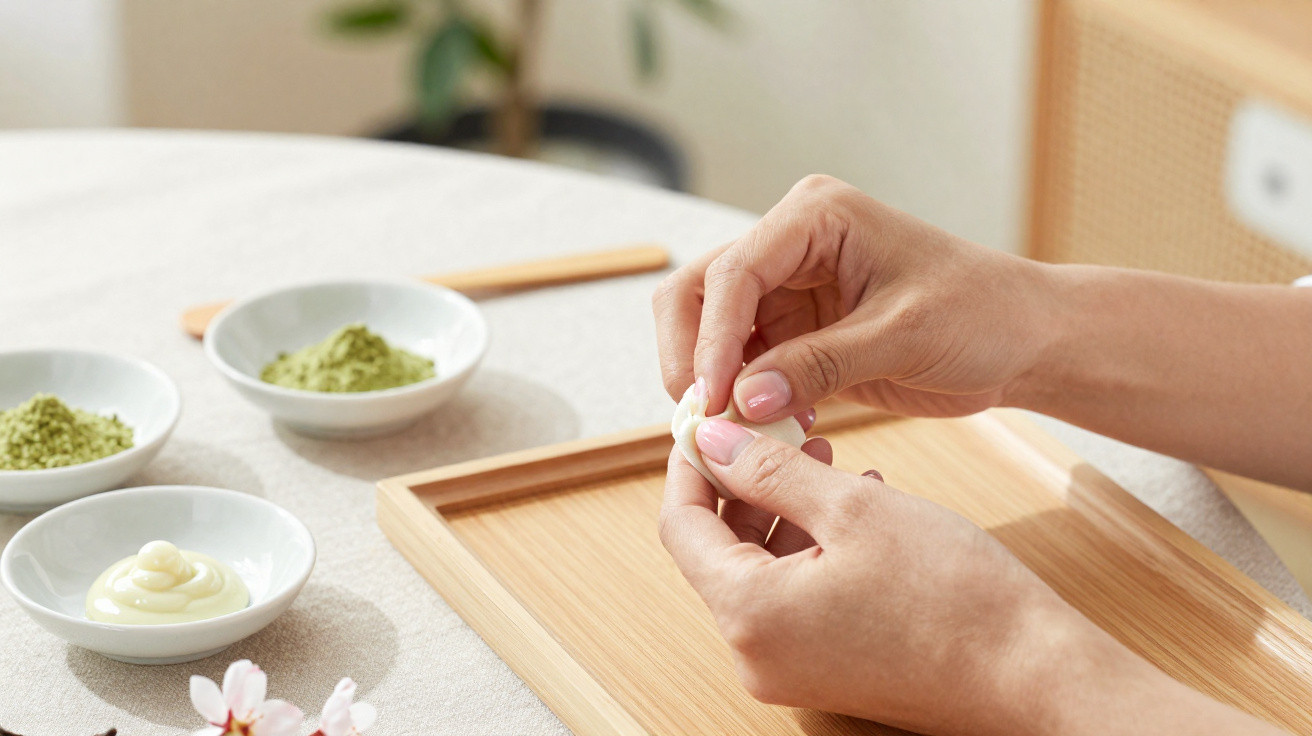
After hiding their nails beneath layers of gel, acrylic or BIAB for years, many people eventually see the consequences: brittle tips, ridges and dry cuticles. This is where the Japanese manicure comes in. Rather than adding fresh artificial layers, it is designed to gradually restore the natural nail, leaving a delicate pearlescent sheen that looks more ‘well cared for’ than ‘done’.
What the Japanese manicure is really about
The Japanese manicure is not another TikTok nail trend that will disappear next season. This method has been offered in traditional Japanese salons for decades. It is now gaining significant popularity in the West as the demand for gentle, minimalist beauty continues to grow.
Rather than sticking new layers onto the nail, the natural nail is nourished, polished and sealed – like a treatment from within.
A paste made with natural active ingredients is central to a Japanese manicure and is worked thoroughly into the nail. A fine layer of powder is then applied to seal it all in and create its signature glass-like shine. There is no polish, no artificial nails and no lamp.
Natural ingredients instead of harsh chemicals
The products used for this technique sound more like a care treatment than a typical nail-salon formula:
- Beeswax – forms a protective layer over the nail to help prevent dryness.
- Keratin – the protein that nails are naturally made from, intended to support brittle areas.
- Minerals and silicon – reinforce the structure and visually smooth out minor unevenness.
- Vitamins – provide an extra dose of care, particularly for stressed nails.
This blend is massaged into the nail plate using gentle movements. The pressure and warmth of the fingers allow some of the active ingredients to penetrate the upper nail layers. It is then worked in with a special powder and a buffing block until the well-known pink pearly shine appears.
How a Japanese manicure is carried out in a salon
For anyone who has never had this treatment, the process generally looks like this:
- Cleansing: Old polish is removed and the nails are filed into shape.
- Cuticle care: The cuticles are gently pushed back rather than aggressively cut away.
- Gentle buffing: The nail surface is very lightly roughened so the treatment can adhere more effectively.
- Massaging in the paste: The active-ingredient paste is carefully worked into every nail.
- Powder and polishing: A fine powder seals everything in, before a buffing block builds up the shine.
At the end, the nails look as though they have been coated in a transparent, lightly pink polish. The difference is that nothing can peel or chip, because no polish has been applied.
Why everyone is switching from gel to a Japanese manicure in 2026
Many people who have relied on gel, acrylic or BIAB for years are noticing how much these methods can put nails under strain. The issue is less about any one product and more about the continual cycle: building, infilling, filing away and sealing again. The nail plate becomes thinner, the surface rougher and nails break more easily.
The Japanese manicure breaks this cycle – it does not build up layers; it rebuilds.
A few reasons why beauty fans are embracing this look in spring 2026:
- Fewer chemicals: No aggressive solvents, UV lamp or artificial layers.
- The ‘clean beauty’ trend: Across skin, hair and nails, care is taking priority over visual perfection.
- Everyday suitability: The look works in the office, while working from home and with any outfit.
- Lower maintenance: The shine simply grows out with the nail, without unsightly regrowth lines.
Depending on nail growth, the result lasts around two to four weeks. Rather than visibly peeling away as polish or gel can, the shine simply grows out. Many people therefore choose to repeat the treatment at longer intervals.
Who is the Japanese manicure suitable for?
This method is especially aimed at people whose nails have already been through a lot. Typical candidates include:
- former gel or acrylic fans with nails thinned by filing
- people with brittle, splitting tips
- those with very sensitive skin or a tendency towards allergies
- pregnant or breastfeeding people who want to focus on mild care
- professionals for whom bold nail art is unsuitable
Because only mild products containing food-grade ingredients are used, the method is considered particularly well tolerated. It can also be combined with colour for anyone who loves vibrant designs: minimalist details can be added to the cared-for, polished nails, such as a fine micro-French tip or a subtle glazed effect using transparent polish.
Advantages over gel, acrylic and BIAB
| Aspect | Gel/acrylic/BIAB | Japanese manicure |
|---|---|---|
| Material | Synthetic polymers | Nourishing pastes and powders |
| Setting method | UV/LED lamp, curing | Mechanical polishing |
| Stress on the nail | Filing, acetone, pressure | Gentle buffing, massage |
| Look | Highly opaque, artificial | Nude, pink shimmer, natural |
| Longevity | Up to 4 weeks, may chip | 2–4 weeks, grows out softly |
Japanese manicure at home – is it actually possible?
Home-use kits are now available. They usually include a care paste, powder, buffing block and small nail file. They can certainly recreate the basic idea, although they rarely match the standard of a professional salon treatment.
Anyone starting at home should keep the following in mind:
- Never file too aggressively, or the nail plate may remain permanently thin.
- Work only on clean, oil-free nails; otherwise, the shine will barely last.
- Allow breaks between applications so the nail can rebalance itself.
After years of gel extensions, an initial appointment at a professional salon is particularly worthwhile. There, the nail base can be assessed properly and a realistic care plan can be created.
Risks, limitations and what the trend cannot do
Despite all its benefits, a Japanese manicure is not a miracle cure. It cannot resolve severely misshapen nails, deep ridges or medical issues such as nail fungus. In these cases, the first stop should be a dermatologist, not a salon.
There is another consideration: anyone who loves striking, long stiletto nails or elaborate 3D nail art is unlikely to be satisfied. This method gets its appeal precisely from its natural finish. Nails remain at their own length or are only slightly reinforced. For some, that is exactly the attraction; for others, it simply is not dramatic enough.
Why this Japanese manicure trend is perfect for our 2026 beauty year
Many people are currently cutting back in several areas: less make-up, more skincare; less perfume, more ‘skin scent’; fewer filters, more real-life appearance. The Japanese manicure fits seamlessly into this movement. The idea is that the body itself should once again be the starting point, rather than a building site.
“Your nails, only better” – this motto sums up the Japanese manicure perfectly.
Anyone who is still undecided can use it as a transition: take a season away from artificial nails, nurture the nail with this method, then see whether returning to gel and similar treatments is even desirable. Many are surprised by how pleasant short, strong, naturally glossy nails feel in everyday life.
Ultimately, the focus is not on the most spectacular look, but on a quiet luxury: hands that appear well cared for without looking as if they have just come from a salon, and nails that finally feel like your own again.




Comments
No comments yet. Be the first to comment!
Leave a Comment