
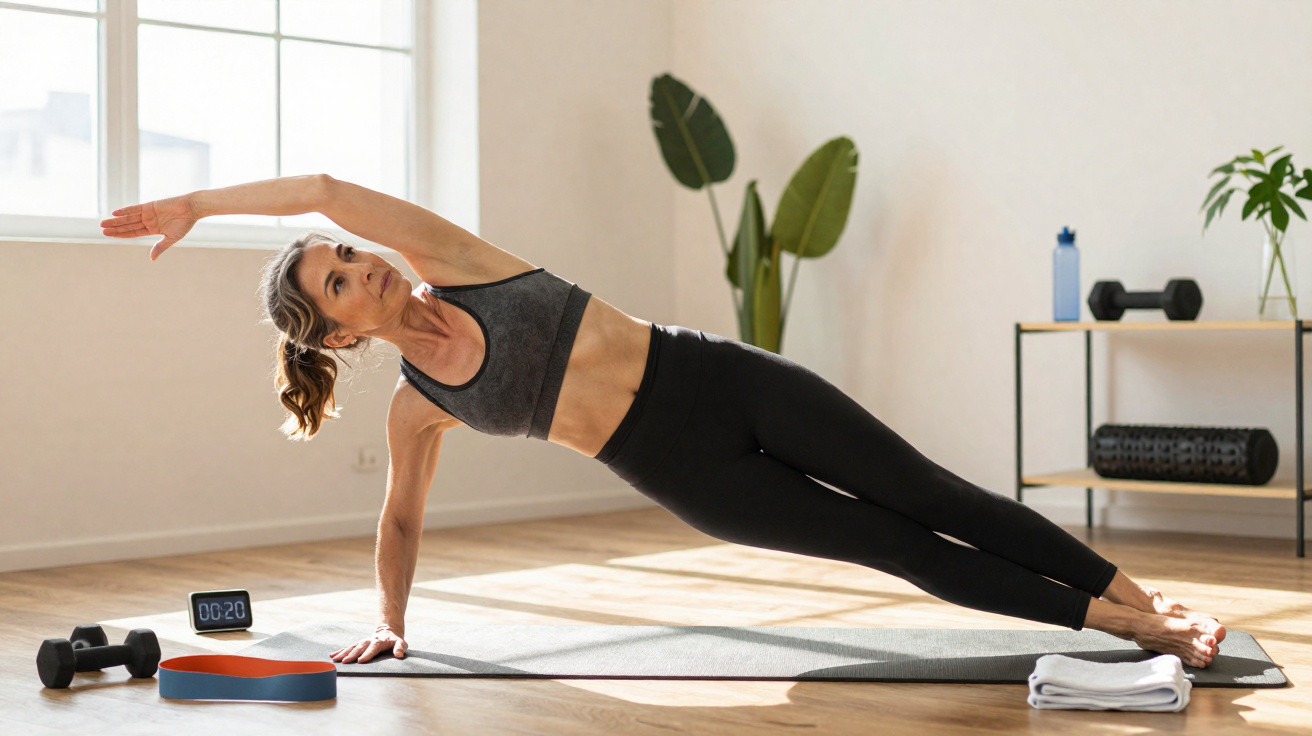
If you are over 50 and have noticed changes in your posture or that your lower back complains more than it once did, the 20-20-20-20 method may be worth exploring. It has become popular among people seeking a straightforward workout without a gym, aimed at building a firmer core and giving the spine greater protection.
The straightforward principle behind the 20-20-20-20 method
Its name explains the format. The 20-20-20-20 method structures a workout into sets of 20 repetitions or 20 seconds, according to the variation being followed. There is no single fixed routine, although every version is built around the same uncomplicated approach.
One of the best-known versions specifically targets the core. Performed on an exercise mat, it uses two blocks of exercises, each repeated 20 times. No dumbbells, resistance bands or other extra equipment are required.
- Controlled repetitions: perform every movement slowly and without rushing, so that the intended muscles do the work.
- ⏱ Blocks of 20: sets consist of 20 repetitions or 20 seconds for each exercise.
- No equipment: it can be done at home, in the gym or even outdoors.
- Core focus: it strengthens the abdominal and lower-back muscles to support the spine more effectively.
- Better balance: it can help improve stability in everyday life.
Can this make a difference to your routine after 50?
As the years pass, the body naturally loses muscle mass and bone density. Keeping the core strong therefore becomes important for protecting the spine and making ordinary daily tasks easier.
A workout such as the 20-20-20-20 method supports this by working the deep abdominal and lower-back muscles. Its effects can be seen in posture, balance and readiness for everyday activities.
The detail that makes this workout genuinely effective
Personal trainer Chris Zaremba created one variation especially for people over 50. It brings together exercises for the main muscle groups, cardio and stretching across four workout blocks.
The version designed for people over 50
Technique comes before everything else
Beginners do not need to complete all 20 repetitions in one go. The advice is to start with five, then gradually increase the number while respecting your own pace.
The lowering phase of each movement is another important consideration. It should take roughly twice as long as the effort phase, because resisting gravity places greater demands on the muscles.
If fatigue sets in before the end of a set, it is best to stop. Carrying on with poor technique raises the risk of injury and reduces the training benefit.
A strong core changes more than you might expect
Core strengthening is about more than appearance. It can improve posture, help prevent lower-back pain and make simple activities feel safer, such as carrying shopping bags or getting up from the sofa.
It also supports coordination and body control, which become increasingly valuable with age as balance needs more attention.
From the exercise mat to everyday life: what comes next
One appealing feature of the 20-20-20-20 method is that it can be adjusted as each person progresses, gradually adding more load, more time or new exercises to the workout.
Ultimately, this workout shows that getting stronger after 50 does not have to be complicated. Sometimes, a simple number and a good measure of consistency can make all the difference.
If this workout has made you want to try it, share it with someone else who is also looking after their body after 50.



Comments
No comments yet. Be the first to comment!
Leave a Comment