
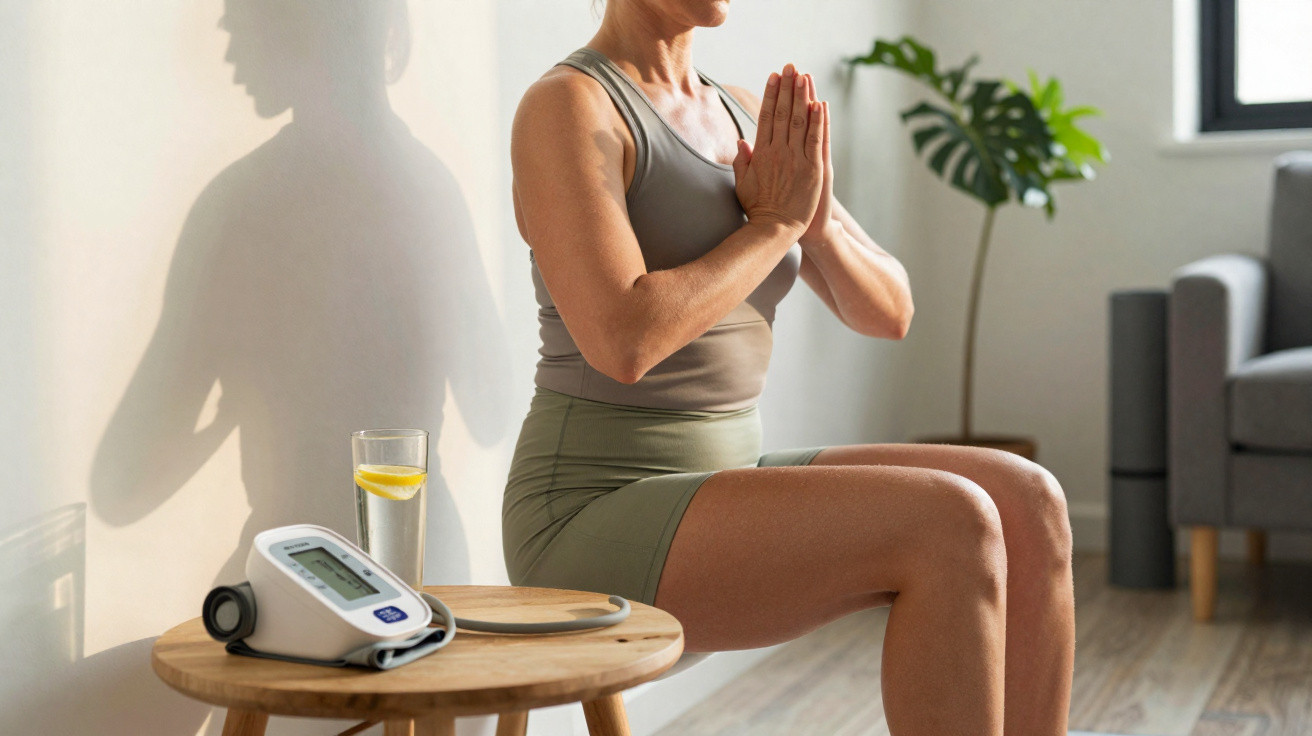
Exercise can do a great deal for heart health. Yet the prospect of going to the gym or heading out for a run can discourage some people from taking part. For anyone who already has a heart condition, this sort of dynamic exercise may also be unsafe.
Fortunately, vigorous workouts are not essential for achieving cardiovascular benefits. Heart health can even be improved by staying in one position and making a determined effort not to move.
Known as isometric training, this approach is gaining popularity for lowering blood pressure and hypertension, while also building strength and muscular stability.
To develop strength and force, muscles would usually change length as a movement is performed. Squats and bicep curls, for instance, both make the muscles change length during the exercise.
With isometric training, however, you simply tense the muscles. This produces force without requiring the joints to move. The more intensely a muscle contracts, the greater the force it creates – and a more forceful muscle enables us to perform movements more powerfully.
Adding weight to an isometric exercise makes the muscle contract with still greater intensity. Wall sits and planks are both examples of isometric contractions.
These exercises involve a high degree of "neural recruitment" because the contraction has to be sustained. They are therefore effective at engaging specialised neurons in the brain and spinal cord, which have an important role in every movement we make, whether voluntary or involuntary.
Higher levels of neural activation recruit more muscle fibres, generating more force. This can consequently result in strength improvements.
Strength and power athletes have long used isometric exercises to prepare their muscles to produce high levels of force through activation. Research also indicates that isometric exercises can benefit other aspects of health, including lowering hypertension and improving blood flow.
Why isometric training supports heart health
There are two main reasons why isometric exercises can be so beneficial for the heart.
As a muscle contracts, its size increases. This compresses the blood vessels that supply the muscle, restricting blood flow and increasing pressure in the arteries through a mechanism called the "pressor reflex".
Once the contraction is released, blood suddenly rushes into the vessels and muscle. This flow delivers more oxygen and, crucially, nitric oxide to the blood vessels, making them widen. Blood pressure then falls as a result. Over time, this process can make the arteries less stiff, potentially reducing blood pressure.
Restricting blood flow during an isometric movement also decreases the oxygen available to cells for normal function. This prompts the release of metabolites, including hydrogen ions and lactate. These stimulate the sympathetic nervous system, which governs our "fight of flight" response. In the short term, this raises blood pressure.
When isometric exercise is repeated over a number of weeks, though, sympathetic nervous system activity declines. Blood pressure is then lower and the cardiovascular system is placed under less strain, making these exercises beneficial for the heart.
Isometric exercise and blood pressure reductions
Isometric exercises may offer greater heart-health benefits than other forms of cardiovascular exercise. One study comparing isometric exercise with high-intensity interval training found that isometrics produced significantly larger reductions in resting blood pressure during the study period, which lasted between two and 12 weeks.
How to use isometric exercise
For people using isometric training to lower blood pressure, the recommendation is to hold each isometric contraction for two minutes at roughly 30-50% of maximum effort. This is sufficient to prompt physiological improvements.
Start by completing this four times a day, three-to-five times a week, concentrating on the same exercise. With progress, you can introduce different exercises, add weights, or include more than one isometric exercise.
A static squat, wall sit and plank are useful isometric exercises for beginners. Even in these brief exercise sessions, heart rate, breathing and arterial pressure will rise – the same reactions seen with more conventional whole-body activities, such as cycling and running.
Beneficial changes in blood pressure generally begin to appear around 4-10 weeks after beginning isometric training, although this will depend on an individual's health and fitness when they start.
Isometric training seems to offer a straightforward, low-intensity form of exercise with substantial cardiovascular health benefits, while demanding little time compared with other workouts.
Dan Gordon, Professor of Exercise Physiology, Anglia Ruskin University; Chloe French, PhD Candidate in Sport and Exercise Science, Anglia Ruskin University; and Ruby Cain, PhD Candidate, Anglia Ruskin University
This article is republished from The Conversation under a Creative Commons licence. Read the original article.






Comments
No comments yet. Be the first to comment!
Leave a Comment