

The woman sitting in the salon chair had an immaculate line-up of products in her bag.
Vitamin C, retinal, a hydrating serum, SPF 50 – the full Instagram-worthy shelf. But when she looked in the mirror, her skin appeared… tired. Not terrible. Simply lacklustre. Beside her, an older woman with barely any make-up waited for her blow-dry. Her skincare routine? “Soap and a bit of cream,” she laughed. Light caught her face in a way it did not catch the younger woman’s: luminous, at ease and alive.
The contrast was not about what they put on their skin. It was about the way they touched their faces – or, more accurately, how seldom they truly did.
There is a low-key practice that can change the appearance of skin without introducing a single extra product.
The glow most people seek in a bottle is already in their hands
Ask any facialist about clients with genuinely glowing skin and they will often point to the same thing. Those clients touch their skin purposefully rather than aggressively. They spend thirty unhurried seconds working in cleanser instead of scrubbing it away as though it were a mark on the sink. They glide, press and pause. Their bathroom routine resembles a brief daily ritual rather than another task.
We do not often discuss this because it does not make for compelling social media content. You cannot do a “haul” of a habit. There is no brand to tag in the way you run your fingers along your jawline. Still, the understated gap between hurried rubbing and conscious contact can gradually influence circulation, muscular tension and the way skin sits over bone.
Glow is not just chemistry. It is behaviour.
A London facialist spoke about a client who arrived exhausted after a difficult year. Her products had not changed for months, yet her skin had shifted from bouncy to dull and blotchy. She had breakouts along her jaw, redness around her nose and make-up catching on texture that had not been there before. It was the familiar panic of “my products stopped working”.
The client expected to be prescribed a new serum. Instead, the facialist asked her to demonstrate how she cleansed her face. She rapidly scrubbed her cheeks in harsh circles, pulled at her eyes with a cotton pad and slapped on moisturiser as if she were running late. The facialist gave a quiet laugh and said, “Your routine is fine. Your hands are the problem.” During the next session, they retrained her touch rather than changing her shopping list.
Three weeks afterwards, she returned using exactly the same products – but with a markedly different-looking face.
The explanation is straightforward: circulation and tension. Every touch we give our skin sends tiny, ongoing signals. Fast, forceful movements may leave the surface mildly inflamed, the barrier under stress and the muscles tense. Gentle, considered contact can have the reverse effect. It brings blood nearer the surface, supports lymphatic flow and encourages facial muscles to relax rather than clench.
That is why people leave a facial looking radiant before their serum has fully absorbed. The therapist’s hands have roused the skin. Nothing more magical is required. The glow is often just very local, very focused blood flow meeting relaxed muscles and a calm nervous system. Once you recognise it, it becomes difficult not to notice it in your own reflection.
The subtle skincare habit: make application a micro-massage
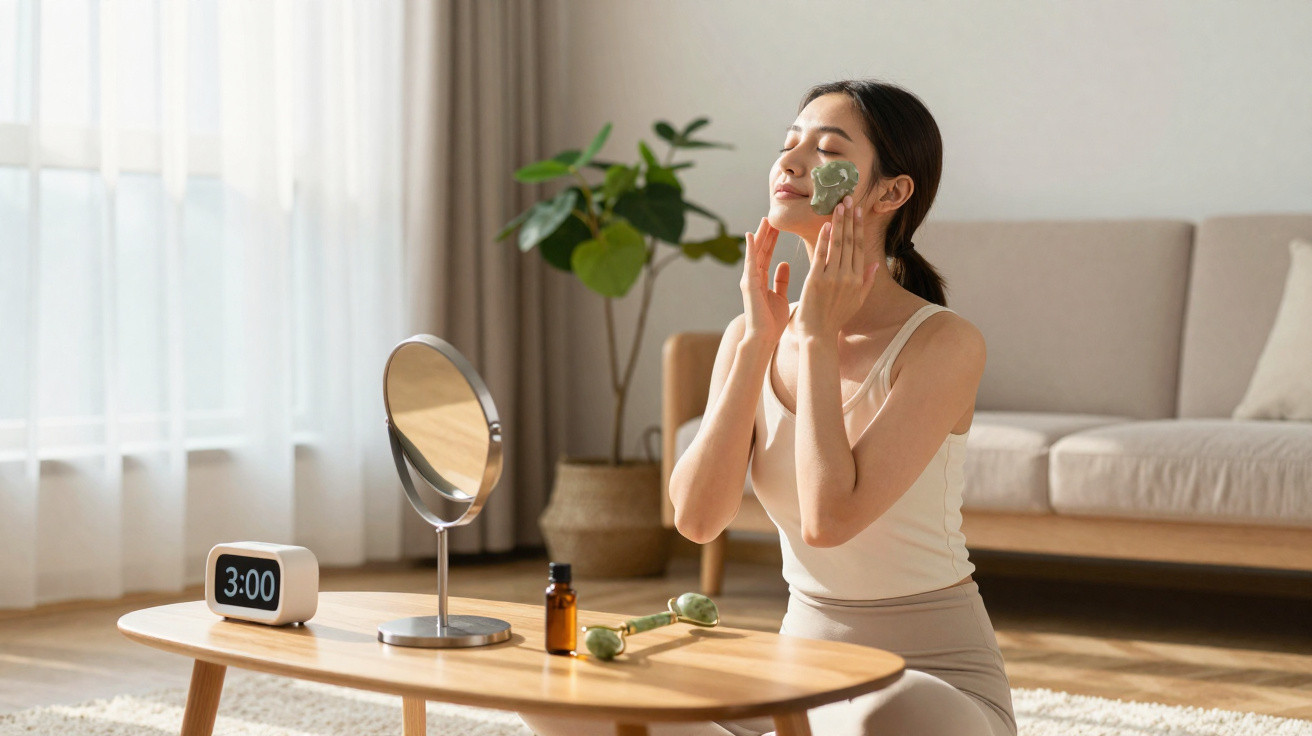
The quiet practice is simple: whenever you touch your face, turn it into a mini massage rather than a purely mechanical job. Use the same cleanser, moisturiser and SPF. Bring different energy, and the result can differ too. Think of your hands as tools for shifting fluid, stimulating circulation and easing tension, not merely for spreading product.
Begin when cleansing. Dampen your face and spread your cleanser from the centre outwards. With your fingertips, use slow upward and outward sweeps over the cheeks, light circular motions around the nose and feather-soft movements around the eyes. Spend ten seconds on the forehead, working from the middle towards the temples. Then glide your knuckles along the jawline, from chin to ears.
It adds only one minute, yet the difference in how awake your skin appears after rinsing can be surprisingly noticeable.
At night, most people hurry through this stage. They are weary, the day has felt heavy and the bathroom mirror seems like one more item on the list. The face is then scrubbed as though it were a dirty plate. The neck is ignored, the jaw is clenched and the shoulders have crept towards the ears. On particularly bad days, frustration with our skin can make us take it out on it. A red patch? Scrub it harder. A breakout? Pick at it “just a little”. We have all been there.
The adjustment is almost laughably minor. Reduce your speed a little. Lay your fingertips flat rather than prodding. Glide instead of pulling. When applying serum, press it in with open palms, moving from the centre of the face outwards. For moisturiser, use soft upward strokes, as though smoothing creases from silk rather than rubbing at a stain.
Let’s be honest: nobody really does this every day. That is absolutely fine. Even doing it three evenings a week can be enough to spot a change in how your skin “wakes up” in the morning.
During a workshop, one facial trainer put it this way:
“Products feed the skin. Your touch teaches it how to behave.”
What she meant was that your handling of your face creates a pattern to which the skin responds. Persistent tension, friction and hurried motions? Skin may react with sensitivity, dullness or a tight, drawn appearance. Calm, rhythmic and respectful touch? It will often answer with a softer tone, a natural sheen and less angry redness.
- Choose one “slow touch” stage daily: cleansing, serum or moisturiser.
- Exhale slowly as you massage to release tension in the jaw and forehead.
- Avoid harsh exfoliating tools when your skin feels hot or delicate.
- At night, use gentler pressure as your nervous system begins to settle.
- Twice weekly, pause and properly observe your skin while touching it, rather than focusing only on perceived flaws.
Glow as a side effect of living gently with your own face
On a packed train on a Monday morning, you can often sense who had a hurried, tense evening and who allowed themselves that small extra measure of care. This is not about having poreless skin. It is about a quiet, rested luminosity that no sparkling highlighter can create. Skin that appears to know it is being treated kindly carries itself differently.
This practice sits between skincare and our relationship with our reflection. On a difficult day, the mirror can feel like hostile ground. On a better one, it becomes a moment to check in. The same hands can either punish or soothe. The distinction shows, even when it is hard to put into words. On screen, we call it glow; in person, it feels like softness.
Treating application as a micro-massage has another effect: you begin to notice your skin properly. Not with harsh judgement, but with a sense of, “what is happening here?” You may identify dehydration before it turns into flakiness, notice a stress breakout before it spreads or feel jaw tension before the headache arrives. That awareness alone can prevent you from panic-buying another serum whenever something changes.
There is a quiet emotional layer too. On the surface, this is about circulation and lymph. Underneath, it is about respect. Spending 60 extra seconds moving slowly over your own face is a small way of saying, “I’m on my own side”, including on untidy days. For the nervous system, that matters.
Most of us know the experience of arriving for a professional facial stressed and dull, then leaving feeling lighter and brighter, without anyone having transformed our entire lives. Yes, part of that is skill. The other part is simply that someone spent twenty or thirty minutes touching your face with care, rhythm and attention. Each evening, you can borrow a small portion of that effect.
There is no algorithm-friendly way to market this habit. There is no new bottle or expensive label. It does not belong in a haul, and nobody in the office will ask, “What are you massaging with your hands these days?” Yet that is precisely why it works. Quiet habits do not fall out of fashion. They simply continue working beneath the noise, day after day.
The next time you are standing in front of the mirror, pay as much attention to your fingertips as you do to your fine lines. Notice your pace. Notice where you rush and where you almost flinch at your reflection. Then slow one part down by twenty seconds. That is all.
Glow can certainly be a goal. It can also be a side effect of choosing to live more gently with your own face.
| Key point | Detail | Benefit for the reader |
|---|---|---|
| Touch over products | Changing the way you apply your current products can boost glow without buying anything new | Improves skin radiance at any budget |
| Micro-massage habit | Using slow, upward and outward strokes while cleansing and moisturising | Supports circulation and relaxation in under two minutes |
| Consistency over perfection | Practising this a few times a week is enough to notice change | Makes the habit realistic and sustainable in everyday life |
FAQ:
- Do I need a special oil or tool to make this work? No. You can use any cleanser, serum or cream you already own. The important part is using slower, lighter and more intentional movements with your hands.
- How long should a “micro-massage” take? Roughly 30–60 seconds per step is sufficient. Treat it as an upgrade to your existing routine, not an entirely new one.
- Can this replace professional facials?





Comments
No comments yet. Be the first to comment!
Leave a Comment