
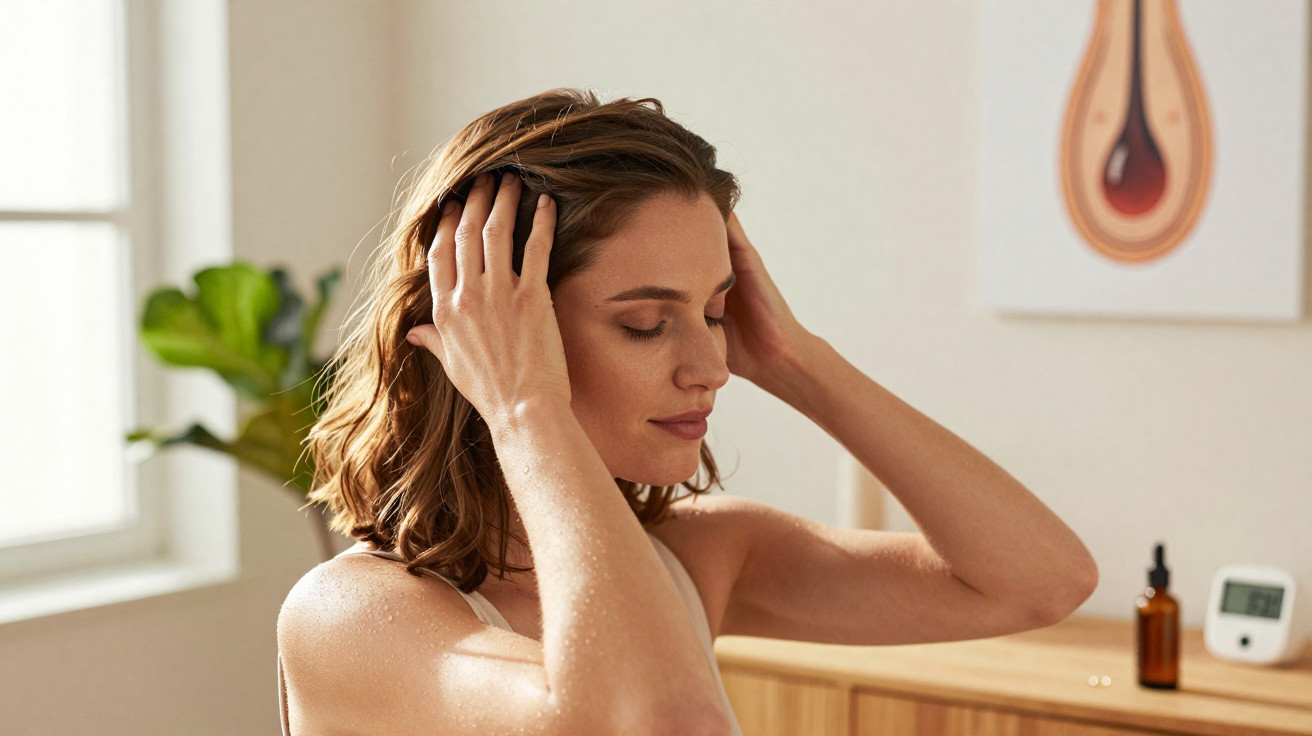
You swipe past yet another polished serum advert and find your hand drifting to your hairline. Your friends recommend rosemary oil, your barber tells you “less shampoo”, and a trichologist on TikTok repeatedly mentions “tension in the galea.” Each suggestion leads back to one understated practice: intentional scalp massage. This is not a spa-style indulgence. It is a method designed to encourage blood and oxygen towards sluggish roots while preventing tension from constricting them. What matters most is the way your fingers travel, and the sequence they follow.
I once saw a commuter in a navy jumper bend over a sink, settle the pads of his fingers at his hairline and work in unhurried circles, as though rotating tiny coins beneath the skin. There was no hurry in it; he simply kept to a rhythm that felt older than the habit itself. Soon afterwards, the tingling began.
What scalp massage really does for your follicles
Hair follicles depend on a small-scale system beneath the skin, in which blood circulation and mechanical signals can determine what flourishes and what slows down. When trichologists recommend massage, their aim is improved circulation and reduced scalp tension, both of which are known to affect hair behaviour. Most of us know the feeling of a tight crown after a long day, as though we have been wearing an unnoticed helmet.
A small Japanese study gave this some measurable context: four minutes of scalp massage each day increased hair thickness across several months in healthy men. It was not a miracle, but a gentle prompt. A London client I met documented his progress in photographs and noticed baby hairs around his frontal hairline after eight weeks of consistent, light massage. He had not switched shampoo; he had changed his pressure and routine.
There is a physical element as well. Muscles that remain tight around the temples and the back of the head can compress the tissue that supplies your follicles. Massage helps release that hold. Picture it as restoring softness to areas where stiffness has taken up room. Circulation can move more easily, nutrients move with it, and the follicle’s cycle faces fewer disruptions.
The trichologist-approved scalp massage sequence, step by step
Begin with circle-warm: rest your finger pads along the front hairline, then create slow circles of one centimetre, working from the centre out towards the temples for 60–90 seconds. Follow with the temporal sweep: position your fingertips above both ears and draw them upwards towards the crown in firm strokes for one more minute. Next comes the occipital anchor: press both thumbs into the base of your skull, hold for three deep breaths, then release with tiny circular movements.
Then try the crown lift: comb your fingers from the nape towards the vertex, lightly raising the skin as though you are making micro-space beneath the scalp rather than pulling across the hair. Include temple presses, using three counts in and out, before ending with a slow lymphatic drain-run feather-light strokes behind the ears and down either side of the neck. Realistically, few people will do this daily. Even two to four sessions weekly can still support your roots.
Use moderate pressure-more like pressing a ripe peach than kneading dough.
“You want movement in the scalp, not friction on the hair shaft,” says one trichologist. “If the skin glides, you’re there. If hair squeaks, you’re too aggressive.”
Use these as cues rather than strict rules:
- Spending one minute on each zone is more useful than giving every area ten seconds.
- Use your finger pads rather than your nails.
- Oil is not essential, though some slip can be useful.
- Breathe slowly to ease tension in your shoulders.
- Stop if you experience soreness the following day.
Your fingers should guide circulation, not battle through knots.
Make scalp massage a habit without irritating your scalp
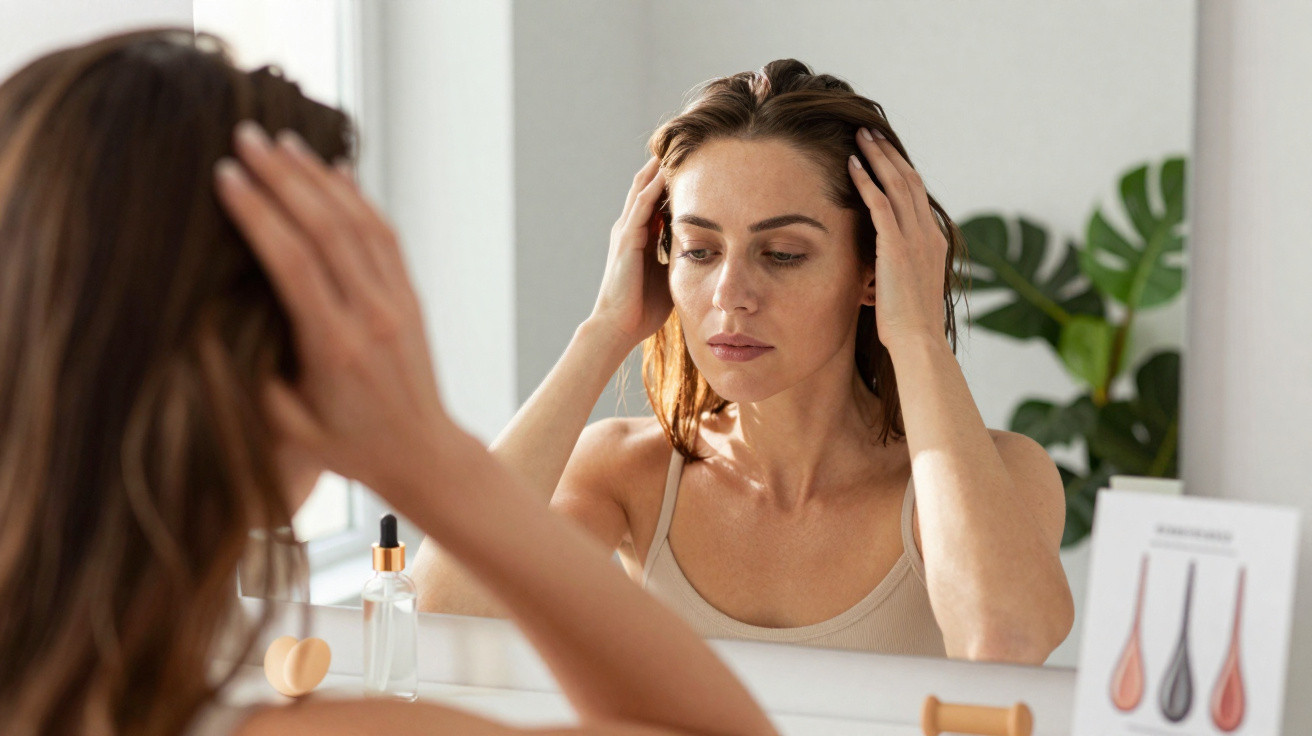
Tie the ritual to moments already built into your day: after shower steam, during a podcast or while your conditioner is left to sit. Hair responds better to rhythm than force. If your scalp is oily or flaky, reserve it for clean-scalp days and use only a pea-sized drop of lightweight oil when you need extra glide. Your setting matters as well. Low lighting, a song you play repeatedly and two to four minutes set aside can all help. You are showing your nervous system that this is a moment of rest for your head, rather than one more task on your list.
| Key point | Detail | Benefit for the reader |
|---|---|---|
| Target the right zones | Hairline, temples, crown, occipital ridge | Concentrates on areas where tension and thinning often begin |
| Pressure and pacing | Moderate, slow circles and lifts, 2–4 minutes | Encourages blood flow without causing irritation |
| Sequence order | Warm front, sweep sides, anchor back, lift up, drain down | Creates a pattern the scalp “understands” |
FAQ:
- How long before I notice changes? Most people describe their scalp as feeling “lighter” immediately; noticeable shifts in density can take 8–12 weeks of regular practice.
- Do I need oil for scalp massage? No. A very small amount can improve glide on dry scalps, but avoid it if you are prone to product build-up.
- Can massage regrow lost hair? Massage helps support a healthier environment. It cannot reverse scarring hair loss, and outcomes vary according to genetics and hormones.
- Is a massage tool better than fingers? Fingers provide more useful feedback. Soft silicone tools may help, provided the pressure remains gentle.
- When should I avoid massage? Avoid it on infected or inflamed skin, after fresh transplants or during active flare-ups of a condition. Speak to a clinician if you are unsure.


Comments
No comments yet. Be the first to comment!
Leave a Comment