
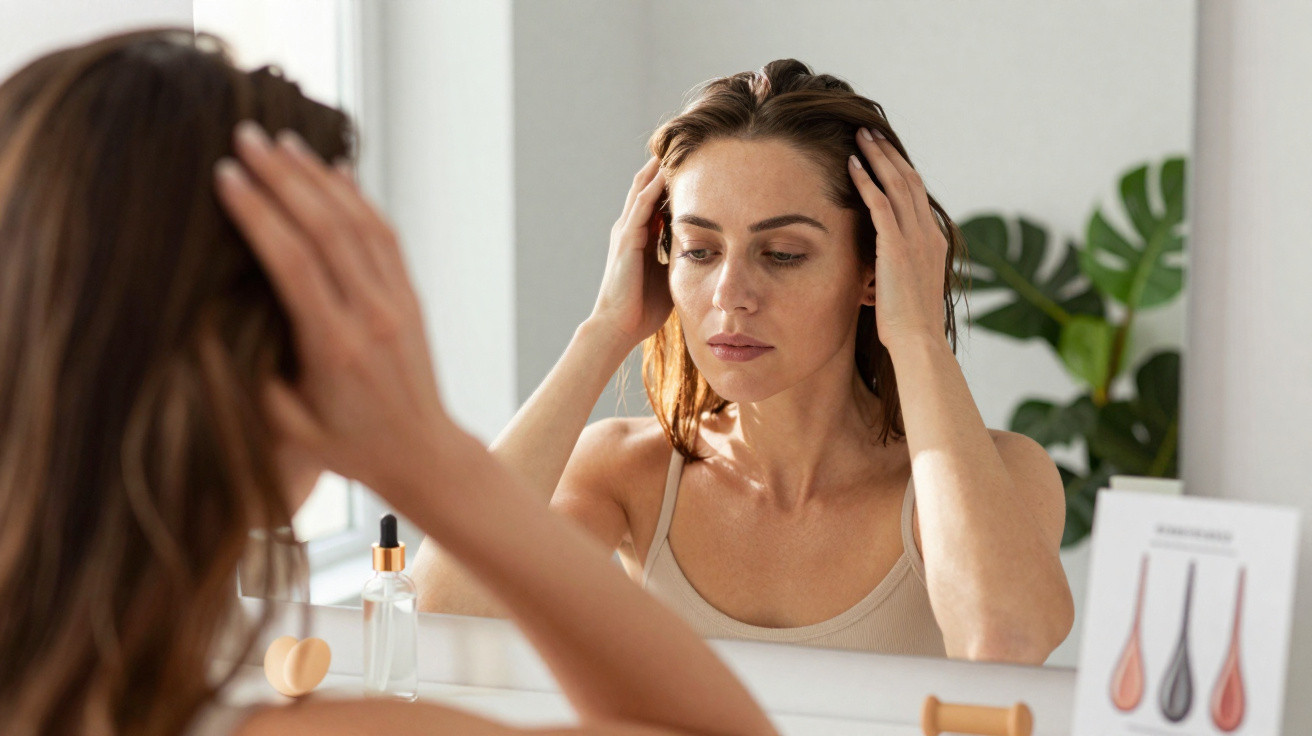
“I laughed, but later, at home, I stood in front of the mirror for far too long, ran my fingers over my roots and wondered whether there really were still ‘dormant’ hair follicles there. In forums, TikToks and Facebook groups, I kept coming across the same claim: one particular, highly intensive scalp-massage ritual could wake those follicles and produce dramatic regrowth. Some people swear by it; others call it nonsense. And caught in the middle are trichologists - hair specialists - who argue fiercely about whether this routine is a game changer or simply a waste of time. The further I looked into it, the clearer it became: a few seemingly simple hand movements conceal a rather major dispute.”
The controversial scalp-massage ritual everyone is suddenly discussing
When trichologists refer to this ‘wake-up massage’, they do not mean gently stroking your head while washing your hair. They mean a disciplined routine that is almost athletic: press the finger joints deeply into the scalp, lift it, shift it and move in circles - every day for 10 to 20 minutes. The theory is that mechanical stress stimulates microcirculation and tissue remodelling, supposedly coaxing dormant follicles back into action. Before-and-after images circulate on social media showing receding temples apparently looking fuller and thinning partings seemingly disappearing. You scroll, stare and zoom in. Then you wonder: Photoshop, a lucky exception, or genuine biology?
On specialist forums, people document their ‘hair journey’ much like fitness transformations. One 34-year-old IT worker, for instance, posts photographs of the top of his head: the first shows a broad, pale parting, while the third, taken after nine months of daily massage, makes the parting look noticeably narrower and the hair darker and denser. He says he changed nothing else - no minoxidil drops, no PRP treatments, just this single ritual. Dozens of comments appear beneath it: “What exact technique do you use?”, “How firmly do you press?”, “Does it hurt?” Right alongside them, a frustrated woman reports that she has been massaging for a year without spotting even one new hair. One method, two entirely different experiences.
Trichologists are unusually divided on the subject. One camp points to small studies in which participants using structured scalp massage had measurably greater hair density after 6–8 months. They cite increased blood flow, improved oxygen transport and mechanical stimulation of stem cells within the follicles. The opposing camp is dismissive: there is too little evidence, the groups are too small and the placebo effect is too great. It warns that overly rough kneading can trigger inflammation, hair breakage or increased hair loss, particularly on a sensitive or already inflamed scalp. The sober truth is that there are not yet enough robust facts to either celebrate or dismiss this method conclusively. Meanwhile, millions of people stand before the mirror wondering whether they should try it.
How the scalp-massage routine is meant to work
Anyone intending to take the routine seriously needs more than a quick head rub while watching Netflix. Trichologists who support it recommend a defined structure. Start with a dry or lightly oiled scalp, so that the fingers do not tug abruptly. Next, place the palm on the head, spread the fingers and use the fingertips not to rub the scalp, but to properly move it - as though you were ‘sliding’ the skin back and forth over the skull. Spend 30–60 seconds on each area: the front hairline, temples, parting and back of the head. Follow this with circular movements, again using pressure rather than friction. The whole process should take 10–15 minutes, ideally every day but at least 5 times a week. Some trichologists combine it with lukewarm oil treatments, while others strongly advise against oil for people prone to an oily or seborrhoeic scalp.
Many beginners set themselves completely unrealistic targets. They expect baby hairs to appear within three weeks. When this does not happen, disappointment follows - often accompanied by self-blame. Yet even the most optimistic experts say that anyone hoping for realistic results must think in months, not days. And, honestly, nobody maintains this ritual every day of the year without missing sessions. That is exactly where many people falter. They massage far too aggressively because ‘more pressure = more effect’ sounds logical. Or they stop during the first ‘shedding weeks’, when it seems that more hairs are coming out during massage. Trichologists explain that older, already weakened hairs can sometimes shed more quickly as circulation increases. For those affected, however, it still feels like a setback rather than an intermediate stage.
Scalp health, risks and realistic expectations
Another common mistake is forgetting about the scalp itself. For people with dandruff, seborrhoeic dermatitis or low-level inflammation, intensive kneading can simply create more problems. Instead of ‘waking’ follicles, it may lead to increased itching, redness and burning. Anyone also using harsh brushes, very hot water or aggressive shampoos is creating the perfect storm. The wish for fuller hair can then turn into constant irritation and a tight feeling across the scalp. More critical trichologists see this as one of their principal concerns: a TikTok routine is suddenly being used as a ‘treatment’ without proper diagnosis, even though the actual cause - androgenetic alopecia or autoimmune processes, for example - may lie elsewhere entirely.
“Massage can be an enhancer, but not a miracle cure,” says Berlin trichologist Dr Jana K., who recommends daily scalp massage herself - but only after a thorough diagnosis. “Anyone with hormonally related alopecia often needs medication as well. Massage can help follicles remain in the growth phase for longer, but it is not a magic formula.”
- Think long term: Anyone who gives up after 4 weeks will almost never see changes. 6–12 months is more realistic.
- Use gentle pressure rather than force: the scalp may be worked, but it should not burn or remain painful for days.
- Find your own pattern: Some people do well with 2×10 minutes/week, while others swear by a short daily routine.
- Have your scalp checked: if you have severe itching, dandruff or inflammation, see a dermatologist or trichologist first.
- Set expectations straight: A smooth, scarred patch will not become a teenage fringe - but weak, fine fuzz sometimes can improve.
Between miracle claims and “It does absolutely nothing” lies a quiet grey area in which many real experiences take place. Some people slow their hair loss with this routine, achieve fuller-looking roots and feel more comfortable in photographs again. Others see no visible difference despite their discipline - apart from realising that they had never previously allowed this much physical contact with their own head. Ultimately, this debate forces an uncomfortable question: how far will we go to see a few more centimetres of fullness in the mirror, and when does it still feel like self-care rather than a desperate pursuit?
| Key Point | Detail | Added Value for the Reader |
|---|---|---|
| Understanding the massage routine | Daily, structured scalp massage using pressure and movement of the skin, rather than mere stroking | Readers can follow the controversial ritual correctly rather than rubbing aimlessly |
| Assessing the risks realistically | Excessive pressure, an inflamed scalp or unrealistic expectations can quickly lead to frustration or damage | Helps avoid typical mistakes and assess individual circumstances soberly |
| Combining it with professional diagnosis | A trichological or dermatological assessment before starting, particularly for severe or sudden hair loss | Readers can identify when DIY routines make sense - and when professional support should take priority |
FAQ: Scalp massage and hair loss
- Question 1 Does this scalp massage work for every type of hair loss?
- Answer 1 No. For genetically related alopecia, it may offer support but cannot replace medication. With scarring alopecia or severe inflammation, it may even be harmful. Without a diagnosis, it remains an experiment.
- Question 2 How firmly can I press without damaging my hair?
- Answer 2 The pressure should be strong enough for you to noticeably move the scalp, but not so strong that it burns afterwards or remains sore for days. A few loose hairs in the sink are normal; painful patches or scabs are not.
- Question 3 When can I expect the earliest results?
- Answer 3 Trichologists generally refer to 3–4 months before changes in the hair cycle may become apparent, and 6–12 months before differences in volume are visible. Early signs can include fine baby hairs at the hairline.
- Question 4 Can I combine massage with oil, caffeine serums or tonics?
- Answer 4 Yes, if your scalp tolerates them. Light oils or tonics can improve slip and distribute active ingredients more effectively. If your scalp is very oily, flaky or inflamed, seek medical advice first.
- Question 5 How can I tell that this routine is not a good idea for me?
- Answer 5 If hair loss suddenly becomes much more severe, or your scalp itches intensely, burns, weeps or flakes, stop and consult a dermatologist or trichologist. Persistent headaches after massage are also a warning sign.




Comments
No comments yet. Be the first to comment!
Leave a Comment