
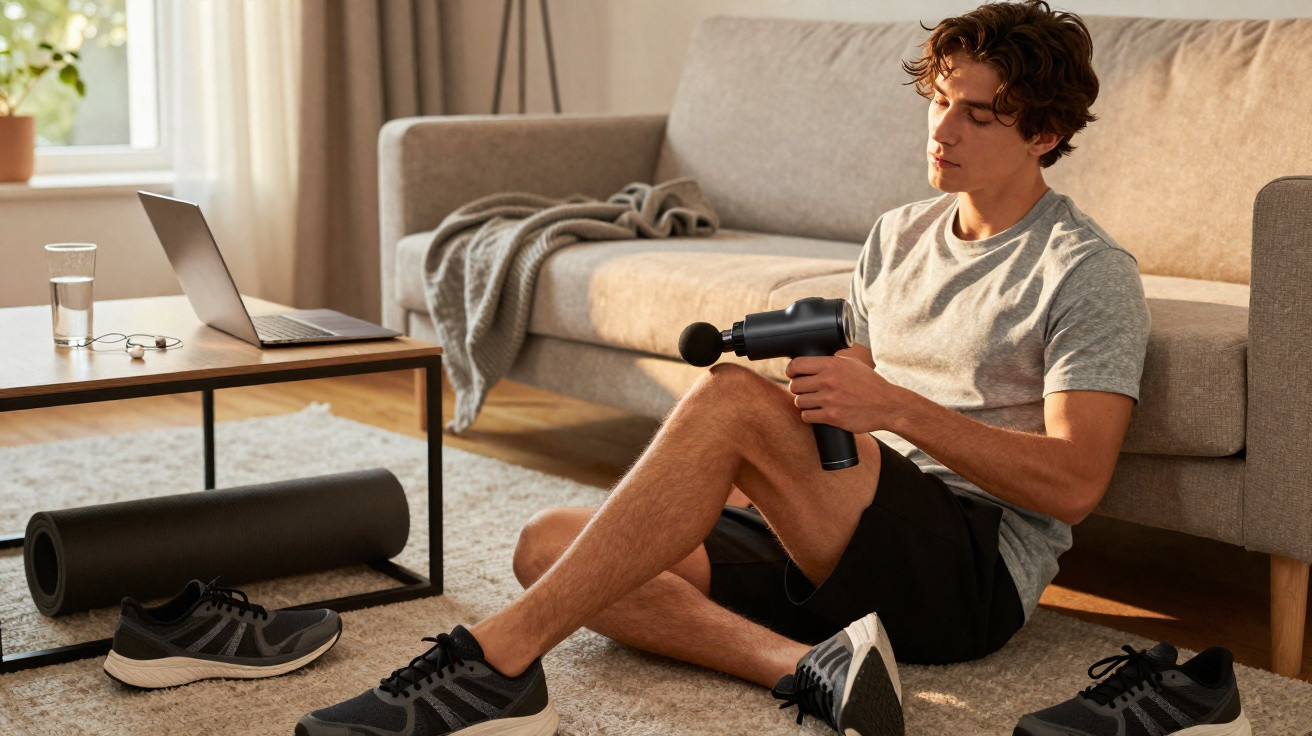
The vibration reaches your skin first: a rapid drumming sensation that seems to travel further than your fingertips could. It is Tuesday evening, your laptop was shut an hour later than intended, and your shoulders feel as though they have been set in concrete. The gym workout from two days ago is still lodged in your quadriceps. Meanwhile, the foam roller in the corner remains untouched, silently passing judgement.
Recovery looks polished on social media: athletes filmed in slow motion, immaculate lounges and faces radiating calm. Most of us, however, stretch for thirty seconds, spend twenty minutes scrolling, and hope everything will feel better tomorrow. You pick up the compact, matte-black Blackroll Fascia Gun, feeling equal parts doubtful and desperate. Its weight feels solid in the hand. Its sound is rather less reassuring.
After two minutes, your legs seem unexpectedly lighter and your back feels curiously alert. Nothing is cured, and there is no miracle involved. It is simply… different. That is when it starts to become interesting.
Muscle fatigue, tension and a vibrating gun
Muscle fatigue rarely announces itself dramatically. Instead, it slips in after lengthy workdays, extra gym sets or rushed runs in tired trainers. One morning you spring out of bed; the next, you descend the stairs as though you have suddenly aged ten years. This heavy, dull tiredness is not merely soreness. It affects the way you move, sleep and even the patience you have for everyone around you.
Massage guns claim to interrupt that pattern. There are no appointments to book and no awkward conversation with a stranger while you lie half-dressed on a treatment table. You simply hold a device, spend a few minutes on each tight area, and hope to regain some comfort without giving up your evening. The Blackroll Fascia Gun fits neatly into that proposition: understated, portable and presented as science-led rather than showy. In theory, one hand is all you need to soothe a day’s worth of tension.
Consider a typical day working from home. You may spend eight, ten or even twelve hours folded over a laptop, with your neck angled forwards and shoulders gradually rising towards your ears. Research indicates that extended sitting may restrict blood flow to the legs and make connective tissue stiffer, leaving muscles with less oxygen and slower recovery after exercise. The result can be hamstrings that never feel fully recovered and trapezius muscles that ache even on days when you avoid the gym. A fascia gun cannot alter your posture or reduce your workload. Used sensibly, though, it can deliver fast pulses into the tissue, encouraging circulation and helping overworked muscles release a little more quickly.
The Blackroll Fascia Gun is designed for that middle ground: discomfort that is not an injury, but is far from spa-like indulgence. It addresses the everyday stiffness that gradually drains your energy - the “I’m fine, but not really” state in which many adults exist. This small device is intended to occupy that same space.
Testing the Blackroll Fascia Gun in everyday life
On my first evening with the Blackroll Fascia Gun, I started with my calves. They were mildly tight after a run, but nothing severe. I attached the round head, selected a middle speed setting and applied it to the familiar knotted section just above the Achilles tendon. Initially, the percussion felt quite sharp, rather like a firm finger tapping one point at speed. Around thirty seconds later, the surrounding muscle had warmed up and felt noticeably freer, as if an unseen control had been turned down.
Over the following days, a clear pattern developed. Five minutes on the quadriceps after squats changed next-morning stiffness from “stairs are the enemy” to “I can walk like a human”. Treating my upper back before bed did not remove the day’s stress, but I fell asleep more quickly and woke with fewer of those irritating, half-conscious shifts in position. A friend who tried it on persistent IT-band tightness described less “knife-like” pain while running, although the improvement arrived gradually across several sessions rather than in one dramatic moment.
In principle, the explanation is straightforward. The gun applies quick, controlled impacts to the muscles and fascia, increasing blood flow and raising tissue temperature slightly. Together, these effects can help move metabolic waste products, such as lactate, away from tired areas while bringing fresh oxygen in. The nervous system matters too: repeated stimulation may reduce pain signals slightly, so the area feels more relaxed and less risky to move. With regular use, your brain can begin to “trust” that tight area again, allowing a fuller range of movement without the constant internal warning signals.
Does it replace proper mobility work, strength, and rest? No. It works more like a shortcut out of the worst stiffness, making you more willing to do the rest. Let us be honest: nobody really does all of that every day. The Fascia Gun does not claim to package discipline into a box. It is simply a highly focused prompt in a better direction.
How to get the most from the Fascia Gun without damaging your muscles
The benefit does not come from using maximum speed until your skin feels numb. Begin on lower settings, treating the session as a gradual scan of your body. Run the attachment along the muscle’s length instead of concentrating solely on the knot. For the quadriceps, start just above the knee and move upwards, spending roughly 30–60 seconds on each section. For calves, follow a path from the Achilles tendon towards the back of the knee, then move slightly to one side and repeat.
Avoid bones and joints. Vibration in these areas tends to be unpleasant and offers little value. On the upper back and trapezius muscles, fit a softer attachment and allow the gun’s own weight to settle into the muscle as you move it, rather than forcing it down. For a complete lower-body session after training or prolonged sitting, aim for 5–10 minutes in total. That is usually enough to make a difference without leaving you overly stimulated or still buzzing afterwards.
A common error is to use the Fascia Gun only where discomfort is loudest. A tight lower back, for instance, can often be linked to stiff hips and hamstrings. Rather than attacking the sorest spot, give attention to the muscles connected to it. Another mistake is pressing too hard, as if pain were payment and greater suffering produced greater results. Your nervous system does not work that way. If you notice yourself clenching your jaw while using the gun, you have gone too far.
Timing deserves some care too. Strong percussion just before bed may make you more alert rather than calmer, particularly when used on large muscle groups. Save more intense sessions for earlier in the evening, then use gentler, briefer passes as part of a bedtime routine. If an area produces sharp or electric pain, or causes tingling down a limb, avoid it and speak to a professional. At-home tools should remain within the range of “helpful discomfort”, never “this feels wrong”.
“The gun won’t fix your lifestyle,” a physio told me, watching me test the Blackroll on my shoulders, “but it might finally give you the relief you need to change it.”
Several points became clear during several weeks of testing:
- Battery life: It lasted through several sessions without recharging, making spontaneous use much more likely.
- Noise level: It is neither whisper-quiet nor thunderous, so you can still listen to a podcast while using it.
- Portability: Its compact, almost unobtrusive form means it can stay beside the sofa instead of disappearing into a drawer.
- Versatility: The different heads allow you to move from large muscles to smaller, more sensitive areas within seconds.
There is also a quietly empowering emotional element to owning a device that lets you respond to discomfort immediately. On a Sunday evening. During a lunch break. On the living-room floor in gym shorts and old socks. We have all experienced that moment when we tell ourselves, “I’ll deal with it later”. The Fascia Gun reduces that postponement through one small, buzzing session at a time.
Where a fascia gun belongs in a real, imperfect recovery routine
After several weeks, the Blackroll Fascia Gun no longer felt like a novelty gadget; it became more like a toothbrush for my muscles. It is not miraculous, but it no longer felt optional either. On demanding training days when I did not use it, the difference was obvious: greater morning stiffness and more reluctance to sink into a deep squat or take the stairs two at a time. When I used it briefly while replying to messages or waiting for dinner to cook, my legs remained in a pleasing “used but functional” state instead of turning resentful.
There is a mental aspect as well. Spending five minutes focusing on one muscle group and genuinely noticing where it feels tender or relaxed can be grounding. After hours spent in your head, it provides a distinctly physical way to check in with yourself. The Fascia Gun does not require complete concentration; it slips this check-in into the gaps while a programme plays in the background or the kettle boils. That convenience is its true advantage. It does not demand a ritual; it works around the chaos.
Can a fascia gun remove every knot and resolve every ache? No. Chronic, unexplained or worsening pain still calls for medical advice, not stronger vibration. For the broad middle ground of routine fatigue, desk-related tension and post-workout stiffness, however, its purpose is remarkably clear. It offers enough relief to help you move more freely. That movement is what genuinely changes your tissue and your habits.
In a world where many options seem remote, costly or impractical, something small, physical, slightly noisy and ready on your shelf can alter the relationship you have with your body. Not through shouting, but through a gentle nudge. Evening after evening.
| Key point | Detail | Why it matters to the reader |
|---|---|---|
| Targeted relief | Rapid percussion increases blood flow and reduces localised stiffness in tired muscles. | It can help you walk, exercise and sleep with less discomfort after long days or hard workouts. |
| Easy to use at home | A compact, portable device with multiple heads and adjustable speeds. | It makes recovery practical on busy evenings, without appointments or specialist preparation. |
| Part of a wider routine | It performs best alongside movement, stretching, sleep and basic self-care. | It supports a more consistent, realistic approach to long-term muscle health. |
FAQ:
- Does the Blackroll Fascia Gun really help with muscle fatigue? It will not remove fatigue by itself, but many users notice less stiffness and “heaviness” in their muscles after short, regular sessions, especially after exercise.
- Is it safe to use every day? On healthy tissue, daily use at a moderate intensity and for a moderate duration is generally well tolerated, although painful or unusual sensations indicate that you should stop and rest.
- Can I use it instead of stretching? It is a complement rather than a substitute; the gun may make stretching easier by relaxing tight areas, but mobility still comes from moving through ranges.
- How long should a typical session last? Most people achieve good results with 1–2 minutes per muscle group and 5–15 minutes in total per session, rather than lengthy, aggressive sessions.
- Who should not use a fascia gun? Anyone with acute injuries, blood-clot concerns, serious cardiovascular conditions or unexplained pain should consult a healthcare professional before using one.




Comments
No comments yet. Be the first to comment!
Leave a Comment