
A simple board design could change that.
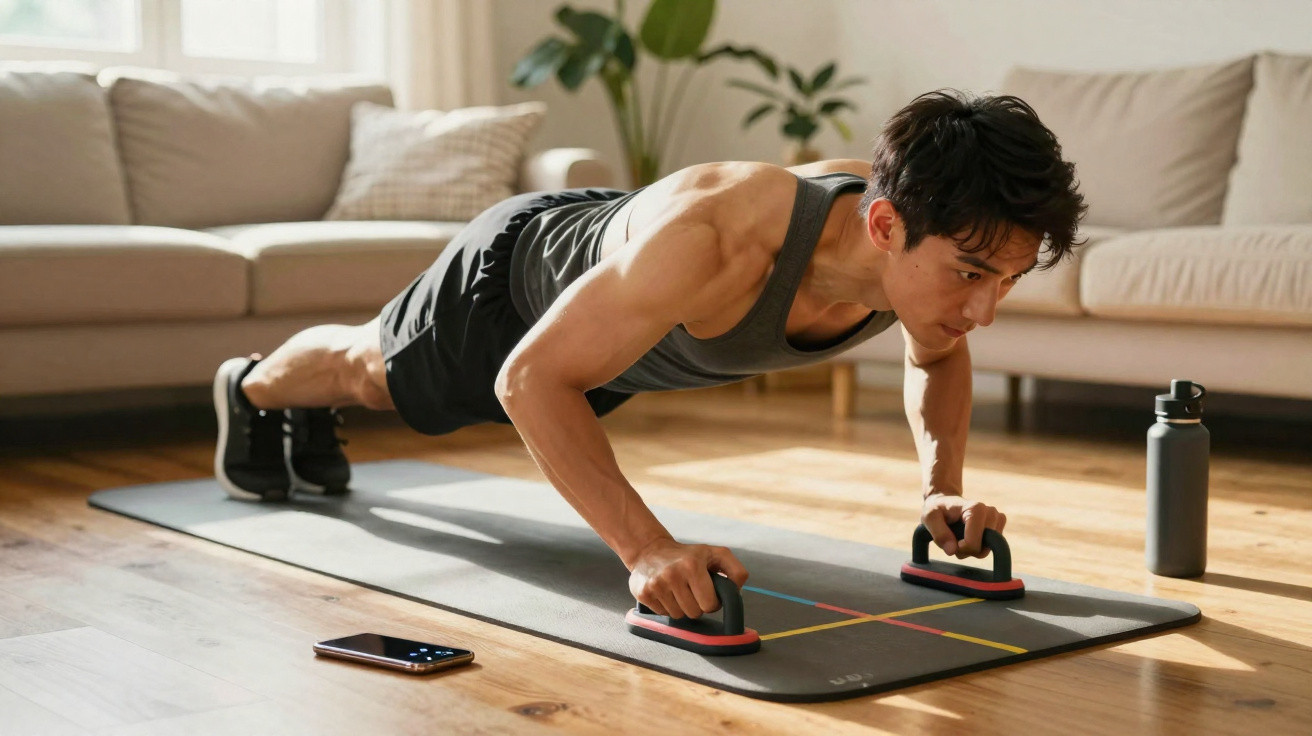
Anyone hoping to shift winter weight and tone their stomach often runs into two obstacles: they lack the money or motivation for a gym, while traditional floor exercises offer little enjoyment. This is where a new product stocked by Decathlon comes in: a multifunctional push-up and plank board that lets you train your entire upper body at home – with a counter that records every repetition.
How the board works and what it offers
At the heart of the device is a sturdy training board into which two removable handles can be locked in a range of positions. Called the push-up Board DBP03 from HMS, the model is designed as a compact home gym for the upper body.
The board combines several features:
- Handle placements at different angles for the chest, shoulders, triceps and back
- A large padded surface for planks and abdominal exercises
- An integrated repetition counter with an optical sensor
- A non-slip base and easy-grip foam handles
“The combination of colour-marked handle positions and an automatic counter makes training far more structured than doing ordinary press-ups on the floor.”
Its built-in sensor detects every downward movement during press-ups and counts it automatically. A small display shows exactly how many repetitions you have completed. For anyone who tends to train by rough estimate, this provides clear, measurable feedback.
Why the HMS push-up Board DBP03 works for abs and upper-body training
The board targets the whole upper body – which is precisely its key benefit for those chiefly looking to improve the shape of their stomach. Crunches alone achieve little if your back, shoulders and arms remain weak.
The board works several areas at once:
- Press-ups with a fixed handle height take pressure off the wrists while challenging the chest, shoulders and triceps more intensely.
- Planks on the padded surface engage the entire core, rather than only the rectus abdominis muscles.
- Dynamic variations, such as moving between a high and low plank, increase calorie expenditure and build stability.
A less widely recognised benefit is that regular upper-body training raises your basal metabolic rate. Muscles use energy even at rest, while a strong core supports every everyday movement – from lifting shopping bags to sitting at a desk.
Colour guidance for different muscle groups
The board has several colour-coded handle holes. Selecting a particular colour shifts the emphasis to a different muscle group:
| Colour | Main muscle group | Typical handle position |
|---|---|---|
| For example, red | Chest | Slightly wider than shoulder-width |
| For example, blue | Shoulders | Further forward, turned slightly inwards |
| For example, yellow | Triceps | Close to the body, with arms kept in |
| For example, green | Back | Narrower position, with handles angled slightly outwards |
The precise colour combinations may vary slightly between product versions, but the principle stays the same: rather than studying training plans, you follow the board to the appropriate handle placement.
How to use the board for abdominal training at home
Getting started is straightforward. All you need is a little clear floor space and, ideally, a mat underneath if you have a delicate floor.
Step-by-step press-ups with the counter
- Insert the handles into the indicated holes according to the muscle group you want to target.
- Put the board on the floor with its non-slip side facing down.
- Hold the handles, bring your body into a straight line and tighten your abdominal muscles.
- Bend your arms until you are just above the board. The sensor detects the depth.
- Push yourself back up in a controlled movement, keeping your gaze directed downwards.
- Check the display: your repetitions are recorded automatically.
If you cannot yet perform a full press-up, place your knees on the floor while keeping your upper body as straight as possible. The counting function works in exactly the same way.
Planks and abdominal variations on the board
For core training, use the padded area directly without the handles:
- Classic forearm plank: Rest your forearms on the board, position your elbows beneath your shoulders, extend your legs, brace your abs and hold the position.
- High plank: Place your hands on the board with your arms straight, keep your body in one line and avoid letting your lower back dip.
- Alternating planks: From the high position, lower yourself one arm at a time onto your forearms, then push back up. This places a major demand on the abs.
“Planks on a stable, slightly raised surface feel easier for many people than doing them directly on a hard floor – so you can hold them for longer and train more efficiently.”
Who the device is worthwhile for – and who should avoid it
At around €54, the board costs considerably less than an annual gym membership. It is particularly suited to:
- Working people with limited time who want to train shortly before or after work
- Beginners looking for a guided option for upper-body and abdominal training
- More experienced users wanting to give their press-up workout more structure
- People who dislike exercising in front of others at a gym
The board is less suitable for anyone with significant wrist problems or an acute shoulder injury. In these cases, it makes sense to consult a physiotherapist or doctor before starting training.
How much can the board really do against belly fat?
A device on its own will not make belly fat disappear. The decisive factor remains a combination of a calorie deficit, everyday movement and strength training. The board primarily provides the strength-training element – in a form that can realistically fit into daily life.
A typical weekly plan using the board could look like this:
- 3–4 sessions each week lasting 15–20 minutes
- 3–4 sets of press-ups in different positions per session
- 2–3 plank variations, each held for 20–40 seconds
- Short breaks of 45–60 seconds between sets
Pair this with reasonably balanced eating habits and a little extra activity in daily life – taking the stairs instead of the lift or walking short distances – and the likelihood of your waist measurement gradually decreasing over several weeks rises considerably.
Practical tips for better results and less frustration
Many people do not fail because of the exercises themselves, but because they do not establish a routine. The board is easy to store, which is useful – but it also means it can disappear into a cupboard and never be used again.
- Keep the board visible: Leave it in the living room or beside your desk, for example, as a constant reminder.
- Short is better than long: Three 10-minute sessions a week beat one lengthy workout that ends up being cancelled.
- Set targets on the display: Choose a fixed number of repetitions or plank seconds and stick to it.
- Add variation: Try a new handle position each week to keep the stimulus high.
Beginners benefit from starting with only two muscle groups per session, such as chest and abs. Once you feel more confident, add the shoulders and back.
Background: why planks are so effective for the abs
When people think of abdominal training, crunches are often the first exercise that comes to mind. Planks may seem unremarkable, but they are considerably more functional. Instead of simply shortening individual muscles, they train the interaction between the abs, back, hips and shoulders.
A stable core:
- protects the spine during everyday physical demands
- improves posture and walking pattern
- lowers the risk of back pain
- often creates the appearance of a slimmer waist as an added benefit
The board’s firm surface makes the position easier to maintain because your elbows or hands cannot slide away. Anyone whose elbows are uncomfortable on hard flooring benefits from the padding.
Combined with press-up training, it becomes a small yet fairly complete home gym for the entire upper body. Those who use the board regularly and also make small adjustments to their eating and movement habits can take a noticeable stand against stubborn belly fat – without a gym membership.



Comments
No comments yet. Be the first to comment!
Leave a Comment