
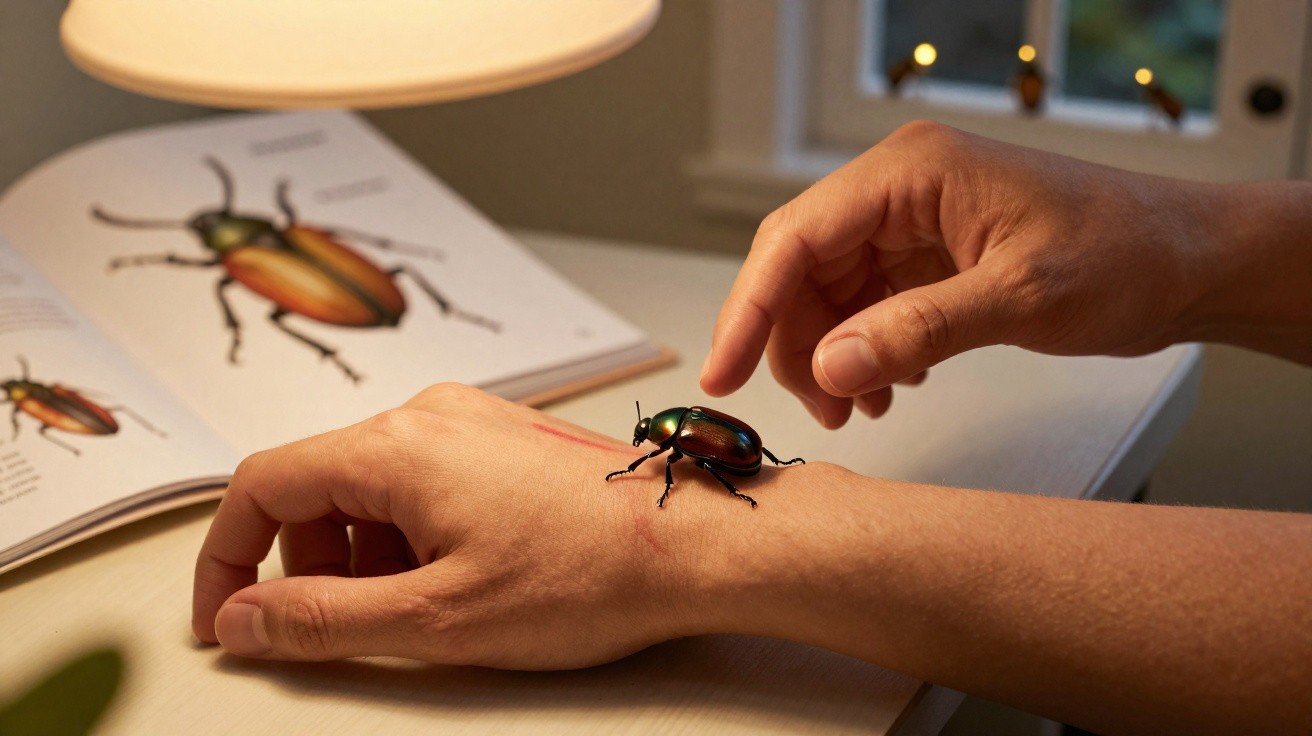
A potó beetle can land on an arm without causing any immediate reaction, then leave a burn-like lesion seconds later. The potó, the common name for beetles in the Paederus genus, does not need to sting to cause this issue. The danger arises mainly when the insect is crushed or pressed against the skin.
Why does a potó hurt without stinging?
The characteristic lesion caused by a potó is not the result of a sting. If the beetle is compressed against the skin, its bodily fluids may release pederin, a substance with irritant and blistering properties. Contact with it can trigger dermatitis precisely where the skin was exposed.
This is why someone may notice the insect walking across their body without feeling instant pain. The problem generally begins when they try to kill it with their hand, rub the area or unknowingly squeeze it. Rather than a “sting”, the reaction is caused by chemical contact between the substance from the insect and the skin.
What does skin look like after contact with pederin?
Symptoms can differ, although burning and redness are among the most typical signs. In more severe cases, itching, small fluid-filled blisters and larger blisters may also develop, leaving a mark that resembles a superficial burn.
Some lesions have a linear shape because the substance spreads over the skin as the insect is crushed or dragged. If contact occurs, health services advise washing the affected area with running water and soap. Significant lesions or those close to the eyes should be assessed by a healthcare professional.
What should you do if a potó lands on your skin?
The safest response is the one that may feel least instinctive: do not crush the beetle. If it is on an arm, leg or another part of the body, gently move it away, allowing it to walk onto another surface or removing it without pressing its body against the skin.
A few simple precautions can prevent a harmless encounter from becoming dermatitis. The aim is not to fear the insect, but to avoid the specific situation that encourages the release of its irritant substance.
- Gently move the beetle away if you notice it has landed on your skin.
- Do not slap, squeeze or rub the insect directly against your body.
- Wash the skin with soap and water if you suspect the animal was crushed on it.
- Seek medical care if the lesion is extensive, very severe or affects sensitive areas, such as the eyes.
Watch the video shared by the YouTube channel TV Costa Norte Parnaíba-PI, which offers advice on protecting yourself from burns caused by “potó beetles”.
Why do these beetles appear near lights?
In certain regions and at particular times of year, Paederus species may be attracted to artificial light sources. Studies and outbreak records describe these beetles entering places occupied by people, particularly during periods that favour their proliferation, such as the rainy season in some areas.
As a result, contact can occur inside homes, accommodation and other spaces lit at night. In Brazil, potó does not refer to one single species: entomological studies have recorded several species of the genus linked to dermatitis cases in different parts of the country.
Why can knowing about potó beetles prevent such an easy accident?
The most curious detail about this beetle also points to the best way to prevent harm. It does not need to chase, bite or sting a person to trigger a reaction. In most situations, simply avoiding crushing it on the skin prevents the very mechanism that turns a chance encounter into a painful lesion.
If a potó appears near a light or lands on your body, resist the urge to slap it. Move it away carefully and share this information with people living in areas where the insect is common. A gesture lasting only a few seconds can prevent days of burning, blisters and skin discomfort.






Comments
No comments yet. Be the first to comment!
Leave a Comment