
At a Super Bowl party buffet or a wedding reception, the scene is immediately familiar: tables overflowing with food. There are trays of sliders, bowls of crisps, plates of brownies and salads that are barely touched.
It looks generous, celebratory and innocent enough. Yet this abundance of buffet choices may subtly encourage people to eat more than they intended.
A recent study found that a greater range of foods does not simply lead people to take a small amount extra. Instead, they put substantially more calories on their plates - before they have taken a single bite.
Testing buffets in virtual reality
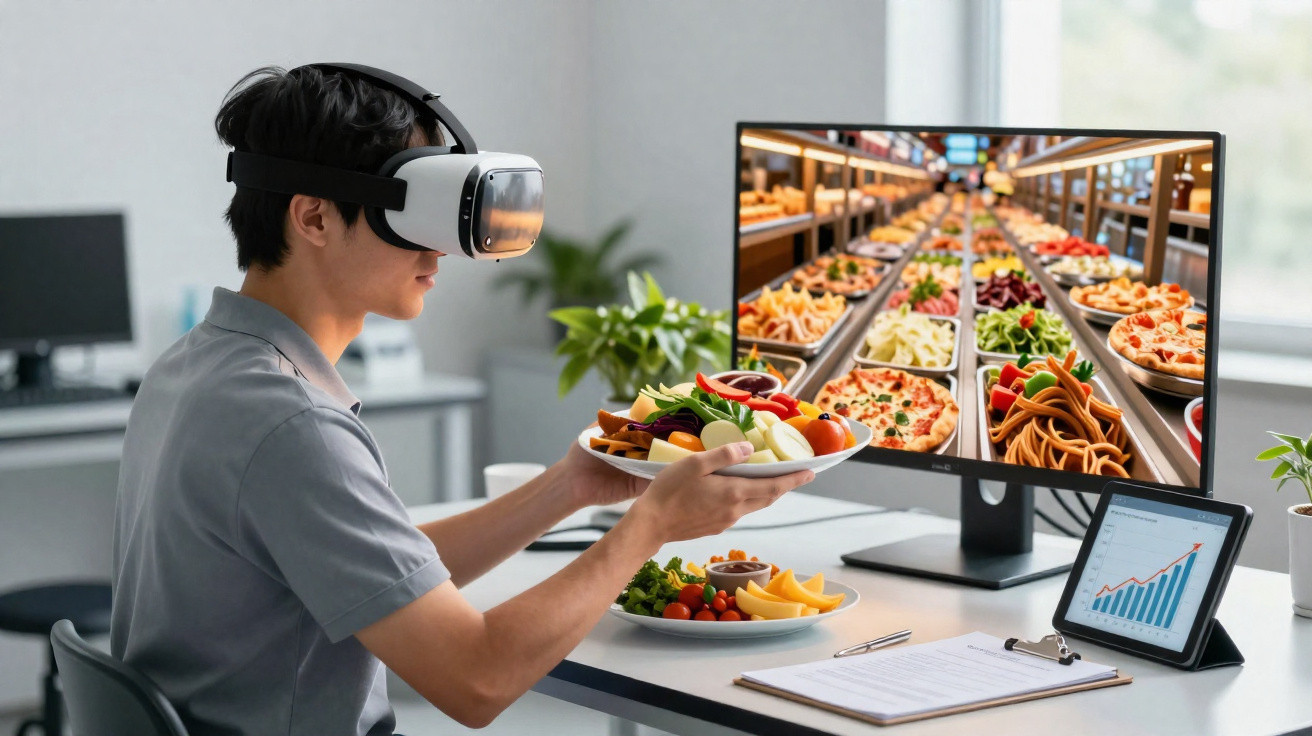
To investigate what happens at buffets, researchers created one entirely in virtual reality.
Researchers from Penn State’s Department of Nutritional Sciences recruited 50 adults aged 18 to 65. Every participant attended the laboratory on three occasions, spaced one week apart, for either lunch or dinner.
Ahead of each session, they refrained from eating, exercising and consuming caffeine for several hours, ensuring they arrived hungry.
Rather than approaching real serving trays, the participants wore VR headsets. In the simulated setting, they entered a buffet-style restaurant and used video-game controllers to choose their meals.
The programme recorded the weight and total calorie content of the selected food. It also measured the amounts chosen from high-energy-density foods, such as biscuits, and lower-energy-density foods, including vegetables.
On one visit, the buffet contained nine foods; on another it had 18; and on the final visit it presented 27. The balance between higher-calorie and lower-calorie foods remained broadly consistent, regardless of the number of choices available.
Previous research had shown that people make similar selections at a VR buffet and a real-life buffet. This reassured the researchers that behaviour in the headset reflected real-world behaviour.
More buffet options mean bigger portions
The findings were striking. Faced with only nine food items, participants selected just over 600 grams of food. When they had 18 or 27 options, this rose to more than 900 grams.
Calorie totals increased as well. From nine choices, participants selected an average of 850 calories. With 18 foods available, the average rose to 1,320 calories - roughly 55 percent more.
With 27 available foods, participants chose almost 1,500 calories. This represented a 75 percent rise compared with the amount the same people selected from the nine-item buffet.
John Long, the study’s lead author and a postdoctoral scholar in food science and nutritional sciences, said the researchers aimed to identify what causes overconsumption.
“This study examined what drives people to overconsume food at a buffet similar to dining halls, where millions of college students eat every day,” he said.
“If we identify the aspects of our modern food environment – excessive variety, slick packaging, processed foods and more – that increase how much people eat, we can redesign our environment to help us make healthier food choices.”
Calories rise with more choices
Notably, although the weight of food selected appeared to reach an overall limit, calorie totals continued to rise.
The researchers noted that outside influences clearly affect both what people eat and how much they choose. However, the total food weight selected for a meal seems to reach a ceiling even when variety expands. Calorie intake, by contrast, did not plateau in the same way.
“When presented with more options, people became more likely to choose higher calorie-dense foods,” Long said. “In the U.S., many people consume more calories than they need, and the wide variety of foods in our environment may nudge us to eat more than we otherwise would.”
Why buffet variety keeps us eating
Scientists have understood for years that variety can influence appetite. Eating the same flavour repeatedly makes it less appealing, and the brain responds less intensely. New flavours and textures, however, renew interest and may revive the urge to carry on eating.
At a buffet offering dozens of dishes, something unfamiliar is always available. A mouthful of pasta, a biscuit, or a spoonful of a creamy dish that was never part of the plan can soon add up.
The research also considered personality traits. Participants completed questionnaires assessing characteristics including emotional eating and willingness to try new foods. Of the five main personality traits assessed, only one showed a clear effect.
Those with higher conscientiousness - a quality associated with self-discipline and goal-directed behaviour - were less influenced by the greater variety.
As the number of options increased, they added fewer additional calories and chose less energy-dense food than participants with lower conscientiousness.
“Behavior change starts with being aware of the things that influence us,” said the study’s senior author Travis Masterson, an assistant professor of nutritional science at Penn State.
“If we are aware that variety might tempt us to eat more than is healthy, we may be able to make better decisions for our health.”
The environment behind overeating
Obesity rates in the United States have increased steadily during recent decades. Public-health messaging often centres on individual responsibility: eat less, exercise more and practise self-restraint. The researchers, however, argue that the food environment is equally important.
“Experts have been warning people for decades to watch what they eat, and the obesity epidemic has only increased,” said Masterson. “Clearly, our food environment is overriding our ability to limit our diets.”
Long has the same longer-term aim. “By understanding the factors that drive our choices, we hope to design eating environments that support health rather than overconsumption,” he said.
The next time you are standing before a table filled with choices, it may be worth remembering that more options do more than create a sense of abundance. They can quietly influence how much food ends up on your plate.
The complete study was published in the journal Appetite.






Comments
No comments yet. Be the first to comment!
Leave a Comment