
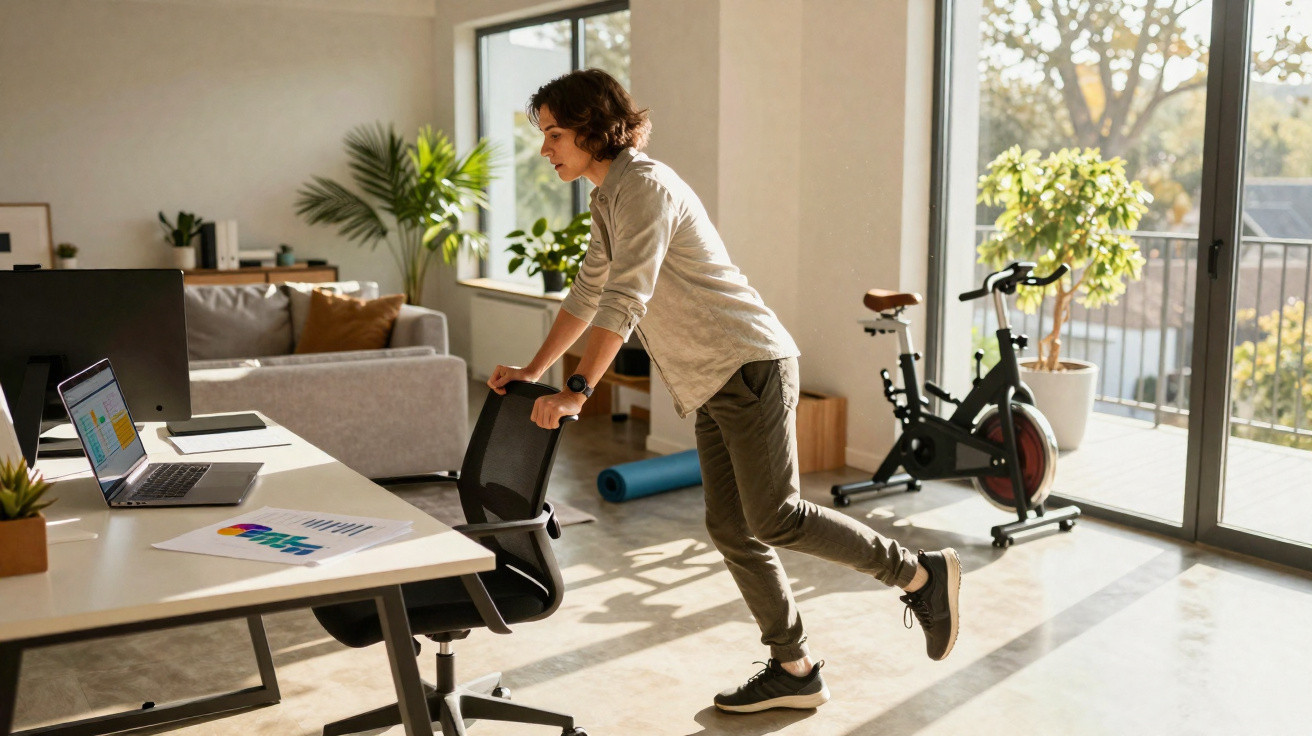
We already know that spending long periods sitting is harmful to health, but how much exercise is required to offset the negative effects of sitting all day?
Evidence indicates that accumulating around 30–40 minutes a day of sweat-inducing activity may be enough.
Exercise to offset sitting all day
According to the research, up to 40 minutes of “moderate to vigorous intensity physical activity” daily is roughly sufficient to counterbalance 10 hours spent sitting. That said, every amount of exercise - and even simply standing more often - offers some benefit.
This conclusion comes from a 2020 meta-analysis that examined nine earlier studies. Together, they included 44,370 people across four countries, all of whom wore some type of fitness tracker.
The analysis showed that, among people with more sedentary lifestyles, the risk of death increased as the time they spent doing moderate-to-vigorous intensity physical activity decreased.
“In active individuals doing about 30-40 minutes of moderate to vigorous intensity physical activity, the association between high sedentary time and risk of death is not significantly different from those with low amounts of sedentary time,” the researchers explained in their paper.
Put simply, reasonably demanding activities such as cycling, brisk walking and gardening can reduce the risk of earlier death to a level comparable with that of people who do not spend so much time sitting. This association was apparent in combined data from many thousands of people.
Fitness tracker evidence and WHO guidance
Meta-analyses of this kind inevitably involve drawing connections between separate studies that have different participants, timeframes and conditions. However, a particular strength of this research was its use of relatively objective wearable-device data, rather than information reported by participants themselves.
The study was released alongside the World Health Organization’s 2020 Global Guidelines on Physical Activity and Sedentary Behaviour, developed by 40 scientists from six continents. The British Journal of Sports Medicine (BHSM) also published a special edition containing both the study and the updated guidelines.
“As these guidelines emphasize, all physical activity counts and any amount of it is better than none,” said physical activity and population health researcher Emmanuel Stamatakis from the University of Sydney in Australia.
“People can still protect their health and offset the harmful effects of physical inactivity.”
Research using fitness trackers broadly supports the 2020 WHO guidelines. These advise 150–300 mins of moderate-intensity physical activity, or 75–150 mins of vigorous-intensity physical activity, each week to counter sedentary behaviour.
Taking the stairs rather than the lift, playing with children or pets, doing yoga or dancing, completing household chores, walking and cycling are all suggested ways to become more active. If reaching 30–40 minutes immediately feels unrealistic, the researchers advise starting small.
Staying active despite desk time
Creating recommendations that apply to every age group and body type is difficult, although the 40-minute activity target is consistent with earlier research. As further evidence emerges, researchers should gain a clearer understanding of how people can remain healthy when they need to spend lengthy periods at a desk.
“Although the new guidelines reflect the best available science, there are still some gaps in our knowledge,” said Stamatakis.
“We are still not clear, for example, where exactly the bar for 'too much sitting' is. But this is a fast-paced field of research, and we will hopefully have answers in a few years' time.”
The research was published here, while the 2020 guidelines are available here in the British Journal of Sports Medicine. Further information is available here.
An earlier version of this article was published in November 2020.






Comments
No comments yet. Be the first to comment!
Leave a Comment