
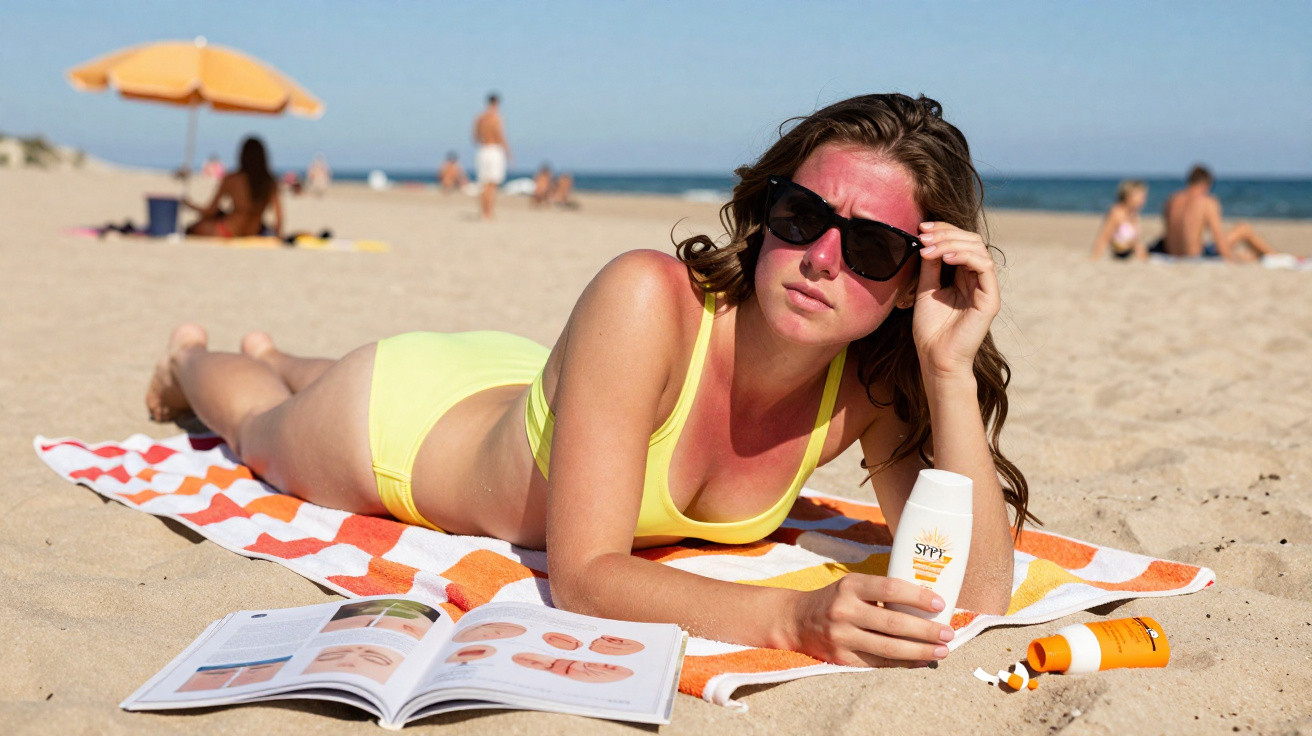
It put an end to the tanning bed’s heyday and sparked thousands of SPF campaigns. But one sun-drenched practice has persisted quietly through decades of warnings, and a huge new government survey shows how widespread it remains.
Imagine a public swimming pool in mid-July: towels spread out in direct sunlight, loungers positioned to follow the rays, and someone turning over every 20 minutes like food on a rotisserie.
No one there is unaware of what sunlight can do to skin. The warnings have been impossible to miss for 40 years.
That raises a worthwhile question: after all that messaging, how many US adults still deliberately lie in the sun to become darker?
Researchers from the Centers for Disease Control and Prevention and the National Cancer Institute have now quantified it. The figure is far higher than many people may expect.
What the survey found
The research team, headed by Dawn Holman from the CDC’s Division of Cancer Prevention and Control, examined responses from more than 31,000 adults.
Their findings came from the 2024 National Health Interview Survey, one of the largest continuing health surveys in the United States.
Respondents were asked one straightforward question: when spending time outside, how often do they seek sun exposure specifically to develop a tan?
About 30% said they did so at least occasionally. That works out at roughly one in three women and one in four men. For women aged 18 to 24, the proportion rises above half.
Compare that with indoor tanning. Sunbeds have faced tough regulation, taxation and years of bleak publicity. Just 3.6% of adults still use them.
According to this survey, intentional outdoor tanning is more than eight times more prevalent. The sunbed lost; the garden recliner prevailed.
Who deliberately tans outdoors most
The pattern in the findings is not what you might anticipate if sun-seeking is assumed to be an unthinking habit. The strongest overlap is not among inactive people, but among those who exercise.
Women who achieved federal recommendations for both aerobic activity and strength training reported tanning more often than women who met neither target. Men showed the same trend.
The researchers cannot determine whether exercise sessions also become tanning opportunities. However, they suggest one credible reason: the enduring cultural notion that a tan, a slim body and fitness together represent the image of health.
Gyms providing sunbeds have further strengthened that connection.
Alcohol is another factor. Almost half of women reporting heavy or binge drinking also said they intentionally tanned, compared with around one-quarter of women who did not drink at all.
Among women aged 18 to 20 who reported underage drinking, 63.7% said they tanned. Two behaviours associated with cancer risk appearing side by side.
The study cannot account for the relationship, although both behaviours can bring an immediate reward - an improved mood or a desired appearance - that may seem more important than a distant danger.
The connection between tanning and sunburn
Those who intentionally tanned were nearly twice as likely to have had sunburn during the previous year: 49.9% compared with 28.3% of all other respondents.
That difference is significant because sunburn is not merely an unpleasant weekend outcome. It is among the clearest preventable risk factors for skin cancer, including melanoma, its most deadly form.
Skin cancer is already the most common cancer in the United States. More than 6 million adults receive treatment each year, at an estimated cost of roughly $8.9 billion.
Even people whose skin burns within an hour of being unprotected in the sun - those with the most sun-sensitive complexions - reported high levels of tanning.
Of sun-sensitive adults who deliberately tanned, 66.2% had been sunburned in the previous year. That is not misfortune; it is the foreseeable cost of pursuing a colour their skin was never designed to retain.
The “base tan” myth
Why does the behaviour persist? One durable piece of folklore plays a major role: the belief that a “base tan” acts as armour against more severe burning later. It is beach advice passed down through generations.
Biology tells a different story. A tan gives only very limited protection against burning. Researchers have measured this effect, finding it roughly comparable with a very low-strength sunscreen.
More troublingly, a tan is itself proof of damage. Skin darkens as a response to injury, producing pigment after UV radiation has already damaged the DNA inside cells.
The tan is not the protection. The tan is the record of injury.
The figures also contain a point about equity. Non-Hispanic White adults had the highest tanning rates, yet the practice was found in every racial and ethnic group included in the survey.
A difficult behaviour to change
This research is a cross-sectional snapshot, meaning it identifies associations rather than causes. The data cannot establish that drinking causes tanning, or that exercise habits lead people to seek the sun.
All responses were self-reported, and people often frame their answers in ways that appear more socially acceptable.
The survey question also could not provide context, such as whether a person sought a tan during a beach holiday or on every lunchtime break.
Even so, the central finding remains. Decades into the SPF era, intentional tanning has not disappeared. It has simply shifted outdoors, beyond the reach of regulation and warning labels.
Return to that poolside scene, with towels arranged in the sunshine. The people lying on them are not unusual exceptions or die-hard holdouts. Statistically, they represent one-third of the country.
Public health spent a generation defeating sunbeds, and that effort succeeded. The next battle is more difficult because the rival costs nothing, feels pleasant and shines straight down from above.
The Sun, it seems, was always going to be the harder habit to break.
The full study was published in the journal JAMA Dermatology.



Comments
No comments yet. Be the first to comment!
Leave a Comment