
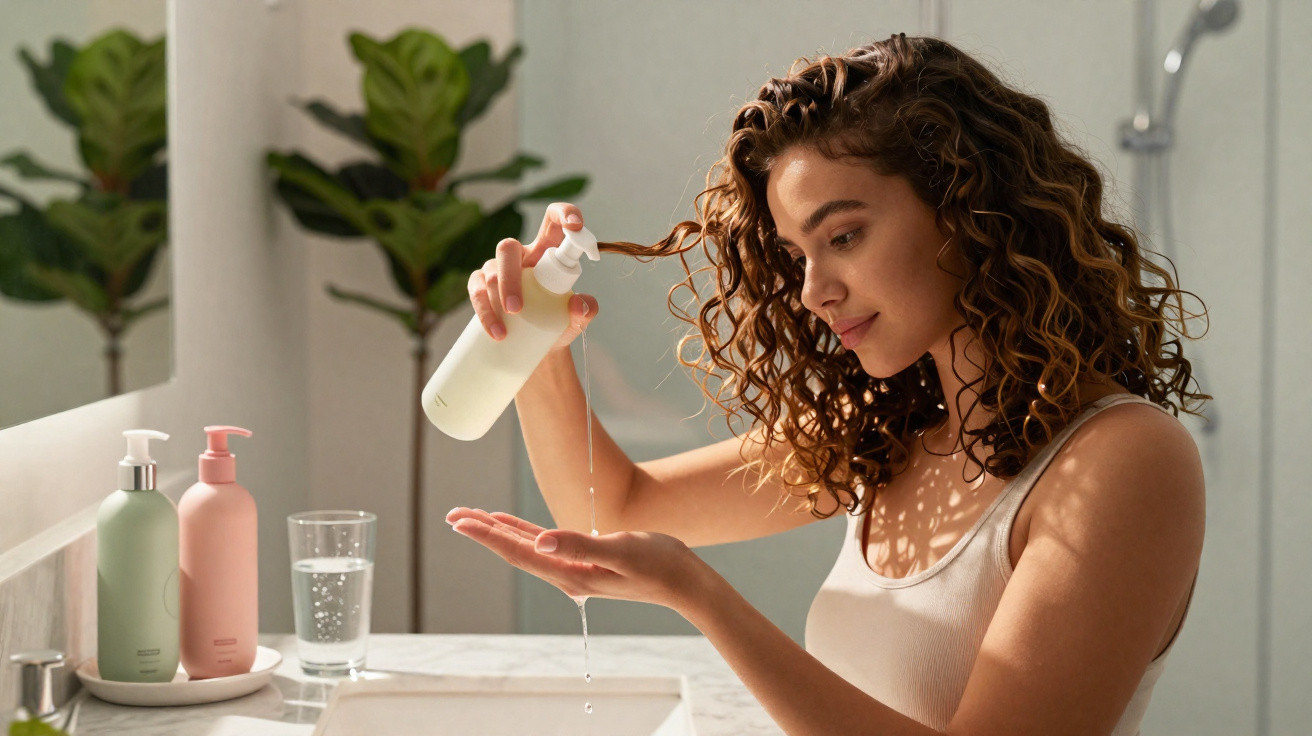
Fluid textures are no longer exclusive to skincare and are now making their way into haircare. Following the liquid hair trend, liquid conditioners are emerging as the next stage in hair treatment, combining high-performance actives in lightweight formulas that moisturise, detangle and smooth the hair without affecting its natural movement.
The trend reflects the influence of K-Beauty and J-Beauty, beauty movements originating in South Korea and Japan that favour high-tech formulations, light textures and treatments focused on the long-term health of the hair. Rather than dense products, the aim is to create formulas that hydrate, repair and protect the hair fibre while absorbing quickly and leaving a natural finish - a feature of Asian haircare routines.
According to Guilherme Téo, R&D Manager at BR Cosmetic, the expansion of this category is closely linked to advances in cosmetic technology. “Today, we can combine high-performance conditioning ingredients, amino acids, peptides and technological polymers in more fluid vehicles, which distribute the actives evenly across the hair fibre. The result is an effective treatment that delivers hydration, cuticle alignment and softness without creating a thick film,” he explains.
Suitable for every hair type
So, are liquid conditioners suitable for all hair types? Yes, provided the product selected matches the hair’s needs and the desired result. According to BR Cosmetic’s R&D Manager, their lighter texture broadens their possible uses.
“Liquid conditioners provide the advantages of a traditional conditioner, including softness, shine, detangling and cuticle alignment, but in a texture that spreads easily and avoids excessive residue. Although they are an excellent choice for fine, oily or sensitised hair, they also suit anyone looking for a lightweight result with movement,” he says.
A versatile haircare product
Versatility is another defining quality of this category. As formulations have evolved, certain products have been able to bring together several functions in one application, expanding how they can be used according to the hair’s needs. In other words, after washing, a liquid conditioner can replace a conventional conditioner.
In some cases, depending on the formula’s intended purpose, it can also be left in the hair as a leave-in product, extending the benefits of the treatment throughout the day. “One example is Jacques Janine Professionnel’s Leave-inAmino Fusion Final Effects. When used as a liquid conditioner, simply apply it after shampooing and rinse. As a leave-in, it stays on the hair, extending the treatment throughout the day,” says Guilherme Téo.
Technology drives a new generation of conditioners
The development of conditioners follows an industry-wide move towards multifunctional formulas and increasingly lightweight textures. As seen with facial serums, gel moisturisers and liquid masks, technology now enables lower-viscosity products to provide high performance, broadening treatment possibilities without compromising the sensory experience.
By Caroline Amorim
Comments
No comments yet. Be the first to comment!
Leave a Comment