
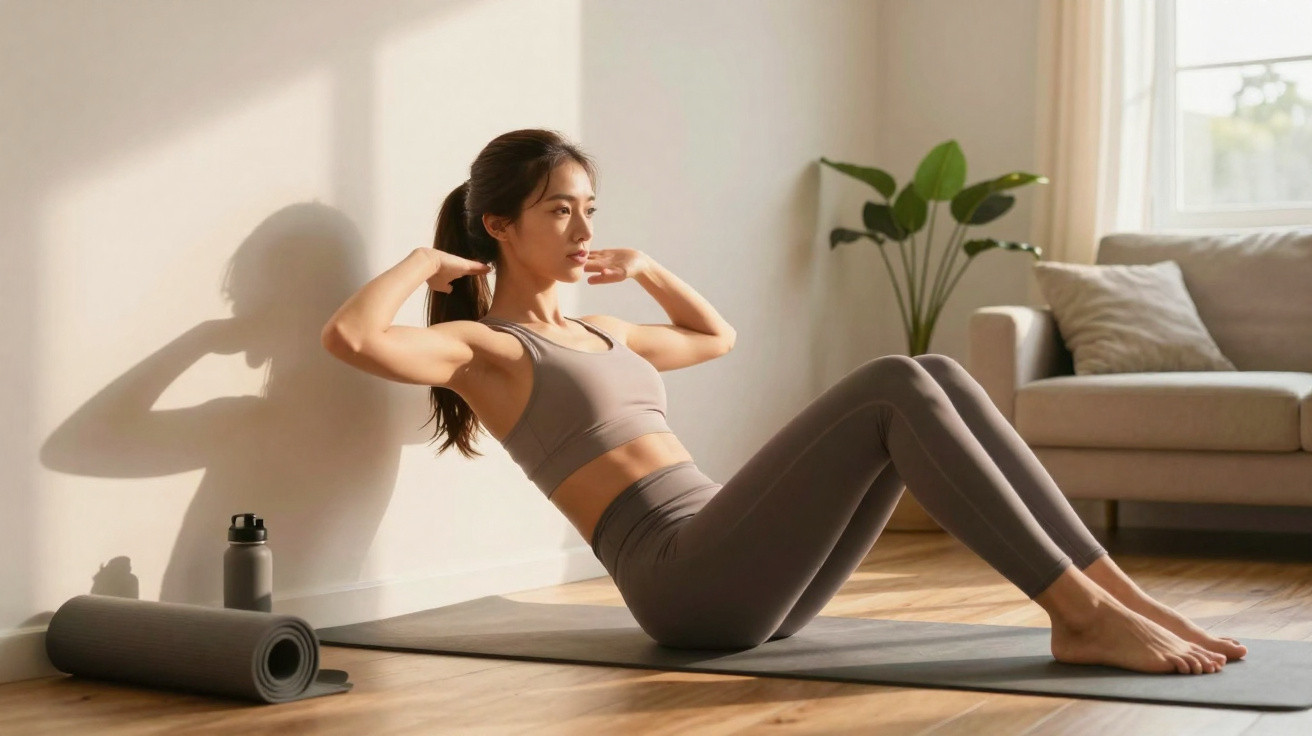
The wall crunch stands out because it uses only body weight and a wall for support, allowing you to train your core without gym equipment. It strengthens the abdominal muscles and may help create a firmer appearance, but “reduce belly fat quickly” needs an important qualification: no single exercise can guarantee localised loss of abdominal fat.
How does the wall crunch work?
One of the most straightforward versions is performed lying down, with your lower back supported by the floor and your feet placed against a wall. Your hips and knees should be bent to roughly 90 degrees. Next, tighten your abdominal muscles and lift your head and shoulders towards your knees, before lowering yourself back down slowly. The wall keeps the legs stable and makes the movement easier to control.
Why can this exercise be easier for beginners?
Keeping the feet supported means there is less need to control the legs during each repetition, allowing you to focus your effort on the centre of the body. This can make it easier to learn the movement if you do not yet have the strength to perform more demanding crunch variations with good technique.
It still needs to be performed carefully. The aim is not to pull on your neck or try to bring your chest all the way to your knees. Instead, make a short, controlled lift while keeping your abdominal muscles engaged. The following points can help structure your practice:
- keep your lower back on the floor and avoid jerky movements;
- keep your feet firmly against the wall;
- lift mainly your head and shoulders;
- breathe out as you contract your abdominal muscles;
- lower yourself slowly to the starting position.
Does the wall crunch actually reduce belly fat?
The exercise directly works the rectus abdominis and other core muscles, but strengthening one area does not necessarily remove fat from that exact location. In one randomised study, six weeks of abdominal exercises performed five times a week improved muscular endurance but did not significantly reduce subcutaneous abdominal fat or other body-composition measurements.
How can you maximise results in the abdominal area?
To change body composition, the wall crunch works best as part of a broader routine. Aerobic exercise and strength training increase energy expenditure and help preserve or build muscle mass, while diet directly affects the energy balance required for fat loss. Current guidance recommends combining aerobic activity with muscle-strengthening exercise throughout the week.
That does not reduce the value of targeted exercise. A stronger abdomen helps stabilise the torso during many everyday movements. To create a more complete routine, you can combine:
- wall crunches to train the core;
- squats and other movements for large muscle groups;
- brisk walking, cycling or another aerobic activity;
- a gradual increase in repetitions and intensity;
- recovery days suited to your training level.
How long does it take for crunches to make your stomach firmer?
There is no single timeframe for noticing changes. Abdominal strength and endurance may improve with regular practice, but visible changes around the waist also depend on body-fat percentage, diet, overall physical-activity volume, sleep and individual characteristics. Even studies of targeted exercise have produced differing findings, making it impossible to promise quick, predictable fat reduction from crunch repetitions alone.
The wall crunch makes more sense as an accessible way to strengthen the central area of the body than as a method to “burn belly fat” on its own. Its benefit lies in its simple technique, the support provided by the wall and the option to progress as the core becomes more resilient; reducing abdominal fat depends on the overall training plan and energy balance over time.




Comments
No comments yet. Be the first to comment!
Leave a Comment