
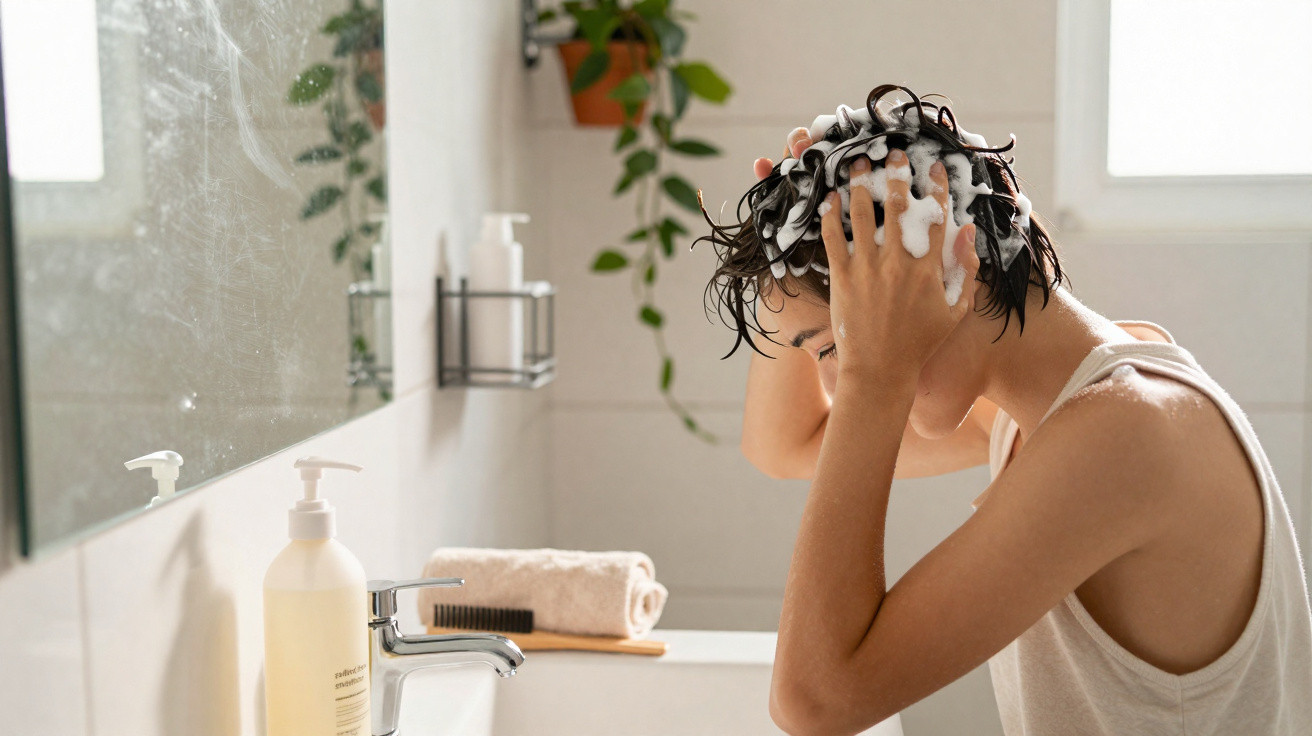
Her face is freshly cleansed, her hoodie is clean and her eyeliner looks perfect. But her hair? Oily at the roots, a limp fringe and a shine that is definitely not the flattering sort. She washed it only yesterday evening. By 7:30 a.m., it already appears to be on its third day.
Her mum says, “Stop washing it so much, you’re making it worse.”
Her friends say, “Just use dry shampoo.”
The algorithm says, “Try this miracle detox shampoo for oily hair!”
So she scrubs more fiercely and reaches for more powerful products, yet still avoids appearing in photographs. The harder she tries to get rid of the oil, the more her scalp appears to push back. That is when a quiet term begins appearing on TikTok and Reddit discussions: low-poo.
It is not no-poo. It is not aggressive clarifying either.
It sits somewhere in the middle.
It is surprisingly gentle… and it works.
The puberty scalp nobody talks about
Puberty affects more than skin and moods; it changes the scalp as well. Hormones increase sebum output, meaning that the oil responsible for forehead breakouts can also collect at the roots. Teenagers see an oily fringe, assume they are “dirty”, and choose the most intensive shampoo available.
That first wash can feel brilliant: light, fluffy and squeaky clean. Yet within 24 hours, the hair falls flat again. The routine then intensifies: washing every day, shampooing twice and taking lengthy hot showers. The scalp interprets this as an “emergency drought” and produces still more oil as protection.
Walk through a corridor in a London secondary school on a Tuesday morning and the pattern is easy to spot. Sleek ponytails, caps worn low, hoods pulled up, and uneasy looks in reflective windows. Oily hair becomes an unspoken, embarrassing part of growing up that hardly anyone acknowledges.
Studies of adolescent sebum show a genuine increase between the ages of 12 and 17, particularly across the T-zone and scalp. This is biology at work, not poor hygiene. Even so, products marketed at teenagers still promise “deep clean”, “oil control” and “purifying”. Powerful surfactants can strip the scalp so severely that, much like dry and irritated skin, it responds by protecting itself. It is not a personal failing; it is chemistry.
Low-poo offers a small act of resistance at this point. Rather than treating oil with harsh detergents, it relies on gentler, sulphate-free formulas used differently. There is less lather and friction, with greater consideration for the scalp barrier. The principle is straightforward: cleanse the roots sufficiently without sending the scalp into panic mode.
The specific low-poo method that actually helps
Low-poo does not mean simply purchasing a sulphate-free shampoo and hoping it solves everything. The approach that can make a real difference for oily teenage hair follows a clear, almost ritual-like routine. Before getting into the shower, begin with what some hairdressers describe as a “dry massage”.
Before the hair is wet, use fingertips to gently release build-up from the roots. Do not use nails or scratch. Instead, make slow circular motions for one to two minutes. This stimulates circulation and loosens sebum and product from the scalp, so the gentle shampoo does not have to work aggressively.
Next comes the crucial step: emulsify a small amount of low-poo shampoo with water between your hands. Use roughly a teaspoon for short hair or a walnut-sized amount for longer hair. Apply it only to the scalp and roots, rather than the lengths. The lengths are cleansed by the rinse-off, and that is generally sufficient.
Consider a 15-year-old called Max. He once washed his hair every day with a menthol “oil control” shampoo because “my fringe gets gross by lunchtime.” His mum advised him to wash it every other day, but when he attempted it once, he went to school in a beanie because his hair looked as though he had dipped it in chips.
Max changed to a low-poo routine after a stylist friend of his older sister talked him through it. During the first week, he continued washing daily, but used the gentler method: dry massage, diluted low-poo at the roots, a cool rinse and no second shampoo. His hair felt unlike the usual ultra-squeaky clean result, but it still looked presentable.
In the second week, he began leaving 36 hours between washes. He still washed after football training, but on quieter days he used only a small amount of dry shampoo along the parting and fringe. By the third week, something unexpected occurred: the panic about oil after 24 hours eased. His fringe did not flatten as quickly. He could go to the cinema with friends with “day two hair” and no cap.
There is a straightforward reason behind this method. Standard shampoos frequently use sulphates such as SLS or SLES, which are highly effective at dissolving oil and dirt. For teenage scalps already producing extra oil because of hormones, that intensely clean sensation may mean the protective lipid layer is repeatedly removed. The scalp then compensates by making sebum more quickly.
Low-poo products use milder surfactants, including coco-glucoside or sodium cocoyl isethionate, which lift excess oil while preserving some of that barrier. Together with roots-only application and reduced contact time, this means the scalp no longer feels under attack. Sebum production often becomes more stable over several weeks. That does not mean “zero grease ever”. More commonly, it means oiliness develops more slowly and is easier to manage.
There is a psychological change too. Rather than waging war against their bodies, teenagers can begin to work with what their scalp is trying to do. That can alter the way they face the mirror on school mornings.
How to do low-poo when you’re actually tired and busy
The most practical low-poo routine for oily teenage hair has to fit real life: snoozed alarms, missed buses and rushed showers. On every wash day, start with a one-minute dry scalp massage. Then soak the hair using lukewarm, rather than hot, water.
Squeeze a small amount of sulphate-free shampoo into your palm. Add a little water, then rub your hands until it forms a light foam. Work it only into the scalp: the front hairline, sides, crown and nape. Spend more time moving your fingertips than applying more product. Rinse thoroughly with your head tipped back, allowing the foam to travel through the lengths without scrubbing them.
Do not shampoo a second time. Apply a lightweight conditioner solely from the mid-lengths to the ends, never at the roots. Rinse with cool water. Gently press the hair dry with a towel rather than rubbing it. That is the essential low-poo method: mild surfactants, attention on the scalp and as little friction as possible.
For many teenagers, the issue is not the product but the habits surrounding it. They use water that is too hot, scrub with their nails and nervously add a second or third shampoo because it does not feel clean enough. They saturate the roots with conditioner “so it detangles faster”, then question why their fringe is oily again by early afternoon.
Overusing dry shampoo is another subtle pitfall. At first it can seem magical, but applying it layer after layer each day can clog the scalp. It then takes a harsher wash to feel clean again, which is precisely the cycle low-poo is intended to prevent. It is better reserved for one or two emergency days each week than used as a permanent disguise.
Then there is the guilt: “My hair looks dirty, I’m disgusting.” That inner voice can be more damaging than the oil itself. On a difficult hair day, switching the parting, wearing a loose braid or making a low bun can buy some time while the scalp gradually adjusts to its new rhythm. Let’s be honest: nobody truly follows the perfect Instagram tutorial routine every single day.
“When I stopped trying to make my hair bone-dry, it actually got less greasy,” explains 16-year-old Leah. “Low-poo felt wrong at first because there was less foam, but my scalp stopped freaking out all the time.”
For parents who want to help without nagging, small and practical actions tend to be more useful than lectures. Buying one gentle low-poo shampoo and saying, “Try this for two weeks, no pressure,” can open the conversation. Telling your own awkward teenage hair story may reduce the shame. In practical terms, many families place a simple low-poo checklist on the bathroom mirror, so tired minds do not need to recall every step.
- Massage the scalp before the water touches it
- Use a small, diluted amount of sulphate-free shampoo
- Clean only the roots, with no second shampoo
- Condition the lengths and ends, never the scalp
- Rinse with cool water rather than very hot water
Living with hair that changes as fast as you do
Hair can be unpredictable throughout puberty. It may be thick and heavy one year, finer and flat the next, then suddenly form unexpected waves. Low-poo does not guarantee perfect hair. It provides a way to stay connected to the scalp rather than treating it as an enemy every morning.
On social media, the most compelling low-poo transformations are not glossy “after” photographs. They are the understated comments such as, “I can finally sit in class without constantly touching my hair,” or “I stopped planning my life around wash days.” The method may sound technical on paper, but it gives back mental space.
At some point, the teenager studying their reflection notices a small difference. The fringe may still look shiny by evening, but lunchtime is easier. Their ponytail has more movement. They feel less inclined to hide beneath a hood. It is a quiet, deeply personal change, and it is not the sort of thing that appears in brand campaigns.
We all recognise the moment when a minor routine change unexpectedly helps us feel more like ourselves. Used carefully, low-poo can offer that kind of shift: not a trend or miracle cure, but a gentler way of caring for a scalp doing its best to adapt. Once teenagers understand that their hair is not “wrong”, only hormonal and adaptable, they often begin asking a larger, braver question: what else in my body story could be rewritten without a fight?
| Key point | Detail | Benefit for the reader |
|---|---|---|
| Gentle cleansing only at the roots | Apply a small amount of sulphate-free shampoo to the scalp and let the foam run through the lengths | Reduces rebound oiliness while leaving hair clean enough for school and social life |
| Dry massage before washing | A one- to two-minute fingertip massage loosens sebum and build-up | Allows low-poo shampoos to work more effectively without harsh cleansers or excess product |
| Gradually extending time between washes | Begin with daily low-poo washing, then slowly lengthen the time between washes | Keeps the transition realistic and reduces stress over “greasy phases” during puberty |
FAQ:
- How long does it take for low-poo to reduce oily hair? Most teenagers notice small differences within two to three weeks, with more consistent results after six to eight weeks of regular low-poo washing.
- Can low-poo work if I have dandruff as well as oily roots? Yes, but choose a gentle, dermatologist-tested low-poo shampoo and avoid scratching; persistent dandruff should be checked by a professional.
- Do I have to stop using dry shampoo completely? No, it can still be used for emergencies or special events. Simply limit it to one or two days a week and wash the scalp properly afterwards.
- Is low-poo only for long hair? Not at all. Short hair can benefit as well, especially when the scalp becomes oily quickly or feels tight after standard shampoos.
- What if my hair looks worse during the first week of low-poo? A brief “adjustment phase” is common. Continue the routine, use simple hairstyles to manage the gap and assess the results after at least three weeks rather than only two washes.



Comments
No comments yet. Be the first to comment!
Leave a Comment