
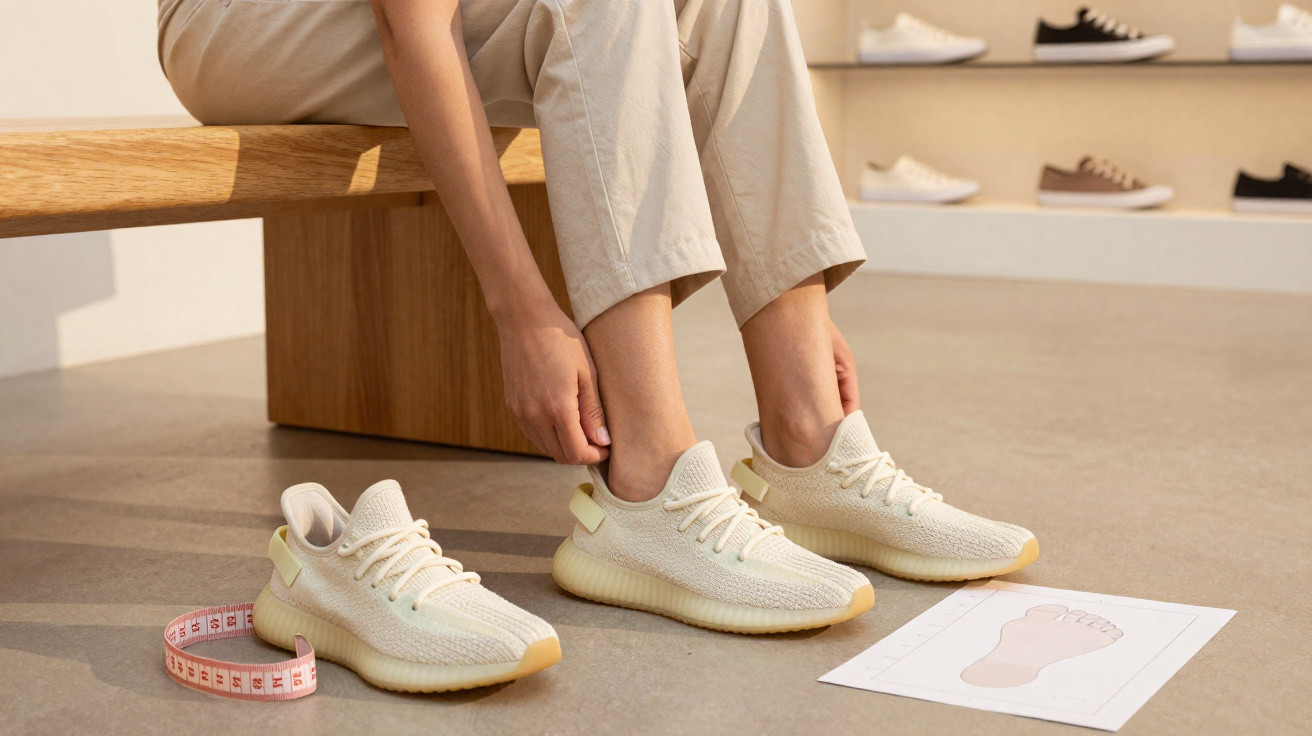
Social media is currently awash with clips showing a wide foot suddenly appearing slim, elegant and almost dainty simply by changing shoes. The latest trend trainers promise a narrower silhouette, using high-tech knit fabrics and fitting the foot like a second skin. Although this may sound like a fashion miracle, it can bring tangible everyday risks for joints, toes and ligaments.
The desire for a dainty foot
For years, bulky “Dad Shoes” and thick-soled chunky trainers dominated the streets: plenty of sole, plenty of volume and lots of comfort. Now the pendulum is swinging the other way. Slim, streamlined styles that visually reduce the size of the foot and lengthen the leg are in demand.
The effect looks dramatic in online clips: first a wide trainer, then a close-fitting style with a flexible upper, and the foot suddenly seems considerably narrower. Many fashion fans embrace the look because it creates a sleeker overall outline with skinny jeans, tailored trousers or skirts.
A visual reduction of up to 1.5 centimetres – the new shoe design deliberately relies on illusions.
At the same time, this is shifting the beauty ideal. Feet are expected not merely to look well cared for, but visibly small and narrow. Ultimately, that pressure is placed on the material – and on the wearer's health.
High-tech knit: how the “second-skin” effect is created
The secret of these new styles lies in the upper. In place of thick leather or multi-layered textile construction, they use an exceptionally fine, stretchy knitted or mesh fabric. Brands often refer to this as “knit” or “mesh”.
Unlike traditional trainers featuring numerous seams, reinforcements and a thick tongue, this fabric hugs the foot closely. There are barely any unnecessary layers and no broad overlays that add extra bulk. In effect, the foot sits in a knitted tube with a sole.
This design produces several effects:
- less visible bulk around the foot
- hardly any seams or side panels that add width
- monochrome colours that visually elongate the lines
- light compression that makes the foot seem narrower
Rather than many small sections, the result is a calm, smooth surface. This makes the foot appear slimmer and longer to the eye. The dark shades frequently used in this trend reinforce the effect as well.
Study: up to 1.5 centimetres narrower – visually, at least
A research group at an Italian university examined the strength of this effect in greater detail in 2025. Test participants wore different trainer styles: some with conventional construction and others with stretchy knitted uppers.
The findings showed that perceived width fell by around 1 to 1.5 centimetres, depending on the model. The deciding factors were the combination of a close fit, the absence of side reinforcements and a uniform colour scheme.
The researchers did not regard this difference as a medical benefit, but purely as a visual adjustment. The foot's structure itself does not change – it is simply compressed more and visually concealed.
Styling tricks: how to make the silhouette genuinely longer
Anyone wishing to follow this trend can enhance the effect through suitable clothing without immediately creating a health issue. Above all, it matters how much of the leg and ankle remains visible.
Why cropped trousers work so well
Cropped trouser styles are currently a fashion staple:
- cropped trousers ending just above the ankle
- jeans in a 7/8 length
- chinos or tailored trousers turned up slightly
The reasoning is straightforward: if the shoe already looks narrower at the front, an exposed ankle supports the effect. The leg appears longer and slimmer overall, while the transition looks more harmonious.
Long, very wide trousers, by contrast, can almost swallow up these delicate shoes. Wide cargo trousers or extremely flared styles make the foot disappear visually, quickly leaving the overall outfit looking disproportionate.
Where the trend becomes risky: too much pressure, too little support
Many of these knitted trainers essentially work like a tight sock with a sole. That is precisely the issue: their structure lacks stability while the material applies constant pressure in certain areas.
Typical risks include:
- excessive compression: The fabric constricts the foot, potentially affecting blood flow and nerve signals.
- lack of lateral support: Without firm side sections, the foot can roll inwards or outwards more easily.
- restricted toe room: The toes cannot spread sufficiently during push-off.
- continuous strain on joints: The knees, ankles and hips attempt to compensate for missing stability.
Anyone already prone to fallen arches or overpronation can quickly aggravate the issue with these styles. Early signs of hallux valgus, meaning a big toe that angles outwards, may also develop more rapidly under continual pressure.
Fashion can be changed; damaged joints cannot – that may sound harsh, but it gets to the heart of the issue.
What orthopaedic specialists would look for in these trainers
There is no need to advise against the new footwear category entirely. What matters is the construction in detail. Specialists highlight three features that can make a model considerably safer.
1. A firm toe box (“boxer toe”)
The front of the shoe should have a reinforced toe cap. This gives the toes room even when the rest of the upper is knitted. It allows them to spread more effectively during push-off without being squeezed.
2. Sufficient room in width and length
For this type of shoe, choosing a size based on length alone is not enough. If, when trying them on, the knit feels noticeably constricting or the outlines of the toes are highly visible, the style is too tight. Leaving a thumb's width of space at the front and some room across the width remains sensible guidance.
3. Rotate shoes in everyday life rather than wearing them constantly
Even the best-designed knitted style is not suitable as the only everyday footwear option. Orthopaedic specialists generally advise changing shoes regularly so that the feet and muscles are placed under varying loads.
| Situation | Suitable shoe type |
|---|---|
| Long day sitting in the office | Knitted trainers with a firm toe box and moderate compression |
| Walking around town, lots of walking | Supportive trainers made from leather or more robust textile |
| Sport, jogging, training | Sports shoes with pronounced support and cushioning |
Warning signs to watch for
The first few times a trend trainer is worn will often reveal whether it suits an individual's foot. Anyone noticing the following signs should question the model carefully:
- tingling or numbness in the toes or ball of the foot
- severe pressure points on the side toes
- pain along the inner edge of the foot or in the ankle after only a short walk
- visibly red areas that remain for a long time after taking the shoes off
If such symptoms occur every day, the foot may sustain long-term damage. Neither an expensive insole nor a thicker pair of socks will help in that situation – in many cases, a different shoe is simply needed.
Why feet need space – and what they do not tolerate
From a biomechanical perspective, the foot is a complex system of bones, ligaments, muscles and tendons. With every step, it distributes forces that can reach roughly two to three times body weight. The toes spread slightly in the process to provide stability.
When a tight upper permanently restricts this natural movement, the structures compensate. Ligaments stretch, muscles work at unfavourable angles and joints move away from their optimum position. The foot may look smaller, but internally it is working under strain.
A healthy compromise therefore means: a fashionable look, certainly, but with room for the toes, a firm heel counter, a sufficiently wide sole and limited wearing time. Those seeking an elegant effect can often achieve more with the right trouser length and colour combination than with an extremely tight toe area.
Over the long term, this approach pays off. A foot that can move freely remains more resilient, hurts less often and causes fewer issues in sport, work and daily life. Ultimately, nothing looks more attractive than a confident, pain-free gait – regardless of how narrow the shoe looks on camera.



Comments
No comments yet. Be the first to comment!
Leave a Comment