
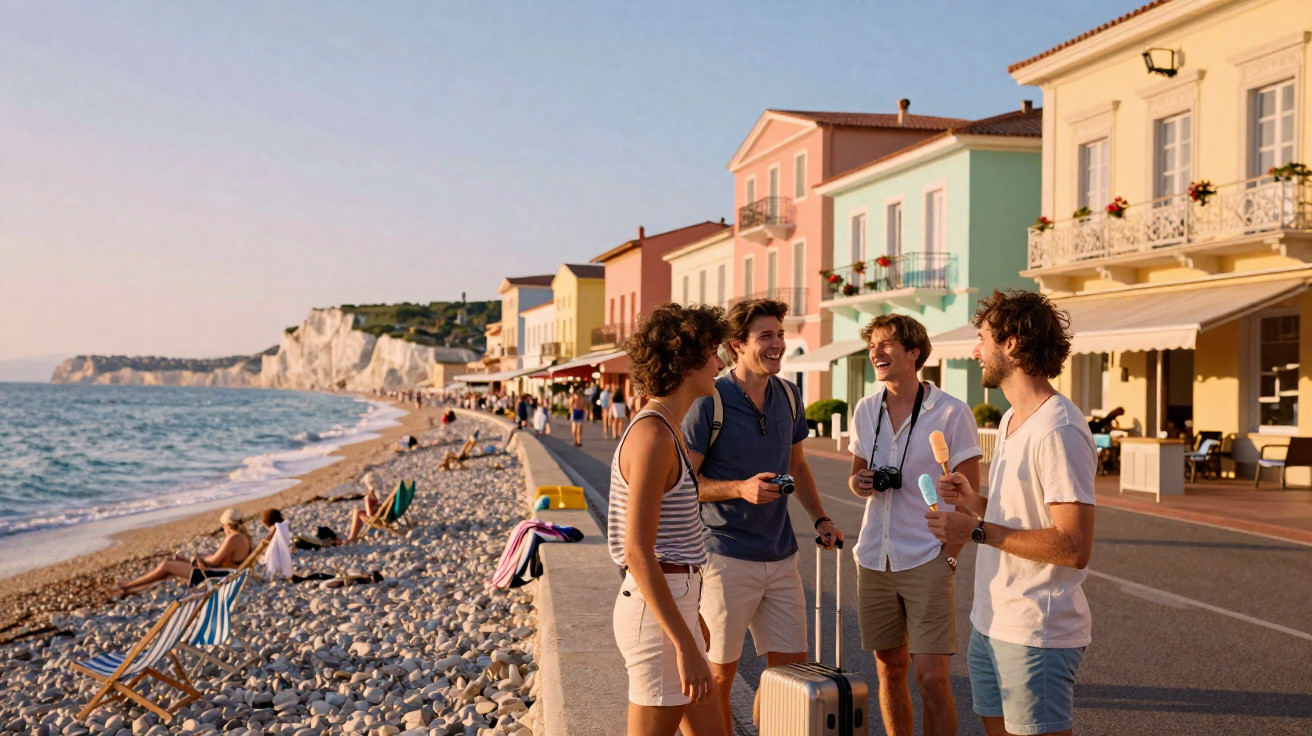
Far from the Côte d’Azur and the Riviera, a small town on the English Channel coast is suddenly taking centre stage: a prestigious lifestyle magazine has named the charming seaside resort of Mers-les-Bains the best summer destination for 2026. But what lies behind the buzz surrounding this colourful village on the border of Normandy and the former Picardy region – and why is it worth considering for travellers from German-speaking countries?
From a quiet fishing village to an elegant seaside resort
Mers-les-Bains is in the Somme department, directly on the English Channel coast. For centuries, local life revolved around fishing and a little farming. With only a handful of boats, a demanding routine dictated by tides and storms, and just a few hundred residents, it was a typical working coastal village rather than a fashionable resort.
That changed during the 19th century. Sea bathing became fashionable in France, while doctors praised the coast’s “healthy climate”. At the same time, the railway arrived in the area. Parisians could now reach the sea within a few hours instead of spending days on the journey.
As visitor numbers grew, so did expectations. Simple fishermen’s cottages no longer sufficed; people wanted places to stroll, stay and promenade. The village evolved into a seaside resort, gaining boarding houses and hotels, followed by a particularly distinctive style of architecture.
Mers-les-Bains’ Belle Époque villas in sweet-shop colours
The town’s defining look still dates from this era. Magnificent Belle Époque villas line the seafront promenade, many of them several storeys high and finished with bay windows, timber balconies, turrets and elaborately decorated railings.
Their colours are especially striking. Soft mint green, mustard yellow, raspberry red and pastel blue appear side by side, with scarcely any two façades alike. Some look almost whimsical, while others bring to mind British seaside resorts or traditional grand hotels. A walk beside the water can feel like stepping through an architectural catalogue brought to life.
“The colourful villas by the sea have become the hallmark of Mers-les-Bains and shape the town’s character more strongly than any advertising campaign.”
Many of these buildings are now listed. Some have been converted into holiday flats, while others remain in use by families who have been coming here for generations. That gives the setting a genuine character: it does not resemble an artificially created film set, but a seaside resort that has retained rather than concealed its glamorous past.
Beach, cliffs and a kilometre of sea views
One reason the magazine selected Mers-les-Bains as its summer destination for 2026 is the natural landscape immediately surrounding the village. In front of the town lies a pebble beach roughly one kilometre long; when the tide is out, a broader stretch of sand is revealed.
Above it rise the pale cliffs typical of this part of the English Channel. Depending on the light, they can appear almost white or slightly ochre. From the clifftops, visitors can look far out across the sea and, on a clear day, see as far as the neighbouring town of Le Tréport.
The beach itself is considerably quieter than many crowded Mediterranean resorts. Families settle among the characteristic pebbles, couples seek out sheltered spots, and photographers wait for the evening light, when the sun turns the cliff faces pink.
A perfect setting for sunsets
The seafront promenade is particularly popular towards evening. The colourful villas cast long shadows, café lights come on, children ride scooters and older couples sit on benches watching the waves.
Those allowing a little time can try out several viewpoints: first right by the water, then from the higher road, and later perhaps from the cliffs. The town thrives on these shifts in perspective, as the sea, sky and house fronts constantly take on a different appearance.
The trio of the “three sisters”
Together with Le Tréport and Eu, Mers-les-Bains forms a closely linked trio of towns. Officially known as the “trois villes sœurs”, or three sister towns, they are separated by only a few kilometres, and in places one line of houses seems to merge almost seamlessly into the next.
- Mers-les-Bains: a colourful seaside resort with Belle Époque villas and a focus on beach life
- Le Tréport: a lively fishing harbour with a cliff funicular and a classic harbour atmosphere
- Eu: set inland, with a château, historic old town and a slower pace
Holidaymakers can begin the day on the beach in Mers, wander around Le Tréport in the afternoon and dine in Eu in the evening. The distances are short, yet the variety of experiences is remarkable.
“The three sister towns combine beach life, harbour charm and château romance in a very small area – ideal for holidaymakers who like to see something different every day.”
Why this village became the summer destination for 2026
AD Magazine, known for its design and travel features, based its choice of summer destination for 2026 on several factors. Mers-les-Bains scored points for, among other things:
- Architecture with character rather than interchangeable large hotel complexes
- Quality of life in a town of only around 2,500 residents that still provides tourist infrastructure
- Location between the sea, cliffs and rolling green countryside
- An authentic atmosphere based not solely on luxury, but on ambience
- Accessibility through rail connections and proximity to Paris
For travellers from Germany, Austria and Switzerland, there is another advantage: the Somme coast is regarded as less crowded than many areas in southern France, while travelling by car or train through Belgium and northern France is relatively straightforward.
Things to do in and around Mers-les-Bains
The town offers more than a beach towel and sun cream. Typical activities in and around the village include:
- Walking along the seafront promenade while taking in the colourful houses
- Hiking on cliff paths, with photography stops at viewpoints
- Visiting local markets for fish, seafood and regional produce
- Trips to the Baie de Somme, a well-known coastal wetland rich in birdlife
- Short excursions to Le Tréport for its harbour, funicular and fish restaurants
Its proximity to the Baie de Somme adds another attraction to a stay. The bay is among northern France’s most distinctive landscapes, with vast tidal flats, dunes and salt meadows. Many visitors combine several beach days in Mers-les-Bains with nature outings and cycling tours in the surrounding area.
Travel advice for visitors from German-speaking countries
Anyone considering a trip should bear a few points in mind. The Somme coast has a different climate from the Mediterranean. The air is cooler, winds can be strong and the water remains fresh – ideal for anyone who often finds the Riviera too hot.
Useful pointers for planning a trip:
| Aspect | Guidance |
|---|---|
| Best time to visit | Late spring to early autumn, especially June–September |
| Getting there | By car via Lille or Amiens; by train, usually via Paris and then onwards towards the coast |
| Climate | Mild, changeable and fairly windy; ideal temperatures for walks and active holidays |
| Accommodation | Holiday flats in villas, smaller hotels and guest rooms; early booking is advisable for high season |
Families should note that beach shoes are worthwhile because of the pebbles, especially for children. Anyone planning lengthy coastal walks should pack a windproof jacket, including on days that seem summery in the morning.
More than an Instagram backdrop: what keeps Mers-les-Bains appealing
It is easy to reduce Mers-les-Bains to its colourful façades and photogenic cliffs. However, anyone staying for a few days soon notices the rather down-to-earth everyday life behind the postcard appearance: residents who know one another, seasonal workers who return each summer, and fishmongers who have traded from the same spots for decades.
For visitors, this creates a particular blend: guests feel welcome, yet the town never seems like a stage set designed purely for tourists. In cafés, it is common to sit beside local residents rather than only fellow holidaymakers. At the market, accents from across France can be heard, alongside German and Dutch voices from time to time.
Anyone interested in coastal culture will find a vivid example here of how a classic fishing village adopted the bathing culture of the 19th century and has continued it to the present day – through all its changes, but with considerable charm.
For travellers who do not want to return to the same Mediterranean beach again in 2026, this offers an intriguing alternative: a small town that feels lively rather than flawlessly polished. Its new recognition as the “best summer destination” will probably ensure that Mers-les-Bains appears far more often in holiday plans before long.





Comments
No comments yet. Be the first to comment!
Leave a Comment