
In Ottawa, Canada, a cat is battling severe obesity alongside a neurological condition. An ordinary diet plan was not enough in her case. It took an unusual catnip toy to turn things around, gradually transforming this feline into an entirely different animal.
Far from a healthy size
An adult domestic cat of average build generally weighs around four kilograms. When the cat, CC, arrived at Big House Sanctuary and Rehab in Ottawa, she weighed almost 10.5 kilograms. This placed her in the morbidly obese range, carrying all the associated risks for her joints, heart and metabolism.
CC had come from an animal shelter that wanted to help her but simply lacked the resources for a structured weight-loss programme. The shelter therefore approached Big House Sanctuary, which specialises in overweight cats and is run by experienced cat rescuer Kristine Seguin.
CC weighed almost three times as much as a normal domestic cat – a clear case of severe obesity posing a health risk.
As if her excess weight were not enough, CC also had another issue: a neurological disorder caused her to wobble and shake. Walking was tiring and unsteady for her, while jumping was almost impossible. Yet movement is precisely what obese cats need if they are to lose weight.
A gradual beginning to a new life
Before the team began, a vet gave CC a thorough examination. This was the only way to confirm that her heart, organs and joints could cope with the added strain of exercise. The broad plan was then set: fewer calories, more activity and greater mental stimulation.
Kristine Seguin had initially expected a fairly withdrawn and frustrated cat. Day-to-day life revealed something quite different: CC wanted companionship, was affectionate and friendly, but was limited by her weight and condition. The team decided to make use of the cat's sensitive nature: encouragement rather than force, and play instead of a strict exercise regime.
Toys that failed to interest her – until the banana
The biggest hurdle was getting CC to stand up at all. Traditional teaser wands, balls and rustling toy mice did not tempt her for long. She would have a brief sniff, lie back down and quickly appear frustrated. The team needed something that would genuinely hold her attention.
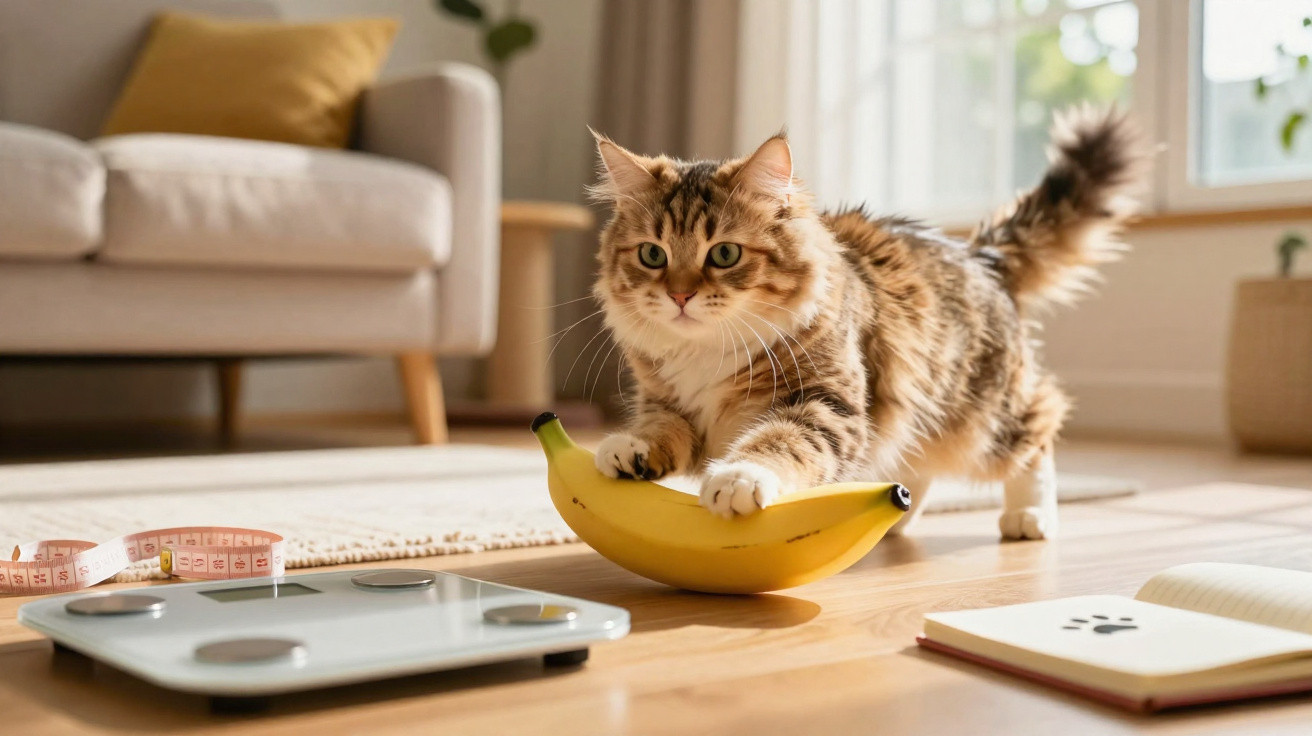
The breakthrough came from an unassuming item: a yellow fabric banana filled with catnip. As soon as CC had the toy in front of her nose, the carers saw behaviour they had not witnessed before. She began sniffing it, nibbling it and batting it with her paws – before eventually getting fully to her feet.
The catnip banana became CC's personal fitness tool – she played with it, rolled around with it, wrestled it and began burning calories.
One toy soon became several. CC now has an entire collection of these bananas. The team places them in different parts of the room, changes their positions and varies the stimulus. As a result, CC has to move if she wants to play with her favourite object.
How the catnip banana replaced formal training
Although it may sound like a silly gimmick, there is a serious principle behind it. Toys containing catnip or similar herbs use cats' sense of smell to encourage them to become active. For animals with very little motivation to move, this can be a crucial trigger.
CC showed exactly this response: she rolled across the floor with the banana, kicked at it with her hind legs and twisted around to keep hold of it. Every one of these movements uses energy. At first, the sessions lasted only a few minutes at a time. Over time, they became longer and more energetic.
- Several short play sessions spread across the day
- The banana repeatedly placed in different locations
- Alternating rest periods with more active spells
- Alongside this: adjusted food with controlled portions
At the same time, her confidence grew. CC became more willing to try things, explored new routes and attempted small jumps onto low surfaces. The shaking remained, but she learnt to live with it and exercise at her own pace.
Three kilograms lighter – a completely different daily life
The combination of diet food, set feeding times and new play routines worked. Her weight gradually fell. According to her carers, CC has now lost almost three kilograms – an enormous difference for a cat.
Three kilograms may not sound like much, but for a cat like CC they mean a new body: less strain on her joints, heart and breathing.
The change is noticeable in everyday life. CC moves more smoothly, stops less often to catch her breath and changes position of her own accord more frequently. Rather than simply lying in her spot, she actively seeks human contact. Her neurological condition has not disappeared, but her muscles have become stronger and she appears steadier on her feet.
In the team's view, CC has not yet reached her goal. She should continue losing weight carefully until she can move freely without overexerting herself. Even so, the contrast with her early days is clear: a lethargic cat whose weight posed a serious danger has become a curious animal able to use her surroundings again.
What owners can learn from CC's case
Many indoor cats become overweight, often without their owners noticing. A few hundred grams each year barely register until getting onto the sofa suddenly becomes difficult. CC's case shows that weight loss is possible, but it is almost never achieved through changing food alone.
The following measures may help owners:
- Regular weighing, ideally every one to two months
- Agreeing the food quantity with a vet rather than relying solely on packet guidance
- Fixed feeding times instead of constantly topped-up bowls
- Encouraging activity through play, using teaser wands, balls and scent-based toys
- Arranging a vet visit in the event of limping, breathlessness or heavy panting
Scented toys in particular, which appeal to the sense of smell, can get lethargic cats moving again. Catnip, valerian or special scented cushions can trigger a short, intense burst of play in many animals. This impulse can be used to get cats that have become stuck in a sedentary routine moving again in the first place.
What catnip toys actually do
Catnip contains substances that produce a kind of “catnip high” in many cats: sniffing, rubbing, rolling and chasing. Not every cat responds, but for sensitive animals such as CC, the scent alone is enough to switch on the urge to play. In the shape of bananas or cushions, the herbs can be used in a well-controlled way.
It is important not to leave these toys out permanently. If cats become used to them, their effect fades. Short, targeted sessions are better. A few minutes of intensive play can achieve more than an hour of bored wandering about.
For animals with additional health conditions, such as joint problems or neurological disorders, it is worth creating an individual plan with a vet. Sometimes mild pain relief is needed to make movement possible at all. In other cases, simple aids such as non-slip rugs or low scratching boards can reduce everyday obstacles.
Why monitoring a cat's weight can save lives
Obesity in cats is not merely a matter of appearance. Cardiovascular disease, diabetes, breathing difficulties and joint damage are all considerably more common in severely overweight animals. Many cats show pain only indirectly, for example by withdrawing or becoming aggressive when touched. Keeping an eye on weight is therefore part of essential care.
CC's case demonstrates just how much an animal can benefit from targeted care. A sound combination of medical monitoring, appropriate nutrition and creative enrichment can get even severely overweight cats moving again. And sometimes, an unassuming banana-shaped toy is all it takes to prompt the first step towards a lighter life.






Comments
No comments yet. Be the first to comment!
Leave a Comment