
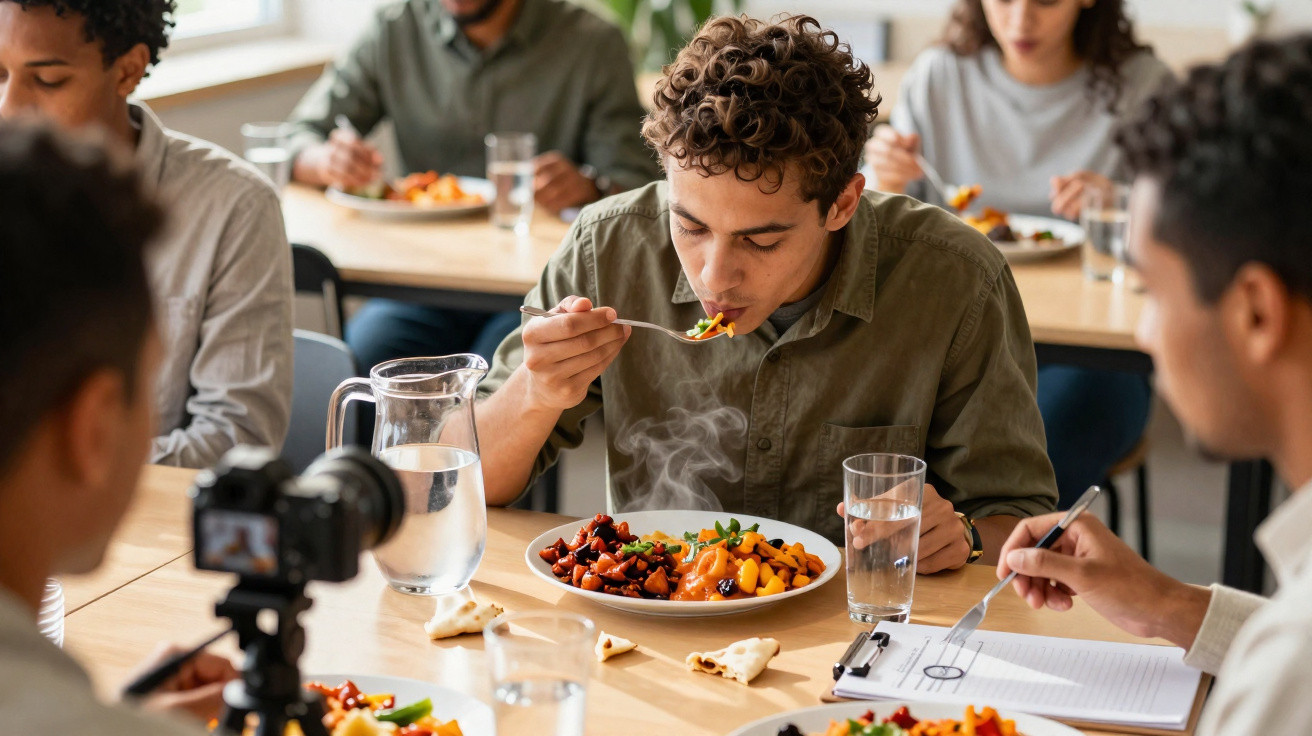
A glass of water at lunch is often assumed to help people eat less. The theory is that it stretches the stomach, brings on fullness sooner and prompts diners to put down their fork earlier.
Paige Cunningham of Cornell University and John Hayes of Penn State analysed lunch videos from 86 adults, recording the amount of water each person consumed. Those who drank the most water also ate the greatest amount of food.
Water ranks third among diet tactics
In a national health survey involving 48,026 adults, 42 percent reported that they were attempting to lose weight. Drinking more water was the third most commonly cited strategy, behind eating less and being more active.
Cunningham, an assistant professor in the Division of Nutritional Sciences, said that any sensation of fullness is short-lived. “But water is emptied quickly from the stomach,” she said.
She and Hayes wrote that research has never backed up the claim. The small number of studies that have examined it have produced conflicting results.
A 2007 study reported that water lowered food intake, but this applied only to older adults and only when they drank before sitting down to eat rather than during the meal.
An earlier study from 1981 reached the reverse conclusion, but only among people with above-average weight and in groups so small that the apparent difference may have been meaningless.
Chilli, tikka masala and a camera
The 86 adults had taken part in two previous experiments. Fifty-two were served beef chilli, while 34 ate chicken tikka masala. Every participant ate the same dish on two occasions, resulting in video recordings of 172 lunches.
Each person was given a 650 g serving and almost 450 g of water, then allowed to eat and drink as much as they wished.
For the different visits, Cunningham and Hayes varied the level of heat by combining hot and sweet paprika in changing proportions.
Researchers then reviewed the recordings. They logged every sip, estimated how large it was, measured the rate at which water was drunk and counted each change from taking a bite of food to taking a sip of water.
More water, more food
For each additional 100 g of water consumed - a little under half a cup - participants ate around 39 g more food. That is equivalent to about 49 calories.
According to Cunningham, water could serve as a lubricant that allows people to eat faster. It might also prevent the mouth becoming dry, meaning food remains pleasant for longer.
Cunningham and Hayes were surprised by another result. Participants who drank water more quickly ate less, rather than more, food.
They do not yet know why. Slow sippers may keep water in their mouths for longer, or the association may instead be explained by longer meals.
A 1978 study found the opposite pattern: people with above-average weight drank more quickly during meals than lean people.
Bites, sips and back again
People partly stop eating because food gradually becomes less appealing as a meal continues. The first mouthful of chilli tastes better than the twentieth.
Cunningham and Hayes believe that a sip of water may disrupt this process. Food becomes enjoyable again, encouraging people to carry on eating.
A person who made one additional switch consumed roughly 4.4 g more food. On its own, that is almost negligible. However, people repeatedly move between bites and sips throughout a meal, so the extra grams can accumulate.
Cunningham and Hayes characterise this switching as a habit that could lead people to eat more than they require.
Before this research, adults had been studied with only one food: the macaroni cheese used by Cunningham’s team in 2023. A separate group identified the same pattern among children the following year.
In 2025, Cunningham’s team associated more frequent switching with a year of fat gain in children from families at high risk of obesity.
Spice slowed people down anyway
Chilli peppers create their burning sensation through a single chemical, capsaicin. Although other drinks are more effective, water is what most people choose to ease the burn, and it is still better than nothing.
This prompted a question. Cunningham and Hayes had previously found that greater spiciness makes people eat more slowly and leaves more food in the bowl.
If water reduces the burning sensation, people drinking alongside a spicy meal might be expected to eat as much as they would with a mild meal, removing spice’s braking effect.
That was not what happened. Spice slowed all participants by the same degree, regardless of how much they drank or how often they alternated between bites and sips.
What two lunches cannot show
Because this analysis used information originally gathered for another question, it can identify associations but cannot establish cause and effect.
“This was a secondary analysis looking at associations,” said Cunningham.
It may simply be that people who consume more food also drink more water. The videos cannot show which happens first.
The meals were also limited to two dishes consumed in a laboratory. Cunningham and Hayes caution that the same pattern should not be assumed for very different foods or for how people eat at home.
Their next experiments are intended to examine cause and effect. “We are following up on this right now,” Cunningham said.
The complete study appeared in the journal Appetite.




Comments
No comments yet. Be the first to comment!
Leave a Comment