

A once-daily tablet has helped some people with vitiligo regain skin colour. Vitiligo causes white patches to develop on the skin.
This advance could provide a simpler treatment, especially for people whose vitiligo covers extensive areas or affects parts of the body that are difficult to reach.
Vitiligo and existing treatments
Rather than being applied to separate patches as creams are, the tablet acts throughout the body.
Vitiligo occurs when the immune system wrongly attacks the cells responsible for skin colour. Although the condition is not contagious, its visible patches can affect everyday life and mental health.
People living with vitiligo may face stigma, anxiety and social exclusion. For this reason, restoring skin colour involves more than appearance.
Current options include creams and light therapy. While they can help skin regain colour, they often require repeated treatment for many months. Creams may also be challenging to apply if vitiligo affects large areas.
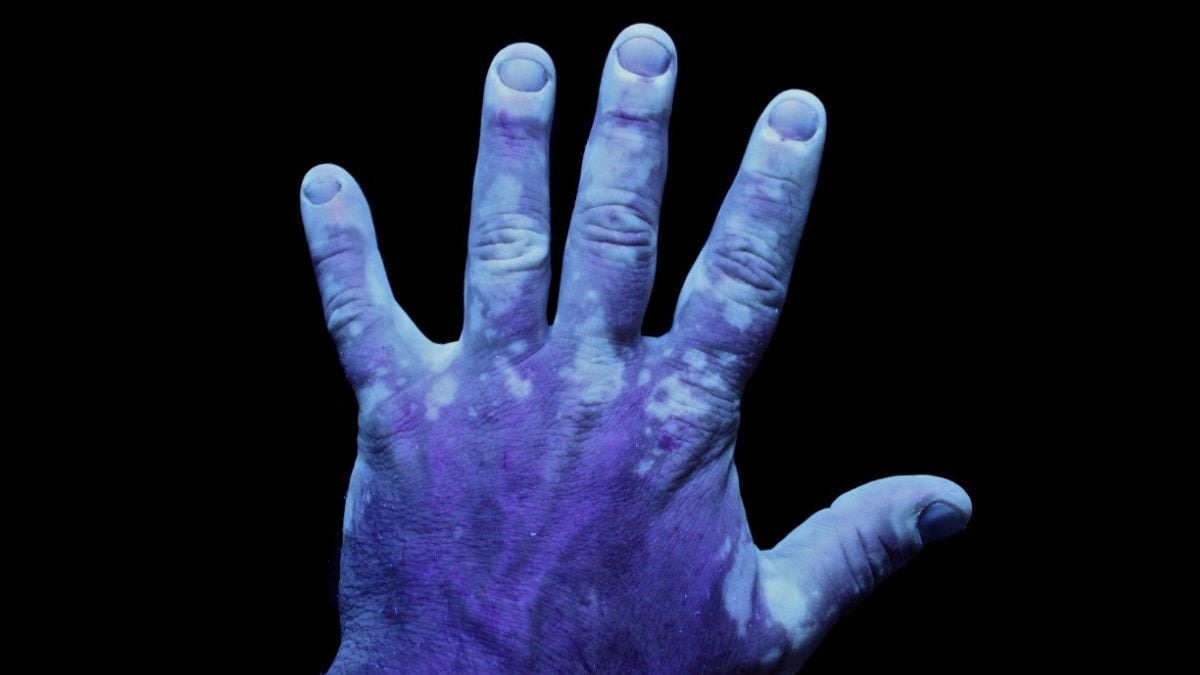
A UV photograph of a hand with vitiligo. (Chip Bobbert/CC BY-SA 4.0)
Upadacitinib trial results for vitiligo
The new research, published in The Lancet, examined a medicine called upadacitinib in 614 adults and adolescents aged 12 and over.
The two studies took place at 138 institutions across 18 countries. Every participant had the most common type of vitiligo, with patches present on both the face and body.
Participants were randomly allocated to receive either 15 milligrams of upadacitinib or a placebo once daily for 48 weeks. Neither the participants nor the researchers evaluating their skin knew who had received the actual medicine.
In the first trial, 25 percent of patients given upadacitinib recovered at least 75 percent of the colour lost from their face. The same goal was achieved by only 6 percent of placebo recipients.
Results in the second study were nearly the same: 23 percent of patients receiving the drug met the target, versus 7 percent in the placebo group.
Colour also returned elsewhere on the body. Across the two studies, 19 percent and 21 percent of patients on upadacitinib recovered at least half of the colour lost in affected areas. In each placebo group, just 6 percent saw an equivalent improvement.
Some patients achieved still greater improvement. Across both trials, 14 percent of treated patients recovered at least 90 percent of the colour lost from their face, compared with 2 to 3 percent of people receiving placebo.
Skin was continuing to regain colour when the 48-week trials finished, indicating that longer treatment might offer additional benefits.
Upadacitinib works by dampening part of the immune response that drives vitiligo. This could lessen the attack on healthy skin cells, allowing affected areas the chance to regain colour.
The medicine is part of a group known as JAK inhibitors. Other medicines in this class have also been investigated for disorders in which an overactive immune response harms the skin.
As the pill works throughout the body, it could be particularly helpful for people with extensive vitiligo or patches in areas where applying creams is difficult. It may also be more convenient than making repeated journeys to a clinic for light therapy.
Upadacitinib has now been approved in the European Union for eligible adults and adolescents aged 12 and over with this common type of vitiligo. Its approval status differs in other places.

Safety questions and limitations
Important uncertainties nevertheless remain. Around three-quarters of patients taking the tablet failed to meet the main facial-improvement target. About four in five did not recover at least half of the colour lost across their body.
The most frequently reported issues were upper respiratory infections, acne, headaches and inflammation of the nose and throat. Seven patients on the medicine developed shingles. Serious health problems occurred in 4 percent of treated patients in the first trial and 2 percent in the second.
A 48-week comparison was insufficient to exclude rare or long-term risks. When prescribed for other conditions, upadacitinib already carries warnings concerning serious infections, cancer, heart problems and blood clots.
Participants will continue to be monitored for a further 112 weeks, which could show how much additional improvement is achievable.
Related: Bacteria Living on Your Skin May Help Protect You From The Sun, Study Says
It also remains uncertain whether recovered colour will persist once treatment ends.
The trials compared the tablet against placebo rather than existing creams or light therapy. Most participants were White, and people with darker skin were underrepresented.
AbbVie, the manufacturer of upadacitinib, funded the study. The company helped to design the trials, analysed the data and took part in preparing the paper.
The results offer early evidence that a daily tablet can restore a meaningful amount of lost skin colour for some people. Longer studies will establish how durable these improvements are and assist doctors in determining who is most likely to benefit safely.
The study was published in The Lancet.
This article was fact-checked by Fiona MacDonald and edited by Peter Dockrill. While we take pride in our process, we are only human. If you spot an error, please let us know.






Comments
No comments yet. Be the first to comment!
Leave a Comment