
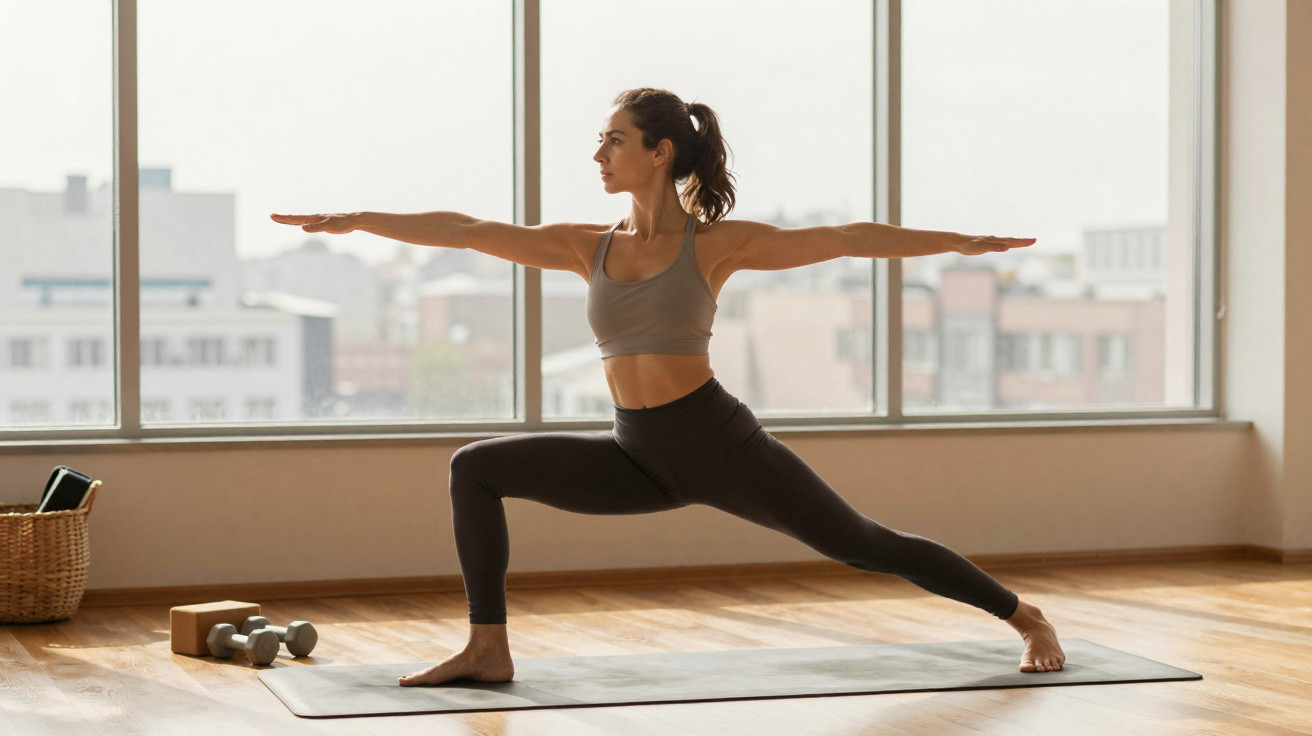
Yoga can deliver far more than flexibility, particularly when a practice includes poses that require the arms, legs and torso to support body weight. Holding positions for several seconds calls for isometric contractions, allowing strength, balance and body control to be worked at the same time. That does not mean every class creates the same training effect: very gentle sequences may serve chiefly as mobility work and relaxation.
Why can some yoga poses also act as strength exercises?
When the body holds a position against gravity, the muscles must generate tension despite there being little joint movement. This occurs in poses such as plank, chair pose and certain balance variations. This isometric work differs from simply relaxing into a stretch.
The level of intensity is determined by the pose, how long it is held and each person's ability.
- Plank poses challenge the arms, shoulders and core muscles;
- Squat-like poses engage the thighs and glutes;
- Single-leg balances place greater demands on stabilisation;
- Arm balances shift some body weight on to the upper limbs;
- Holding positions for longer raises muscular effort.
How does a yoga class differ from a traditional stretching session?
Stretching is primarily intended to develop range of movement and the tissues' tolerance of particular positions. Yoga may include that element, but it also brings together transitions, balance, breathing and held poses. Where there is enough load, certain muscles work in a similar way to during isometric exercises.
Which types of yoga practice usually involve more weight-bearing?
More dynamic styles, including Vinyasa and Ashtanga, often feature sequences containing planks, arm supports and frequent position changes. Hatha practices can also provide a meaningful stimulus when strength-focused poses are held for longer. Restorative classes and other very gentle formats, by contrast, emphasise relaxation, breathing and mobility, with little intense muscular stimulus.
There is no strict distinction based on a style's name alone, however. Two teachers may lead markedly different classes within the same style.
- Check whether planks and arm supports are included;
- Look for poses held with the knees and hips flexed;
- Notice whether the sequence contains one-leg balances;
- Consider whether the muscles genuinely have to hold the position;
- Do not mistake the sensation of an intense stretch for strength work.
Can yoga fully replace weight training?
For beginners, particular poses may provide an important muscular strength stimulus. As the body adapts, however, it becomes harder to increase load gradually and measurably through traditional poses alone. Training with weights, machines or resistance bands enables more direct progression of resistance, which is especially important for maintaining or increasing muscle mass.
Effective yoga practice combines mobility with enough effort to challenge the muscles
Choosing yoga simply because it appears to be a more complete form of stretching can create unrealistic expectations. A restorative class may be excellent for mobility, breathing and relaxation without necessarily providing a substantial strength stimulus. In contrast, sequences involving body-weight support can add muscular contractions, balance and postural control to the same session.
The point is not that yoga “only works” when it includes these poses, because its benefits depend on the goal. For improving mobility, a gentle practice may be enough; to stimulate strength as well, the muscles need to work against gravity or another form of resistance. Those seeking progressive strength or a greater stimulus for muscles and bones can use yoga as a complement, combining it with resistance exercise rather than expecting every class to produce all of these effects on its own.






Comments
No comments yet. Be the first to comment!
Leave a Comment