
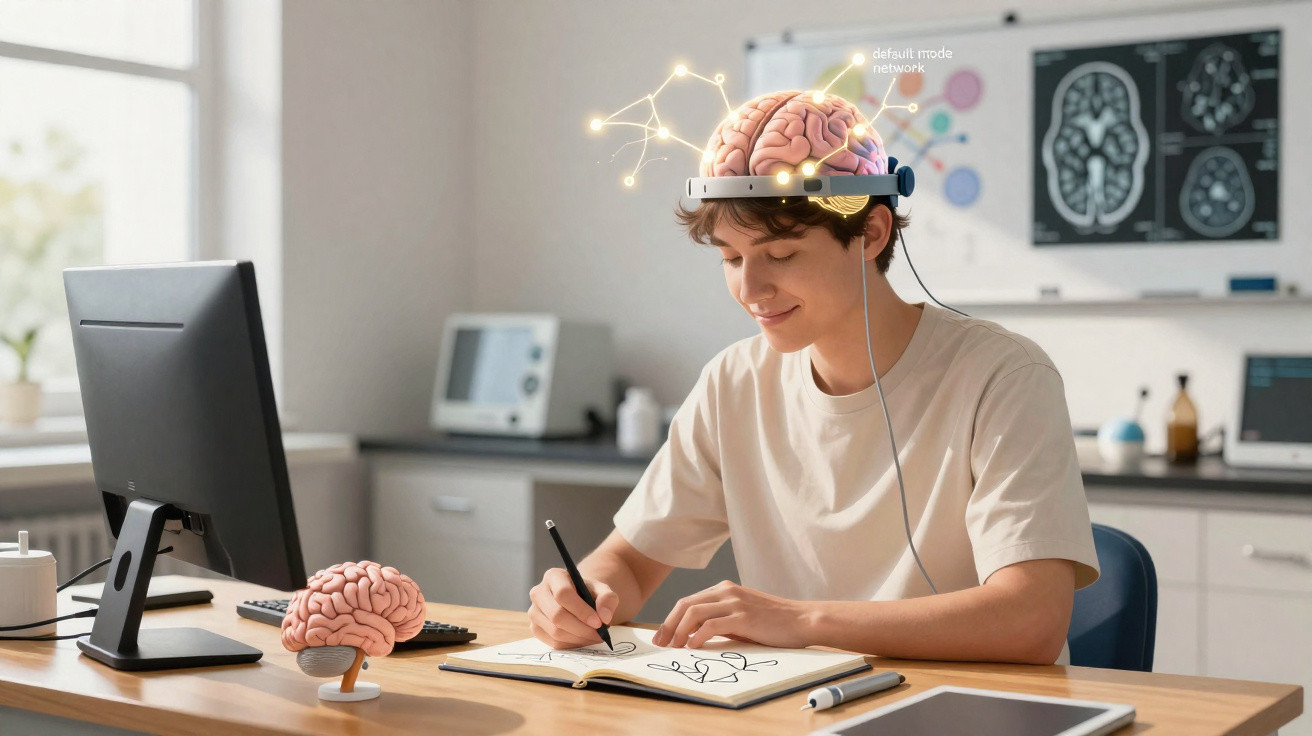
Neuroscientists believe they may have pinpointed the large-scale neural network responsible for sustaining the brain's creative flow.
Creative thinking does not reside in a single area of the brain's folded outer cortex. However, researchers led by Baylor College of Medicine believe they have identified circuits that are essential to particular forms of creativity.
Default mode network and creative thinking
When specific areas of the default mode network (DMN) were temporarily suppressed using deep brain stimulation in nine adult participants, they were less able to think outside the box.
The DMN becomes active when thoughts drift freely from one idea to another. Its organisation makes it well suited to thinking outside the box: connecting "seemingly remote concepts" to produce distinctive ideas or solutions in a spontaneous, free-flowing manner.
Earlier brain-imaging research had already associated DMN activity with creative thought. But in 2022, Ben Shofty, a neurosurgeon at the University of Tel Aviv, and his colleagues became the first to establish a causal connection between them.
While removing tumours from awake patients who had agreed to take part, the neuroscientists found that electrically inhibiting the DMN halted participants' creative flow. Volunteers were no longer able to suggest as many unusual uses for ordinary objects, such as a chair or cup.
Deep brain stimulation during epilepsy monitoring
In collaboration with the University of Utah, Shofty and his colleagues have now demonstrated a comparable result in participants undergoing invasive epilepsy monitoring.
This advanced approach uses electrodes implanted in the brain, enabling scientists to apply 'deep brain stimulation' to selected neural networks and observe changes in electrical activity.
Unlike fMRI, which infers brain activity from blood-oxygen flow, electroencephalograms measure neuronal electrical activity directly and in real time. Electrodes placed inside the brain are also more sensitive than those attached to the skull.
For the new study, 13 epilepsy patients with implanted electrodes were asked to name as many new uses as possible for an everyday object. They were given one minute to carry out the task.
"We could see what's happening within the first few milliseconds of attempting to perform creative thinking," says Shofty.
The DMN was the first brain region to become active. Soon afterwards, its activity synchronised with that of other brain areas, including regions involved in problem-solving and decision-making.
Shofty believes this indicates that the DMN retrieves and sorts different forms of information to create new ideas, before passing them to regions responsible for critical evaluation. This 'top-down' cognition enables the brain to "parse through inappropriate associations and select for useful, novel thoughts," the authors say.
Lateral thinking relies on specific DMN regions
The latest results may help explain why a shower, or simply allowing the mind to wander, can be so effective for generating original ideas and solutions.
Across all 13 participants, the researchers identified particular DMN areas that were especially connected with lateral thinking, whereas other areas were more strongly associated with mind wandering.
Temporarily suppressing the DMN regions linked to lateral thinking through implanted electrodes made it more difficult for patients to devise new uses for ordinary items. Their ability to let their minds wander, however, was unaffected.
"We moved beyond correlational evidence by using direct brain stimulation," says Eleonora Bartoli, a neurosurgeon at Baylor College of Medicine.
"Our findings highlight the causal role of the DMN in creative thinking."
The study was published in Brain.






Comments
No comments yet. Be the first to comment!
Leave a Comment