

Ketamine is an unusual chimera of a drug.
It can serve as an anaesthetic, painkiller, dissociative drug, hallucinogen and exceptionally rapid-acting antidepressant.
Traditionally, this peculiar mix of effects has been credited to its action at the N-methyl-D-aspartate (NMDA) receptor, one of the brain’s principal receptors for glutamate, an excitatory neurotransmitter.
Yet researchers have suspected for many years that the explanation was not so simple.
A team headed by pharmacologist Tao Che at Washington University School of Medicine has now reported "unambiguous structural evidence" that some of ketamine’s actions may additionally stem from its direct interaction with the brain’s opioid receptors.
Published in Nature Structural & Molecular Biology, the finding clarifies both ketamine’s effects and the way it produces them.
Perhaps more significantly, it addresses important gaps in knowledge that could refine the clinical use of ketamine.
"Ultimately, the unique therapeutic profile of ketamine cannot be reduced to a single molecular interaction," write neuroscientists Jordi Bonaventura of the University of Barcelona in Spain and Michael Michaelides of the US National Institute on Drug Abuse in a related commentary.
"Instead, the convergence of structural evidence confirming the direct engagement of ketamine with opioid receptors, together with its classical role as an NMDAR antagonist, establish a compelling case for a bifunctional mechanism of action."
Ketamine’s history and the opioid receptor question
Ketamine’s story starts in the 1950s with phencyclidine, or PCP, a synthetic dissociative drug. Although PCP was developed as an anaesthetic, it caused serious adverse effects, including delirium and hallucinations, psychotic behaviour and seizures.
Seeking a safer alternative, scientists modified PCP during the 1960s to create ketamine. It has subsequently become highly useful as both an anaesthetic and an antidepressant. Like the drug from which it originated, ketamine has generally been understood chiefly as an NMDA receptor antagonist.
Even several decades ago, though, evidence suggested ketamine did more than exert a simple NMDA effect.
A 1978 paper showed that PCP and similar drugs could bind opioid receptors. Then, a 1984 paper found that naloxone - a blocker of opioid receptors - disrupted ketamine’s effectiveness as a general anaesthetic.
Other experiments, however, delivered conflicting results. And although technological advances allowed scientists to image molecules, the decisive evidence - ketamine physically occupying the main binding pocket of human opioid receptors - remained out of reach.
Che and his colleagues set out to obtain precisely that evidence. Their findings leave little doubt that ketamine directly engages opioid receptors.
The researchers first assessed ketamine against the three principal opioid receptor types - mu, kappa and delta - using human opioid receptors expressed in laboratory-grown cells. The drug was able to bind to and activate each of the three, but produced stronger effects at mu and kappa receptors.
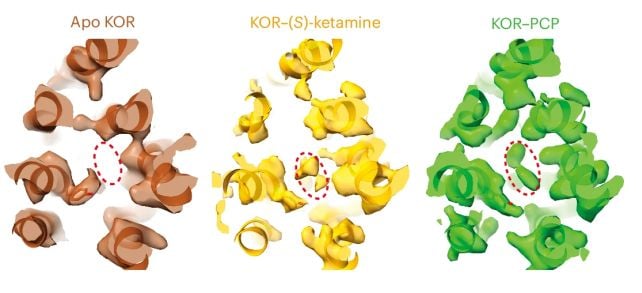
A comparison of the empty kappa opioid receptor with the same binding pocket occupied by PCP and ketamine. (Jiang et al., Nat. Struct. Mol. Biol. , 2026)
The team also established that ketamine is a partial agonist. In other words, it does not merely attach to an opioid receptor: it activates it, although less powerfully than the full opioid agonists used as comparisons by the researchers.
Next, they used cryo-electron microscopy to observe the precise site at which ketamine binds.
There it was: ketamine sat securely within the primary binding pocket of both mu and kappa opioid receptors, the same broad pocket targeted by conventional opioids.
This was the missing decisive evidence: direct structural proof that ketamine was not merely affecting the opioid system indirectly, but physically engaging opioid receptors.
Ketamine’s pain-relieving effects in mice
Binding physically to a receptor does not automatically demonstrate that a compound produces a measurable or meaningful effect in a living animal. To address that question, the researchers turned to the established mouse model.
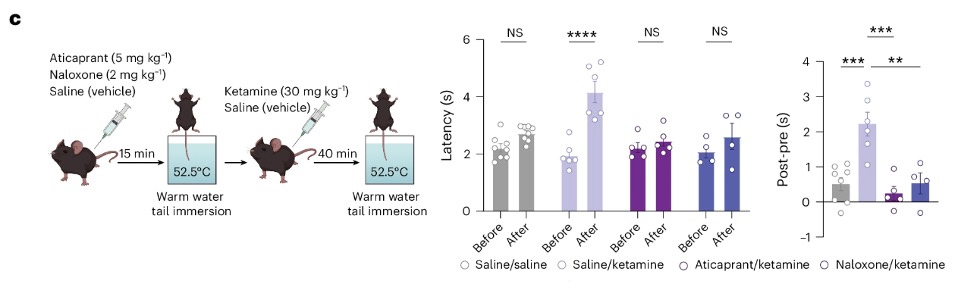
In animal experiments, the analgesic effects of ketamine (light purple) were blocked with aticaprant (dark purple) and naloxone (dark blue). (Jiang et al., Nat. Struct. Mol. Biol. , 2026)
They administered a subanaesthetic dose of ketamine to mice and measured how long it took the animals to remove their tails from warm water. As anticipated, ketamine delayed the mice’s tail withdrawal.
But when the mice were first given medicines that block opioid receptors, the effect vanished.
When ketamine was paired with naloxone, which broadly blocks opioid receptors, or aticaprant, which specifically blocks kappa opioid receptors, the mice reacted to the warm water as if they had received no ketamine at all.
This does not overturn everything previously understood about ketamine. The drug still binds more strongly to NMDA receptors, and this interaction remains significant for many of its effects.
However, the research indicates that ketamine’s distinctive properties may arise from its capacity to act on both systems simultaneously.
The clearest evidence to date concerns pain relief. The mouse studies indicate that opioid receptors contribute to ketamine’s analgesic effects, although the exact way the receptor systems operate together is still uncertain. This could provide an avenue for later research.
Whether opioid activity also accounts in part for ketamine’s antidepressant effects is less certain. Earlier studies have found evidence that opioid receptors are involved, but this new work did not examine whether ketamine’s direct interaction with those receptors drives its antidepressant properties.
Misuse, addiction and improved ketamine treatments
The finding could also matter for a less welcome feature of ketamine: its potential for misuse and addiction.

The mu opioid receptor is of particular interest in this respect. Earlier animal research has linked this receptor to ketamine’s reinforcing effects - the characteristics that promote repeated use of a drug. The discovery that ketamine can bind directly to and activate this receptor offers a possible molecular connection.
Related: Repeated Ketamine Use Fundamentally Changes The Brain's Dopamine System in Mice
That does not mean ketamine dependence is simply another variety of opioid dependence. Ketamine is now known to act on multiple brain systems, and it remains to be established exactly how each one contributes to therapeutic effects, reinforcement and the potential for misuse.
The encouraging prospect is that unpicking these effects could enable scientists to develop an even better version of ketamine.
"An important question is whether ketamine's therapeutic benefits can be pharmacologically dissociated from its abuse potential by appropriately balanced activation of NMDAR and opioid receptors," the researchers write in their paper.
"The structural insights gained here could guide the optimization of ketamine with reduced side effects."
The findings were published in Nature Structural & Molecular Biology.
This article was fact-checked and edited by Clare Watson. Although we take pride in our process, we are only human. If you notice an error, please let us know.






Comments
No comments yet. Be the first to comment!
Leave a Comment