
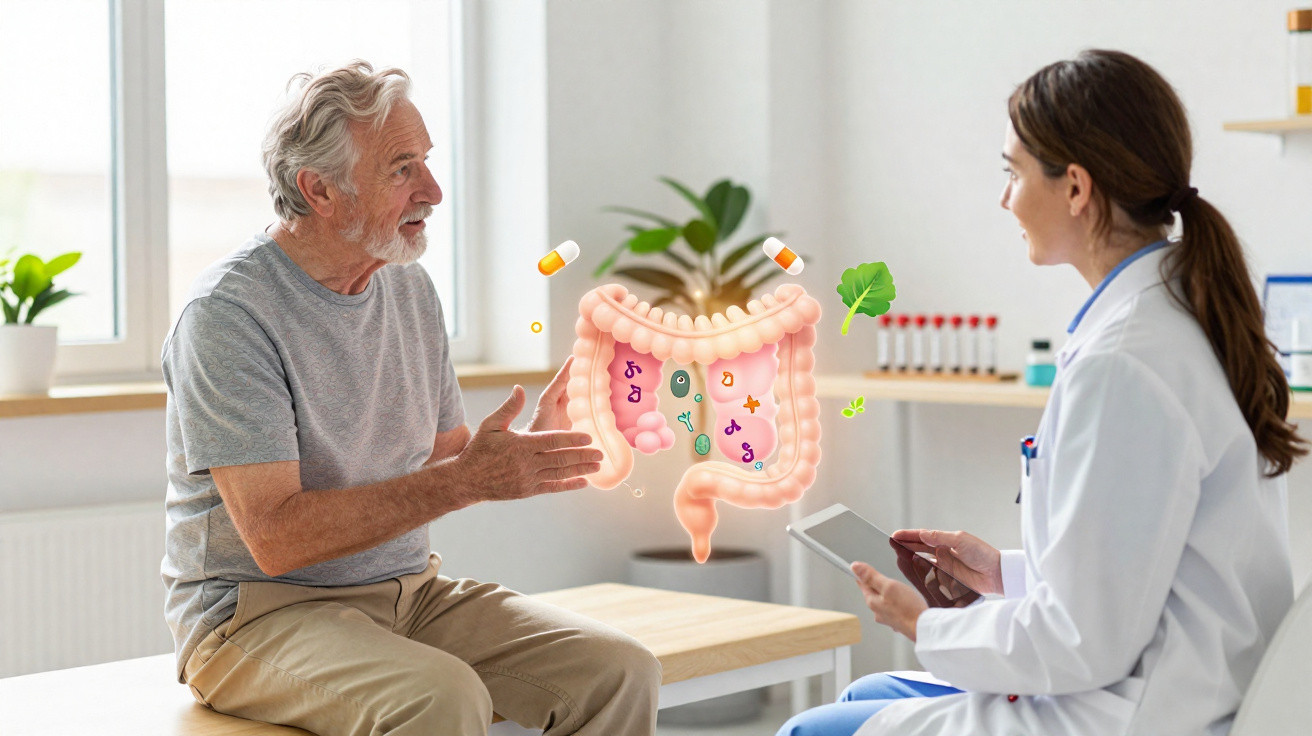
Long before a diagnosis of Parkinson's – in some cases up to two decades earlier – the condition may already be signalling its presence in the body.
Rather than through tremors or other visible signs, it can first appear in subtler forms: constipation and disrupted sleep.
For years, scientists could not explain why digestive problems emerged so early in a neurodegenerative disorder. It is an unusual and understated warning system.
Increasingly, however, researchers have suspected that the explanation involves not just the gut, but also the organisms that live within it.
Gut bacteria and B vitamins in Parkinson's
In 2024, researchers led by Nagoya University medical scientist Hiroshi Nishiwaki in Japan produced some of the strongest evidence to date connecting gut bacteria with Parkinson's.
They compared faecal samples from 94 people with Parkinson's disease with samples from 73 people without the condition, then compared their findings with data from China, Taiwan, Germany, and the US.
Although the composition of gut bacteria differs between countries, the same biological pathways seemed to be affected in Parkinson's. These pathways produce B vitamins, particularly riboflavin (B2) and biotin (B7).
The team therefore suggested that B-vitamin supplementation might be investigated as a future Parkinson's treatment.
"Supplementation therapy targeting riboflavin and biotin holds promise as a potential therapeutic avenue for alleviating Parkinson's symptoms and slowing disease progression," said Nishiwaki when the research was published in May 2024.
Likewise, a small 2003 study reported that high doses of riboflavin might restore certain motor functions in Parkinson's patients who also removed red meat from their diets. However, the study's design could not determine whether riboflavin itself was responsible for the improvements.
Nishiwaki and colleagues found that low B-vitamin levels were associated with reduced short-chain fatty acids (SCFAs) and polyamines, molecules that help maintain a healthy intestinal mucus layer.
"Deficiencies in polyamines and SCFAs could lead to thinning of the intestinal mucus layer, increasing intestinal permeability, both of which have been observed in [Parkinson's disease]," Nishiwaki explained.
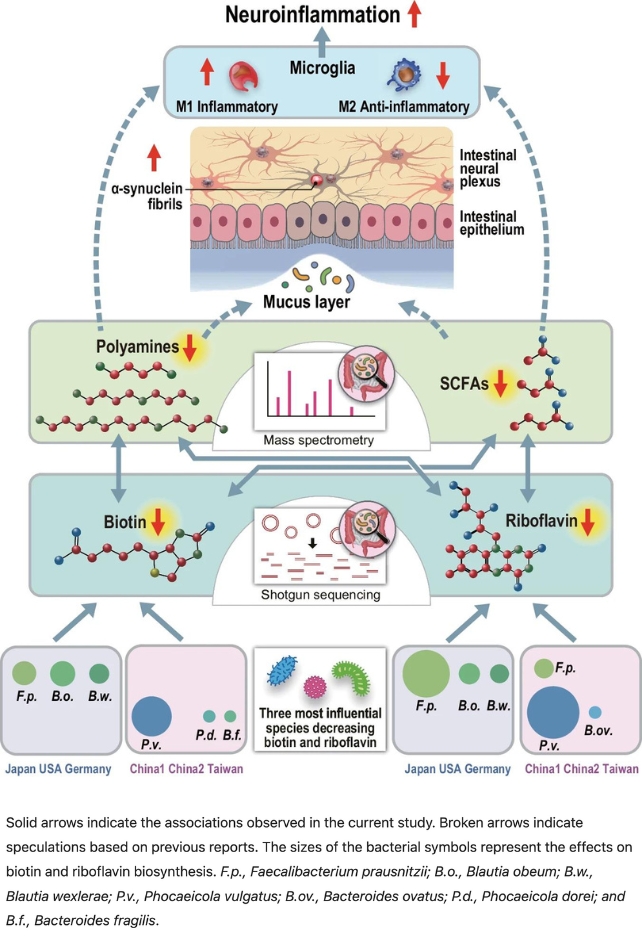
Overview of the study's findings and hypotheses from earlier research. (Nishiwaki et al., npj Parkinson's Dis., 2024)
The researchers suggested that diminished levels of these metabolites may compromise the intestinal mucus barrier, making the gut more permeable. That could allow greater exposure to everyday toxins, including cleaning chemicals and pesticides and herbicides.
"This higher permeability exposes nerves to toxins, contributing to abnormal aggregation of alpha-synuclein, activating the immune cells in the brain, and leading to long-term inflammation," Nishiwaki said.
Alpha-synuclein is a protein that forms clumps in the dopamine-producing brain cells of people with Parkinson's. Its accumulation is thought to contribute to the condition's gradual progression towards tremors, muscle stiffness, and dementia.
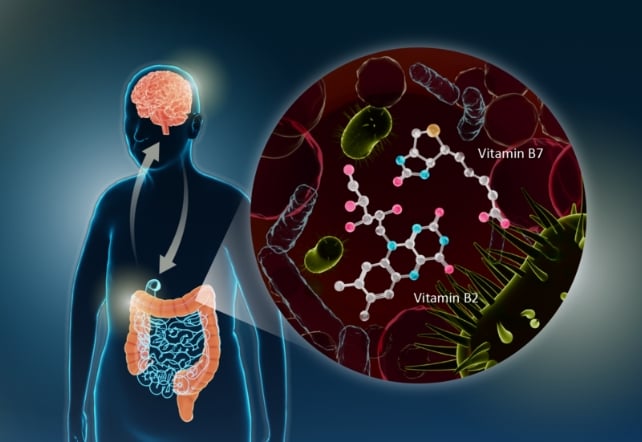
Parkinson's disease was associated with fewer gut-bacterial genes responsible for producing the essential B vitamins B2 and B7. (Reiko Matsushita)
Faecal microbiota transplants tested in Parkinson's
During the past two years, two independent teams have trialled faecal microbiota transplants – also known as stool or poo transplants – in people with Parkinson's.
The procedure is precisely what its name implies: processed stool from a thoroughly screened donor is transferred into a patient's gut. It can be administered in several ways, including through a tube during a colonoscopy.
It may sound like an improbable treatment, yet the therapy has already shown potential to relieve depression and type 2 diabetes, as well as encouraging early signs against food allergies.
Evidence from two randomised, placebo-controlled studies in Belgium and China suggests it could also benefit people with Parkinson's.
The first was the Belgian GUT-PARFECT trial, in which 46 people with mild-to-moderate Parkinson's received either a donor transplant or their own stool as a placebo.
After one year, motor symptom scores had improved by 5.8 points in the donor group, versus 2.7 points in the placebo group. The largest improvements occurred from six to twelve months.
"After 12 months, participants who received the healthy donor stool transplant showed a significant improvement in their motor score," said gastroenterologist Arnout Bruggeman, a member of the University Hospital Ghent team that conducted the trial, when its results were published in 2024.
(Juan Moyano/Canva)
"Our study provides promising hints that [fecal microbiota transplants] can be a valuable new treatment for Parkinson's disease," said team member Roosmarijn Vandenbroucke.
"More research is needed, but it offers a potentially safe, effective, and cost-effective way to improve symptoms and quality of life for millions of people with Parkinson's disease worldwide."
Results from the Belgian and Chinese trials
Then, in March this year, a substantially larger trial from Zhengzhou University in China added further support for the approach.
The researchers assigned 72 newly diagnosed Parkinson's patients who had not received treatment to repeated donor transplants or their own stool, delivered in three rounds over several months.
At 35 weeks, motor scores had improved by an average of 3.8 points in the donor group. The control group's scores changed little, worsening by an average of 0.1 points. Constipation scores also improved markedly.
Nearly half of those receiving donor material experienced a clinically meaningful improvement in motor function, compared with roughly one-fifth of the control group.
In the donor group, potentially harmful bacteria such as E. coli and Shigella became less common. The gut lining strengthened, stool dopamine levels increased and, importantly, gut levels of alpha-synuclein fell.
This is the same molecule that Nishiwaki's team had identified two years earlier as the connection between a leaky gut and brain damage.
"These findings demonstrate that repeated donor FMT is safe, well tolerated, and yields clinically meaningful motor and gastrointestinal improvements," the Chinese study's researchers wrote in [Signal Transduction and Targeted Therapy](https://doi.org/10.1038/s41392-026-02604-9) – adding that the results "reinforce the growing body of evidence supporting gut microbiota modulation as a viable disease-modifying avenue" in Parkinson's disease.
Related: Parkinson's Disease Might Not Start in The Brain, Study Finds
Both studies remain small, and, as with any phase 2 findings, their results require further confirmation.
Faecal transplants may not be the eventual outcome of this research. Nevertheless, they offer another proof of principle that altering gut bacteria can affect Parkinson's symptoms.
"Using these findings, we could identify individuals with specific deficiencies and administer oral riboflavin and biotin supplements to those with decreased levels, potentially creating an effective treatment," said Nishiwaki back in 2024.
The research has appeared in npj Parkinson's Disease, eClinical Medicine, and Signal Transduction and Targeted Therapy.
This article was fact-checked and edited by Rebecca Dyer. Although we take pride in our process, we are only human. If you notice an error, please let us know.




Comments
No comments yet. Be the first to comment!
Leave a Comment