

Looking younger and making ageing skin biologically younger are not necessarily the same thing.
Fillers, lasers, microneedling and other widely used aesthetic treatments may visibly enhance the skin. Yet a new review indicates that there is unexpectedly little evidence that such improvements constitute biological "rejuvenation" or "regeneration".
Aesthetic treatments and biological rejuvenation
Researchers examined 136 publications covering popular aesthetic treatments to address a straightforward question: do these procedures merely make skin appear younger, or can they genuinely renew ageing tissue?
The study, published on Research Square, has not yet undergone peer review.
The publications included common treatments such as fillers, lasers, platelet-rich plasma (PRP), ultrasound, microneedling and radiofrequency. Rather than only considering whether the skin's appearance improved following treatment, the researchers sought evidence of changes to its underlying structure and function.
They applied a 22-point system intended to assess more than collagen increases, examining whether research had investigated wider changes to the structure, function and cells of ageing skin.

What the evidence scores showed
The findings exposed a considerable gap in the evidence.
Of the 34 primary studies that could be scored, 26 – or 76.5 per cent – were placed in the category the researchers termed "inadequate evidence".
Crucially, these scores are not measures of a treatment's effectiveness. Instead, they indicate how many distinct types of biological evidence for rejuvenation were investigated.
No study received more than 5 out of 22. In the researchers' system, 6 points is the threshold for the lowest category they call "rejuvenation".
The study that achieved a score of 5 examined cells in a laboratory rather than people. Of the clinical studies involving people, the highest score was 4.
According to the researchers, this does not mean aesthetic treatments have no effects. Rather, it suggests that the studies assessed had not assembled the breadth of biological evidence required by their framework to establish rejuvenation.
Much of the available research concentrated on one well-known substance: collagen.
Collagen gives the skin strength and structure, and some aesthetic treatments can prompt its production. However, lead author and cell biologist William Richard Webb of Innovation Aesthetics says that increased collagen alone does not prove the skin has regenerated.
"Claiming one part is conclusive without assessing all components is like trying to make bread, and the only ingredient you have is yeast," Webb told ScienceAlert.
The researchers found that most studies focused on collagen, while examining other possible indicators of biological rejuvenation far less frequently. These included the organisation of newly formed tissue, whether skin function changed, and whether cellular changes linked with ageing had been reversed.
Scientists investigating biological ageing can look past outward appearance to alterations within cells. Earlier research on human skin cells, for instance, has assessed shifts in gene activity and chemical markers associated with biological age.
Other skin-ageing research has explored age-related changes in DNA and cells' capacity to multiply.
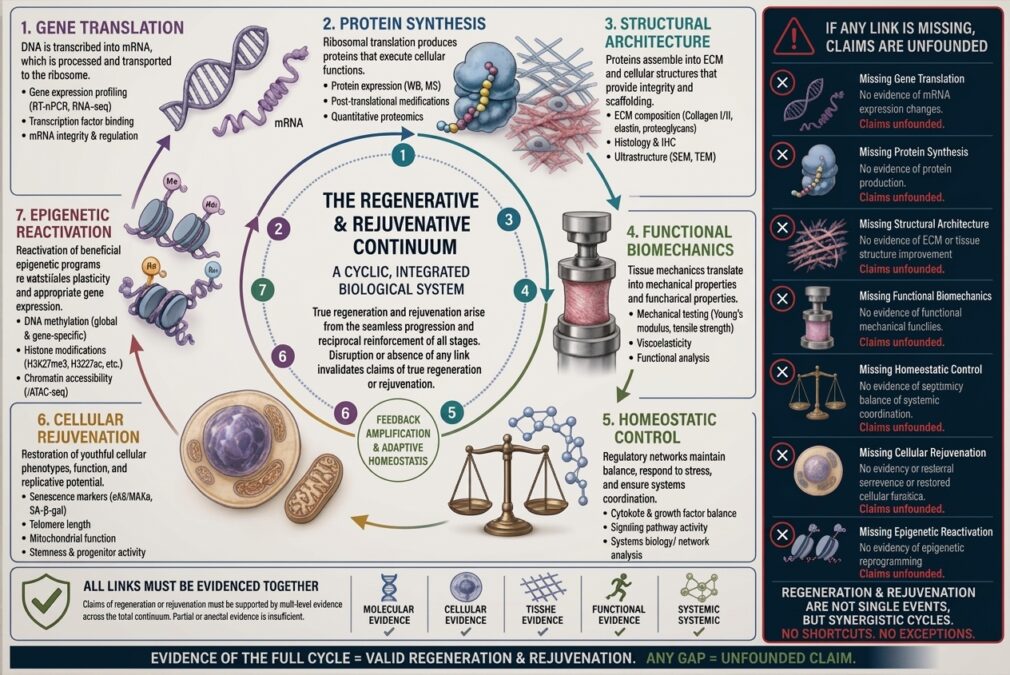
The seven biological domains used by the researchers to assess claims of true tissue regeneration and rejuvenation. (Webb et al., Research Square, 2026)
Benefits, research limitations and marketing claims
None of this suggests that aesthetic treatments offer no benefits. Fillers can restore volume, certain treatments can raise collagen levels, and some laser procedures can improve skin appearance and texture.
The review instead asks whether these effects are sufficient to describe a treatment as "regenerative" or biologically "rejuvenating."
This discussion predates the new study. A 2026 review argued that regeneration in aesthetic medicine should be separated from temporary changes in appearance, while another recent review found that evidence differs between treatments and that more standardised research is necessary.

Webb and his team's review also highlighted shortcomings in the way some existing studies were conducted.
Many used small participant groups, some did not include comparison groups, and others depended on subjective assessments rather than objective measurements. Such limitations can reduce certainty in the results.
The distinction is also important in the way aesthetic treatments are marketed to consumers.
"Marketing claims must mirror scientific evidence," Webb told ScienceAlert.
He says that when terms such as "regeneration" or "rejuvenation" are used, people should be able to understand both what a treatment has been demonstrated to do and what is still unproven.
Related: There Are 10 Signs of Faster Aging Hidden in Your Blood, Study Says
The new study itself also has limitations.
The 22-point system was created by the research team and might not encompass every dimension of skin rejuvenation. The review searched only three scientific databases, and some studies may have measured biological changes that were not reported.
For the moment, the findings underline a simple difference: demonstrating that a treatment can make skin look younger is one thing. Showing that ageing skin has genuinely become biologically younger demands a far higher standard of evidence.
This study is available as a preprint on Research Square.
This article was fact-checked by Rebecca Dyer and edited by Rebecca Dyer. Although we take pride in our process, we are only human. If you spot an error, please let us know.





Comments
No comments yet. Be the first to comment!
Leave a Comment