

An estimated one in four adults in the US has high LDL cholesterol. Over time, it can accumulate in the arteries and raise the likelihood of heart attack and stroke.
However, ‘bad’ cholesterol is not the only concern.
Other lipids and lipoproteins may also reach abnormally high levels in the bloodstream, a condition known as dyslipidaemia. This can contribute to atherosclerotic cardiovascular disease (ASCVD), the leading cause of death and morbidity worldwide.
This year, US specialists revised their official guidance for cholesterol management and dyslipidaemia prevention, replacing the previous 2018 guidelines.
Earlier cholesterol management under the new US guidelines
Although cholesterol management remains central to the new guidelines, they adopt a wider approach that stresses earlier action on blood fats that may damage health.
"We know 80 percent or more of cardiovascular disease is preventable and elevated LDL cholesterol, sometimes referred to as 'bad' cholesterol, is a major part of that risk," says cardiologist Roger Blumenthal, of the Johns Hopkins Ciccarone Center for the Prevention of Cardiovascular Disease and chair of the guideline writing committee.
"While we want to try to optimize healthy lifestyle habits as the first step to lower cholesterol, we realize that if lipid numbers aren't within the desirable range after a period of lifestyle optimization, we should consider adding lipid-lowering medication earlier than we would have considered 10 years ago."

Atherosclerotic cardiovascular disease, fuelled in part by high LDL cholesterol, is the world's leading cause of death. (American Heart Association)
Written for doctors and other clinicians, the updated guidelines chiefly advocate treating dyslipidaemia sooner, to lower the lifetime risk linked with long-term exposure to atherogenic lipoproteins.
"Lower LDL cholesterol for longer, just like lower blood pressure for longer, results in much greater protection against future heart attack and stroke risk," Blumenthal says.
Accordingly, cholesterol screening is advised for children aged 9–11 years who have not already been screened. Screening may start from as young as two years old when there is a family history of serious cardiovascular or cholesterol-related disease.
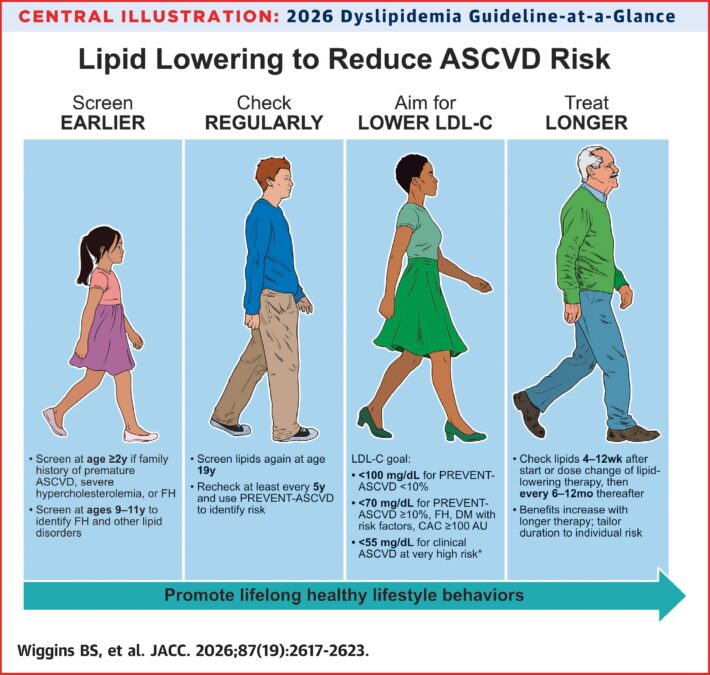
The 2026 dyslipidaemia guidelines at a glance. (Wiggins et al.,* JACC*, 2026)
PREVENT calculator and ASCVD risk assessment
The guidance also tells doctors to use a new disease-risk calculator, PREVENT, to estimate patients’ 10-year and 30-year cardiovascular disease risk between the ages of 30 and 79.
"With this new assessment tool, we can better estimate cardiovascular risk using health information already obtained during an annual physical – cholesterol, blood pressure readings, and other personal information such as age and health habits – and then further personalize the risk score for each individual by looking at 'risk enhancers', which can help guide the need for lipid-lowering therapy," Blumenthal says.
Based on the new equations, doctors may consider LDL-lowering therapies - from lifestyle measures to LDL-lowering medicines such as statins - for patients judged to have borderline risk, meaning a 3–5 percent likelihood of developing ASCVD within 10 years. They ought to consider them for intermediate-risk patients, whose risk is 5–10 percent.
The revised guidelines also bring back target LDL levels to inform lipid-lowering treatment. Researchers say LDL-C goals should be less than 100 mg/dL for people at borderline or intermediate risk, and less than 70 mg/dL for those at high risk. For patients with ASCVD considered to be at very high risk, the target is less than 55 mg/dL.
"In general, lower LDL is better, especially for people at increased risk for a heart attack or stroke," says cardiologist Pamela B. Morris of the Medical University of South Carolina.
"Clinical trials have clearly demonstrated significant benefits for reduction in cardiovascular events when LDL-C levels are even lower than recommended in previous guidelines."
Related: A Common Cholesterol Treatment May Also Remove PFAS And Microplastics From Blood
LDL-lowering medicines and lifestyle changes
Though statins remain the main medicines for reducing LDL levels, the guidance also includes other treatments: ezetimibe, bempedoic acid, PCSK9 inhibitors, and inclisiran.
For patients, the revised advice includes eating healthily, recognising that lifestyle changes can reduce cholesterol, and acting early through regular check-ups, among other recommendations.
When ‘bad’ cholesterol is moving in the wrong direction despite your best efforts, doctors can help - and, under these new guidelines, that may mean making changes sooner rather than later.
The guidelines appear in the Journal of the American College of Cardiology.
This article was fact-checked and edited by Rebecca Dyer. Although we take pride in our process, we are only human. If you spot an error, please let us know.






Comments
No comments yet. Be the first to comment!
Leave a Comment