

One of the most frustrating yet familiar aspects of getting older is finding that a joint no longer works as it should: knees hurt when you crouch down, while shoulders click and clunk.
For decades, the prevailing view has been that cartilage cannot be regrown once it has deteriorated inside a joint.
15-PGDH and cartilage regeneration
Scientists at Stanford University now believe they may have identified the switch preventing that repair process. They traced age-related cartilage loss to a single protein, and when they blocked it in mice, old and worn cartilage began growing thicker again.
The protein is an enzyme known as 15-PGDH, which has already been extensively associated with ageing. As people grow older, levels of 15-PGDH rise, disrupting molecules involved in tissue repair and reducing inflammation.
That ageing connection prompted the Stanford researchers to ask whether the protein could also drive osteoarthritis – a condition in which cartilage collagen breaks down, causing joint pain and inflammation.
In older mice, inhibiting 15-PGDH increased the thickness of cartilage that had already deteriorated. In younger mice with a recent injury, it also stopped the arthritis that would ordinarily develop. To investigate, the team recreated the mouse equivalent of an anterior cruciate ligament (ACL) tear before blocking 15-PGDH. The osteoarthritis normally expected after this type of injury did not develop.
Particularly notably, stem cells appeared not to be involved in this study. Instead, chondrocytes – mature cells that build and maintain cartilage – were able to return to a healthier state when 15-PGDH was reduced.
"This is a new way of regenerating adult tissue, and it has significant clinical promise for treating arthritis due to aging or injury," Stanford University stem cell biologist Helen Blau said in November last year, when the research was initially published.
"We were looking for stem cells, but they are clearly not involved. It's very exciting."
As shown below, cartilage in aged mice where 15-PGDH had been blocked (far right) looked similar to the young, healthy cartilage on the left.
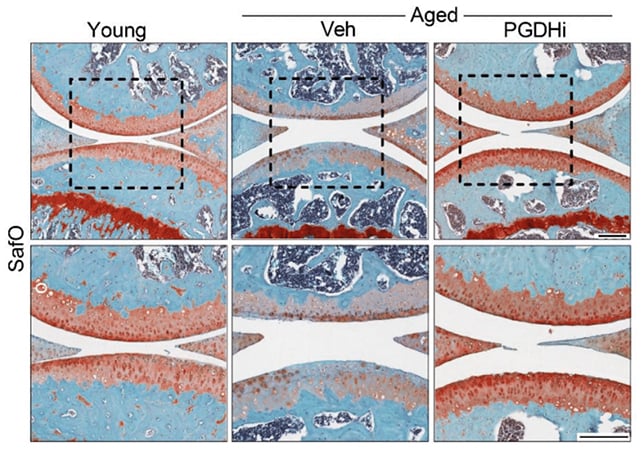
Treated aged cartilage (far right, stained red) looked much more like young, healthy cartilage (far left, stained red). (Singla et al., Science, 2025)
The findings were not limited to mice. The researchers also applied the method to human cartilage collected from people having knee-replacement surgery, finding the same trend: after treatment, the tissue was stiffer and less inflamed.
"The mechanism is quite striking and really shifted our perspective about how tissue regeneration can occur," explained orthopaedic scientist Nidhi Bhutani.
"It's clear that a large pool of already existing cells in cartilage are changing their gene expression patterns. And by targeting these cells for regeneration, we may have an opportunity to have a bigger overall impact clinically."
Other approaches to treating osteoarthritis
This possible therapy is compelling in its own right, but it is only one entry in an increasingly busy effort to eliminate osteoarthritis.
The US government's Advanced Research Projects Agency for Health (ARPA-H) has committed more than US$100 million to accelerate several teams pursuing the same broad objective through different biology, as part of a programme called NITRO.
After two years, these teams have already regenerated cartilage and bone in animals; their next target is human patients.
Earlier this year, one grant recipient, the University of Colorado Boulder, made headlines after its researchers revealed a slow-release drug-delivery system. Injected into an injured joint, it encourages the body's own cartilage and bone cells to repair themselves within only a few weeks.
So far, all testing has taken place in animal models. However, the researchers have since spun the work out into a company named Renovare Therapeutics, which is concentrating on clinical trials involving humans.
"In two years, we were able to go from a moonshot idea to developing these therapies to demonstrating that they reverse osteoarthritis in animals," said chemical and biological engineer Stephanie Bryant of the University of Colorado Boulder in a press release earlier this year.
"Our goal is not just to treat pain and halt progression, but to end this disease."
A Columbia University team has also received ARPA-H funding, although it has adopted a markedly different approach: 3D-printing a living human-knee scaffold containing stem cells. The scaffold dissolves while the body rebuilds its own cartilage and bone around it.
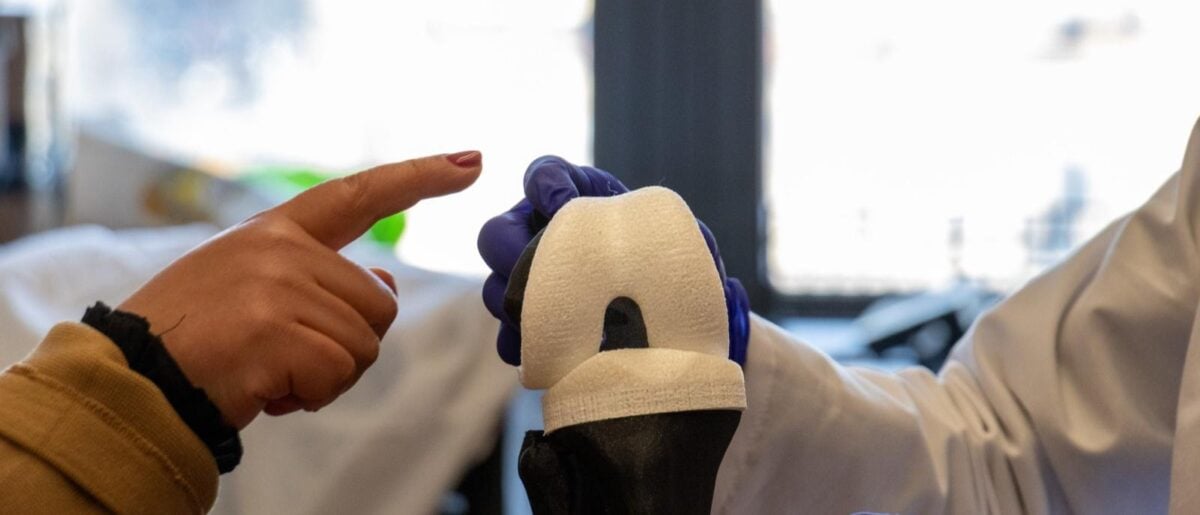
A 3D-printed knee scaffold. (Columbia University)
"NITRO, ARPA-H's first program, was launched with the question: What if we could make our joints heal themselves?" said program manager Ross Uhrich.
"Two years later, it's not only possible, but quickly becoming a reality."
Semaglutide and joint protection
In the interim, a potential treatment may already be in widespread use.
A 2026 study found that semaglutide appears to protect joints – apparently through a mechanism separate from reducing joint pressure through weight loss.
Researchers from China and the US found that the drug reprogrammes the metabolism of cells responsible for maintaining healthy cartilage, enabling those cells to produce more energy.
Among mice and people with obesity and osteoarthritis, semaglutide treatment lessened pain and reduced cartilage degeneration.
In the mouse experiments, the team included a control group that consumed the same quantity of food as animals treated with semaglutide. Despite similar changes in weight, the control animals did not gain the same protection for their cartilage, indicating an effect on the joint itself that was independent of weight loss.
Although further research is required, semaglutide is already taken by many people, making it a treatment that can be investigated more closely in future.
Related: Experimental Drug Can Reverse Osteoarthritis in Weeks, Animal Research Shows
For the Stanford researchers, a clinical trial is the next step.
This can take considerable time, but a 15-PGDH blocker intended to combat muscle weakness has already undergone an earlier human trial. It raised no health or safety red flags, which should accelerate the trial process for comparable drugs.
"We are very excited about this potential breakthrough," said Blau.
"Imagine regrowing existing cartilage and avoiding joint replacement."
The study appeared in the journal Science.
This article was fact-checked and edited by Clare Watson. While we take pride in our process, we are only human. If you spot an error, please let us know.






Comments
No comments yet. Be the first to comment!
Leave a Comment