
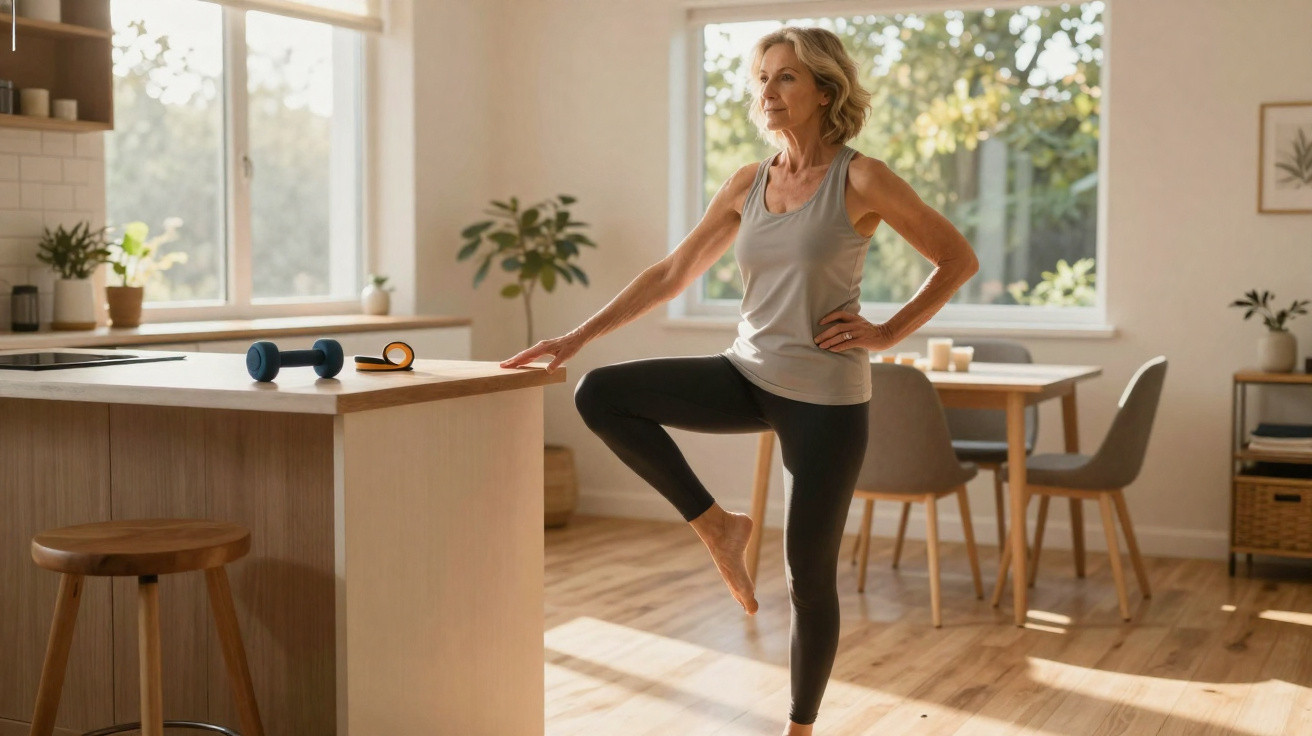
After the age of 60, balance training targeted specifically at stability can be as important as building strength and endurance. One straightforward exercise is standing on one leg for a few seconds, always beside a solid surface. This practice directly challenges the systems that help you regain stability after a trip. Beyond improving physical performance, this type of training helps maintain practical abilities, such as climbing stairs, walking on uneven ground and continuing to carry out activities independently.
Why can standing on one leg help prevent falls?
When walking, the body repeatedly enters phases in which almost all its weight is carried by just one leg. Single-leg support recreates this demand in a controlled setting, requiring the ankles, knees, hips and trunk to make small adjustments to keep the centre of gravity over the supporting foot.
The benefit does not rely on standing still for several minutes. The exercise needs to be demanding enough to require corrections without putting the individual at risk. When practised consistently, balance exercises can improve:
- Body control while changing position;
- Stability in the ankles and hips;
- Coordination between vision, muscles and the vestibular system;
- The ability to respond to minor losses of balance;
- Confidence when carrying out everyday movements.
Are stretching and Pilates enough to prevent falls?
Stretching may help maintain range of motion, while Pilates can support strength, body control and balance, depending on the exercises performed. The issue is expecting any activity to automatically replace specific balance training. Falls-prevention programmes generally work best when they directly challenge stability while also incorporating leg strengthening and functional activities.
How can you do the balance exercise more safely?
A suitable starting method is to stand beside a sturdy worktop or the stable back of a chair. With your feet close together, slowly shift your weight onto one leg and lift the other foot a few centimetres off the floor. You can use your hands for support at first, then gradually reduce that support as your control improves.
The exercise should remain challenging without becoming a risky test. You can progress by changing foot position, using less hand support or adding functional movements.
- Begin beside a solid surface;
- Keep your gaze fixed on a point in front of you;
- Use hand support whenever needed;
- Practise on both sides of the body;
- Increase the difficulty only once the previous position is under control;
- Avoid practising alone where there is a high risk of falling.
Why should strength and balance be trained together after 60?
Regaining balance after a trip requires noticing that the body has moved out of a stable position and generating force quickly enough to take a step, grasp a support or reposition the feet. This is why muscular strength and balance complement one another. Adapted squats, sitting down and rising from a chair, stepping up and calf exercises can help build the muscles used for these responses.
- Sitting down and standing up works the quadriceps and hips;
- Calf raises strengthen the ankles and legs;
- Stepping up combines strength with body control;
- Walking in different directions challenges coordination;
- Balance exercises add the stability component.
The aim is to keep doing independently what seems simple today
A fall can have effects that extend beyond an immediate injury. Following an incident, some people begin avoiding stairs, walks and trips outside because they fear falling again. Becoming less active can further reduce strength and confidence, creating a cycle that progressively undermines independence.
For this reason, the best programme does not depend on one miracle exercise. Balance training becomes more effective when performed regularly alongside strengthening and functional movement. For people who already experience frequent falls, dizziness, major difficulty walking or a history of fractures, the intensity should be adapted with professional guidance. The ultimate aim is very practical: maintaining the ability to rise from a chair, climb a step, walk around the home and safely continue the tasks that support an independent life.




Comments
No comments yet. Be the first to comment!
Leave a Comment