
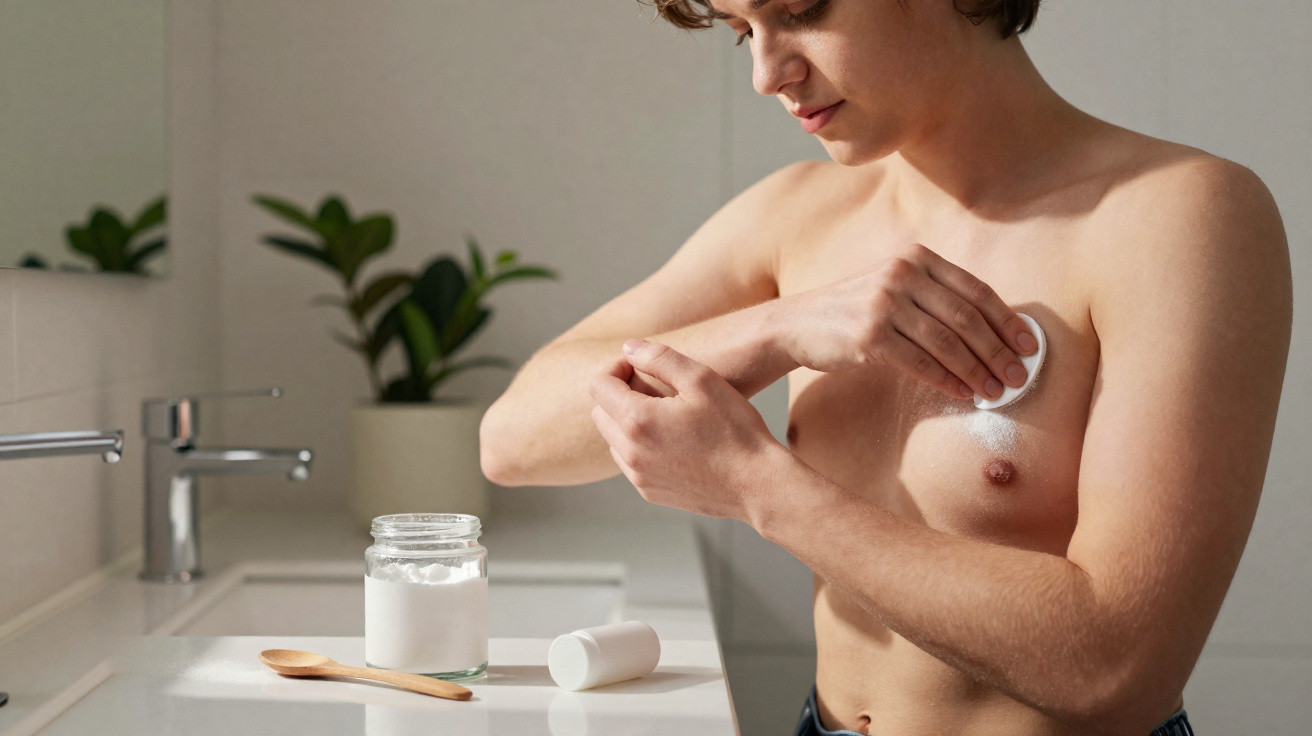
Applying bicarbonate of soda to the underarms may seem like an easy way to manage body odour, and some people do find that it works. However, the very substance that can lessen odour on some skin types may also lead to stinging, redness and irritation on others, particularly if it is used often or immediately after hair removal.
Why can bicarbonate of soda reduce underarm odour?
Sweat itself is not the main cause of a strong underarm smell. Odour develops mostly when microorganisms on the skin interact with compounds in perspiration. Bicarbonate of soda can temporarily change this environment, making certain conditions that encourage unpleasant odours less favourable.
The powder can also soak up some moisture from the skin’s surface, so the area may feel drier for a while. This partly explains why some people regard it as an effective homemade deodorant. Even so, it does not work in the same way as an antiperspirant and does not naturally stop the body from producing sweat.
Why does bicarbonate of soda irritate some skin?
The skin has a protective barrier and a naturally more acidic pH. As bicarbonate of soda is alkaline, repeated use may disrupt that balance. For people with sensitive skin, this can contribute to dryness, stinging, itching and redness, especially in an area such as the underarms, where friction is constant.
Certain circumstances make irritation more likely, which helps explain why a seemingly harmless recipe may suit one person but cause discomfort for another:
- Applying bicarbonate of soda straight after shaving or removing underarm hair increases the likelihood of stinging.
- Using a large amount or reapplying it several times can make dryness and sensitivity more likely.
- Combining it with acidic or fragranced ingredients may worsen irritation.
- People with sensitive skin, dermatitis or a history of allergies may react more easily.
Does bicarbonate of soda replace ordinary deodorant?
Not always. Commercial deodorants are formulated to minimise odour and, depending on the product, may also include antiperspirant ingredients. Bicarbonate of soda, meanwhile, is a single raw ingredient without a formula specifically designed to manage stability, concentration or prolonged contact with the skin.
This matters because cosmetic products commonly bring together ingredients with particular purposes, including odour control, texture, moisturising and reduced irritation. Bicarbonate of soda may appear effective in some routines, but both its performance and how well it is tolerated vary widely from person to person, with no assurance that it is the best choice for everyday use.
Watch the video shared by the YouTube channel Dra. Bruna Scalco, which offers tips on getting rid of underarm odour.
How can you tell when your skin has not tolerated it?
Stinging, itching, flaking and redness may indicate that the area has become irritated. The skin can also feel tender to the touch or become uncomfortable when wearing tighter clothing. Carrying on applying the ingredient in these circumstances is likely to extend the problem and make it harder for the skin barrier to recover.
If a reaction occurs, stopping use is a sensible choice. Persistent or painful irritation, or irritation accompanied by lesions, should be assessed by a responsible adult and a healthcare professional. It is also worth remembering that unusual changes in body odour or sweating can have different causes and should not always be managed with home remedies alone.
Is it worth using bicarbonate of soda on the underarms?
The fact that it works for some people does not mean it is suitable for everyone. The outcome depends on skin sensitivity, how often it is used, the amount applied, and factors such as hair removal and friction. Natural or homemade does not mean free from the risk of irritation, particularly when a substance affects the skin’s normal balance.
If you are considering replacing your usual deodorant with bicarbonate of soda, monitor your skin’s response carefully and do not persist if discomfort develops. Finding an option that your skin can tolerate is more important than following a popular recipe. At the first persistent sign of irritation, it is best to stop the experiment and look for a more suitable alternative.






Comments
No comments yet. Be the first to comment!
Leave a Comment