

Organs can age at different rates
Your birthday records how long you have lived, but it cannot reveal whether your heart, brain or kidneys have all coped with those years equally well.
That is because organs in one body may display very different degrees of biological ageing.
A new study published in Nature Medicine indicates that ageing leaves distinct traces in the microscopic architecture of individual organs.
Researchers have used these signatures to create a method that could identify organs that appear older than expected from a single blood sample.
This is not currently a blood test that can be ordered through a hospital. It also cannot monitor an organ over years to measure its ageing speed directly. Rather, it gauges whether an organ seems biologically older or younger than would be expected for someone’s chronological age.
A group led by André Rendeiro, with Ernesto Abila, Iva Buljan and Yimin Zheng as co-first authors, analysed 25,712 microscopic images of tissue from 983 deceased donors. The collection included 40 tissue types from 29 organs.

The study authors André Rendeiro, Iva Buljan, Ernesto Abila and Yimin Zheng, from left to right. (Wolfgang Däuble/CeMM)
Building tissue clocks for organ ageing
The team trained an artificial intelligence model using tissue samples from people of varying ages. As it processed the data, the system learnt to identify subtle age-linked structural shifts, effectively producing a “tissue clock” for every organ.
For instance, if the clock found that a 60-year-old person’s lung tissue looked like tissue from an older individual, that lung was classed as older than expected.
On average, the models’ predictions were around five years away from the donors’ true ages.
More importantly, these estimates seemed to capture more than a person’s date of birth.
Tissues judged to be older than expected were more likely to contain structural alterations and health problems linked with ageing. These included tissue shrinkage, scar-like stiffening, the disappearance of tiny blood vessels, fat build-up in skeletal muscle and thinning nerves.
Nor did the body follow a single, universal pattern of ageing. Some individuals showed evidence of advanced ageing in numerous organs. For others, one organ - including the heart, lung or stomach - appeared substantially older than the rest of their body.
Using blood samples to estimate organ age
Assessing an organ’s biological age directly would ordinarily require an invasive tissue-collection procedure.
To address that limitation, the researchers paired age estimates obtained from tissue images with gene-activity patterns in blood samples taken from the same donors.
In simple terms, they searched for changes in blood gene activity that were associated with an organ looking older than expected.
"A blood sample does not directly image the organ; it estimates the organ's age gap through a learned correspondence," André Rendeiro, a principal investigator at CeMM and the Ludwig Boltzmann Institute for Network Medicine at the University of Vienna, told ScienceAlert.
The researchers then produced a second model able to estimate the apparent age of different organs from blood data alone. It performed best for whole-body ageing, the digestive system and the spleen.
To determine whether the estimates corresponded to genuine illness, they applied the approach to blood data from healthy participants and people with eight distinct medical conditions. In general, the models attributed larger age gaps to the organs linked with each condition.
Among people who had had a stroke, the brain received the largest age gap.
For people with Crohn’s disease, larger age gaps were assigned to the oesophagus, stomach, small intestine and colon.
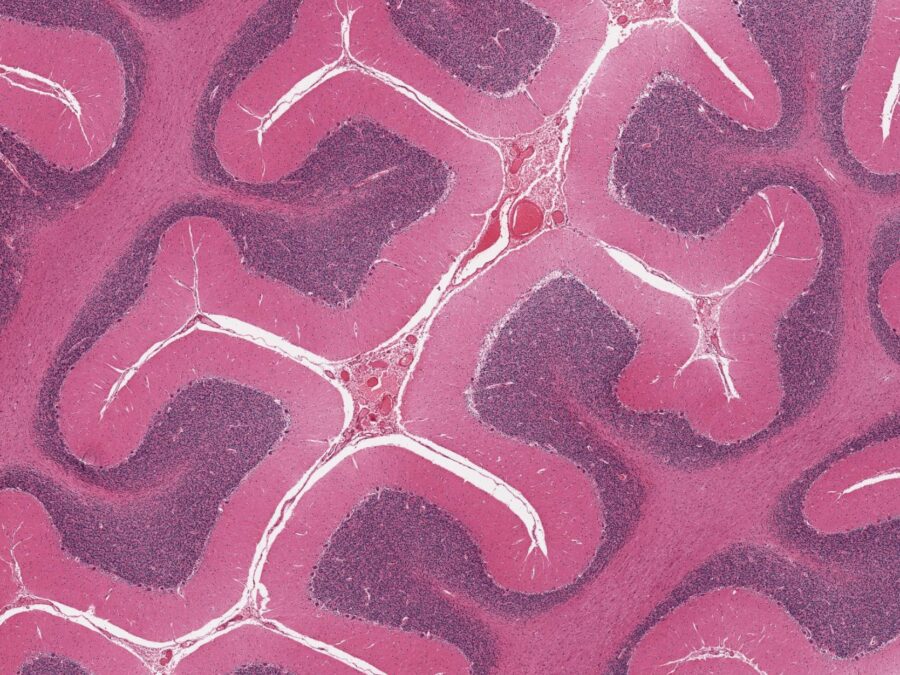
Histological section of a human cerebellum tissue sample used to investigate age-related changes in tissue architecture. (Wolfgang Däuble/CeMM)
Within the Alzheimer’s group, the brain was the sole organ with a significantly increased age gap.
These associations indicate that blood could contain signals of processes occurring deep within the body. Yet an organ that looks older does not show that accelerated ageing caused the disease. The disease itself may have aged the organ, or the two processes may have progressed together.
Earlier blood-based approaches have estimated organ age through measurements of circulating proteins.
One such study reported that an older-looking brain was linked to a greater risk of death.
However, existing commercial biological-age tests may return sharply different results.

Limitations of the new blood test method
The new research also comes with significant limitations.
Most tissue samples were obtained after death, while the researchers did not track the same people as they grew older. The blood-based technique was chiefly assessed in people who had already received a diagnosis.
Whether the test might identify disease before symptoms appear is still unknown.
Prospective research, reliable results across different populations and regulatory approval would all still be needed. Clinical use is "realistically several years, possibly close to a decade," Rendeiro said.
Related: Humans Age Faster at 2 Sharp Peaks, Research Shows
Abila, Iva Buljan, Yimin Zheng and Rendeiro disclosed competing financial interests through a patent connected to the work.
For the moment, the findings indicate that boiling biological age down to one figure could overlook an important part of the picture.
Your heart, brain and kidneys exist in the same body, but they may not experience time in the same manner.
The study was published in Nature Medicine.
This article was fact-checked and edited by Fiona MacDonald. Although we take pride in our process, we are only human. If you notice an error, please let us know.






Comments
No comments yet. Be the first to comment!
Leave a Comment