
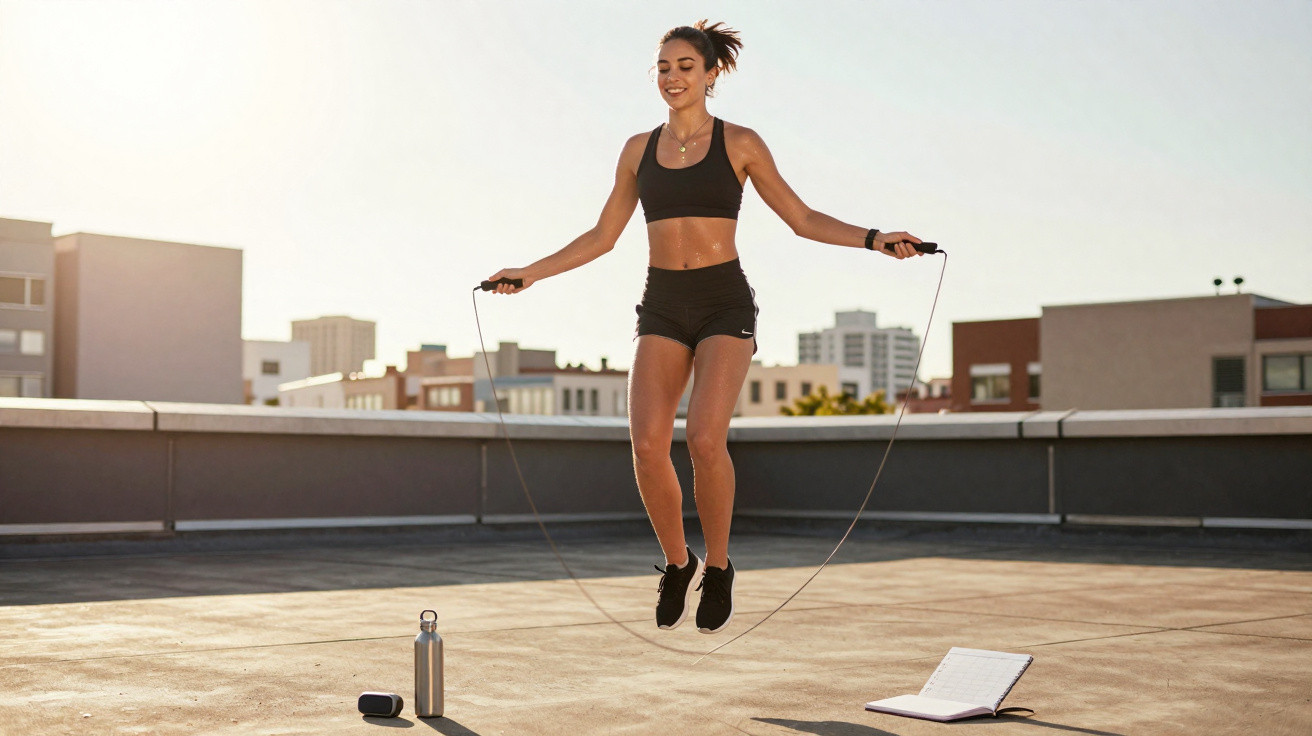
Skipping rope for 15 minutes, five days a week, may sound like a brief routine, yet its yearly effect is striking. At a moderate pace, this exercise pairs substantial calorie expenditure with coordination and muscle work in a simple, accessible workout.
How does the 46,000-calorie annual calculation work?
At a moderate tempo, skipping rope may burn between 10 and 16 calories per minute, according to body weight, speed, technique and fitness level. Over 15 minutes, that equates to an approximate 150 to 240 calories per session.
With an average of around 12 calories burned each minute, exercising for 15 minutes a day, five times weekly, adds up to roughly 46,000 calories over a year. However, this figure is an estimate rather than a guarantee that applies equally to every body.
The calculation is easier to understand through these factors:
- Rope: it requires rhythm, push-off, balance and coordination simultaneously.
- Duration: 15 minutes makes for a short but demanding session.
- Expenditure: burning 10 to 16 calories per minute accounts for the cumulative effect.
- Frequency: five days a week maintains volume without requiring lengthy workouts.
- Variation: fitness, technique and rest breaks alter the actual outcome.
Why does skipping rope use so much energy in little time?
A skipping rope workout involves repeated jumps, coordination between the arms and legs, and continual control of pace. Consequently, it raises the heart rate quickly and engages major muscle groups in a continuous sequence.
Against an easy run, skipping rope can match or even exceed the calorie burn per minute in certain circumstances, as it brings together vertical movement, impact, cadence and upper-body effort. Its effect relies on intensity and consistency.
Which muscles work during skipping rope?
Skipping rope does not target only the legs. The calves, quadriceps, glutes, abdomen, arms and shoulders all contribute, whether by propelling the body, stabilising posture or turning the rope with control and precision.
Short workout, full body
The effort extends beyond the jumps
While the legs perform the jumps, the core supports stability and the arms manage the rope’s rotation.
This combination helps explain why just a few minutes can feel more intense than other continuous exercises.
The core, which includes the abdominal and lower-back muscles, keeps the body aligned throughout the jumps. With appropriate technique, movements become smaller, more efficient and less harsh on the knees and ankles.
The muscle groups under greatest demand are:
- Calves, which provide much of the push-off.
- Quadriceps and glutes, which support jump stability.
- Core muscles, essential for posture and balance.
- Arms and shoulders, which keep the rope turning steadily.
What benefits go beyond calorie expenditure?
Skipping rope can also develop motor coordination, rhythm, agility and body awareness. Because it involves controlled impact, it may support stimuli linked to bone health, provided it is introduced progressively and without excessive joint strain.
Its convenience is another advantage. A rope takes up very little room, costs less than much fitness equipment, and can be used at home, on a court, in the garden or in an open area, without needing a gym or treadmill.
For safer practice:
- Begin with short blocks and planned rest breaks.
- Wear trainers with good cushioning and use an even surface.
- Keep jumps low rather than lifting the knees excessively.
- Stop if you experience pain, dizziness or unusual shortness of breath.
How can you fit 15 minutes of skipping rope into your routine?
One practical approach is to split the workout into blocks, such as three five-minute sets with brief rests between them. The idea of skipping rope for at least 15 minutes works best when technique and fitness level are respected.
The figure of 46,000 calories a year is impressive, but consistency is the main benefit. With a moderate pace, gradual progression and attention to the body, a skipping rope can be a simple tool for improving fitness, coordination and movement in everyday life.





Comments
No comments yet. Be the first to comment!
Leave a Comment