
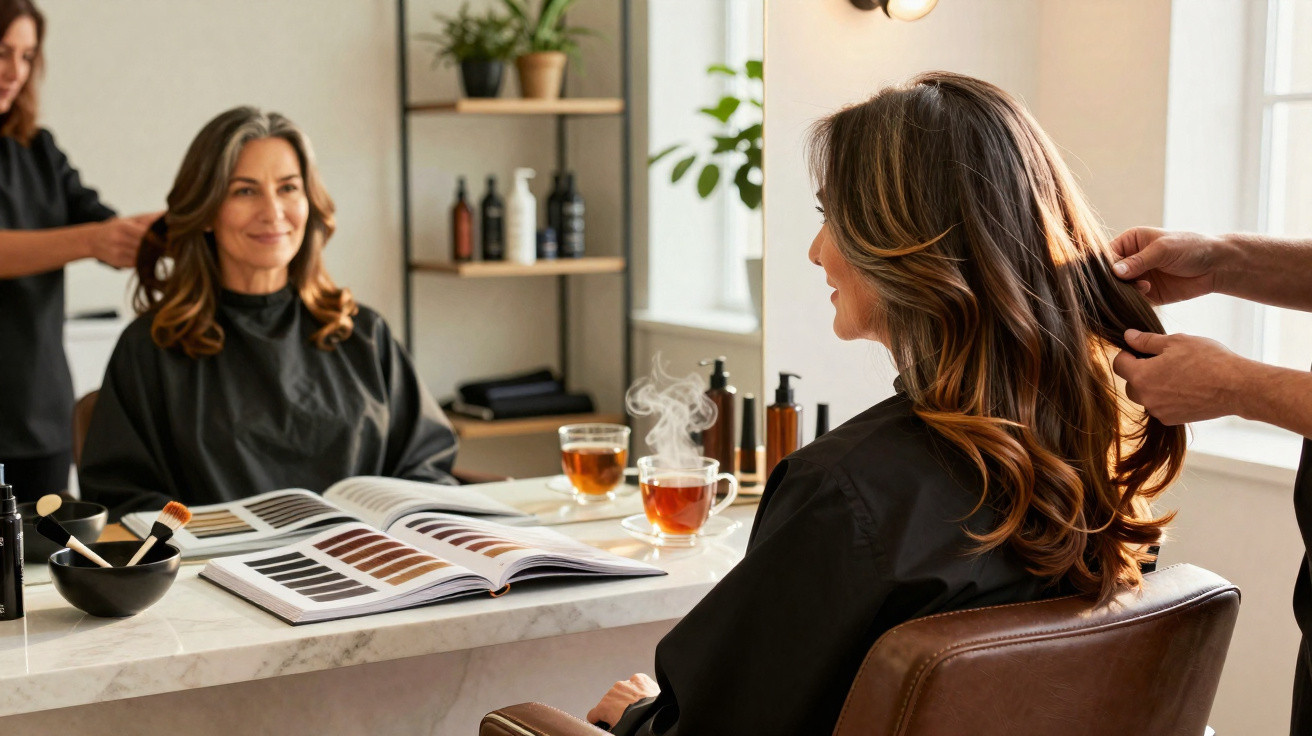
For women over 55, very dark shades such as blue-black and deep cool brown can create a stark contrast against the skin, making the overall look appear harsher. This does not mean giving up dark hair; it means adjusting the depth, highlights and shine so the colour feels softer, more natural and easier to maintain.
Why can very dark shades make the overall look feel heavier?
Very deep colours form a strong frame around the face. With uniform blue-black or cool brown hair, differences between the roots, skin and white hairs become more pronounced.
In certain lighting, this can draw more attention to expression lines, dark circles and skin texture. For this reason, many hairdressers favour less flat-looking tones, retaining elegance without creating a severe outline around the face.
Which colours soften the look without giving up dark hair?
The alternative does not have to be a dramatic move towards blonde. Subtle variations within the brown range can add movement, radiance and depth without taking away the identity of someone who enjoys dark hair.
- Chocolate brown: retains depth while adding a warmer, brighter reflect.
- Hazelnut brown: softens the facial outline with understated shine.
- Illuminated brunette: keeps the roots dark while brightening carefully selected areas.
- Soft caramel: warms the lengths without creating excessive contrast.
- Golden brown: introduces light without completely changing the natural base.
How should colour be adapted to skin tone and white hair?
Ideally, consider the skin undertone, the amount of white hair and the natural root colour. Warm-toned skin often suits chocolate, honey and caramel shades, whereas cool-toned skin may work better with neutral browns, beige and hazelnut.
- Avoid completely uniform colour if white roots show through quickly.
- Ask for fine highlights to blend white hairs with the rest of the hair.
- Use a root smudge to reduce visible demarcation between touch-ups.
- Choose a gentle toner when full coverage is not wanted.
- Take reference photos in natural light to make the choice easier at the salon.
How to ask for this change at the salon?
A clear way to describe it is to say that you want to retain a dark base, with softer and less cool highlights. Phrases such as “illuminated brown”, “warm chocolate”, “root smudge” and “fine face-framing highlights” can help the stylist understand the desired result.
It is also important to request an assessment of the hair’s condition before lightening it. Hair with old colour, porous ends or recent chemical treatments may need conditioning, a strand test and a gradual transition to prevent patchiness or dryness.
How can you keep the colour looking good for longer?
Maintenance begins with washing. Shampoo for colour-treated hair, a weekly hydrating mask and heat protection help preserve shine, softness and highlights. Very hot water can speed up fading and leave the hair looking duller.
The main point is that no colour is off limits after the age of 55. What changes is how the shade is worn: less of a uniform dark block, and more nuance, shine and adaptation to the face, so the hair remains elegant without requiring constant touch-ups.



Comments
No comments yet. Be the first to comment!
Leave a Comment