
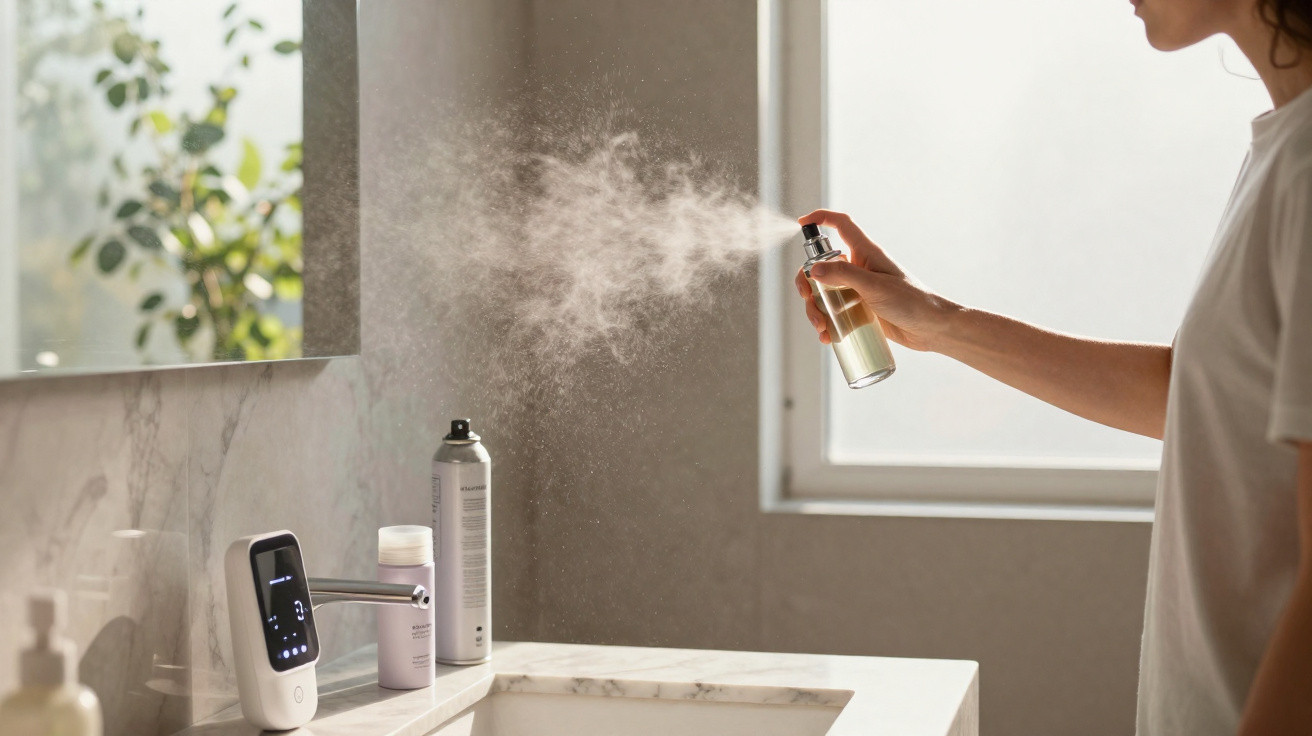
Modern personal care products contain numerous ingredients designed to conceal body odour, limit perspiration, moisturise skin, keep hair in place and provide fresh, appealing scents.
Hundreds of compounds are used to achieve these effects. Some ingredients raise health concerns in their own right, while even those considered less troublesome may react with chemicals in the surrounding environment, creating new pollutants whose toxicity is still largely unknown.
Personal care products and indoor VOC emissions
Researchers led by the École Polytechnique Fédérale de Lausanne (EPFL) in Switzerland have examined the emissions released by several widely used personal care products, as well as the reactions these emissions undergo in a typical indoor setting.
The team detected more than 200 distinct volatile organic compounds (VOCs), at concentrations reaching several parts per million.
Most of these compounds are generally considered harmless, particularly at low concentrations. However, certain notable chemical groups reacted rapidly to produce secondary organic aerosols, which cannot so readily be assumed to be safe.
"Some molecules 'nucleate' – in other words, they form new particles that can coagulate into larger ultrafine particles that can effectively deposit into our lungs," says EPFL engineer Dusan Licina.
"In my opinion, we still don't fully understand the health effects of these pollutants, but they may be more harmful than we think, especially because they are applied close to our breathing zone. This is an area where new toxicological studies are needed."
Ozone reactions in indoor environments
Many contemporary homes and workplaces contain one or two sources of ozone (O₃), a form of oxygen often released by printers, photocopiers and, ironically, air purifiers. Even where there is no ozone-generating equipment, outdoor pollutants can react in sunlight to form ozone. It can then enter buildings through open windows and ventilation systems.
Although it superficially resembles the oxygen required for breathing, ozone is comparatively unstable because it has a third oxygen atom. This makes it highly reactive with VOCs, including monoterpenes.
To assess the potential range of pollutants produced when ozone reacts with VOCs from personal care products, Licina and his colleagues bought samples of deodorant body spray, hand lotion, roll-on deodorant, perfume and dry shampoo hair spray. They then carried out two types of experiment.
In one set of tests, the researchers measured emissions from each product after it was applied to a person standing in a simulated indoor environment, or to a tissue left in the room for an hour. For the second set, ozone was introduced at roughly 35 to 40 parts per billion, and the team recorded the results of reactions between it and emissions from each personal care product.
Particle pollution from fragrances and sprays
A literal 'smog' of particles formed in every case apart from the roll-on deodorant. Worryingly, particle growth occurred at a substantially faster rate than studies usually document for outdoor air quality in either urban or remote locations.
As concern grows over the health effects that fine particles in the air can have even over unexpectedly short periods, the prospect of producing comparable pollution whenever we style our hair or apply perfume should raise alarm bells.
"I know this is difficult to hear, but we're going to have to reduce our reliance on these products or, if possible, replace them with more natural alternatives that contain fragrant compounds with low chemical reactivity," says Licina.
The research was published in Environmental Science & Technology Letters.





Comments
No comments yet. Be the first to comment!
Leave a Comment