
Candida auris is a yeast that takes up residence on human skin and hair, where it proves exceptionally difficult to remove. Most people have not heard of it, yet hospitals have been unable to wash it away.
Its persistence creates the threat. People colonised by the yeast can transmit it to others and subsequently face a substantial risk of bloodstream infection. Between 30% and 70% of patients die from these infections.
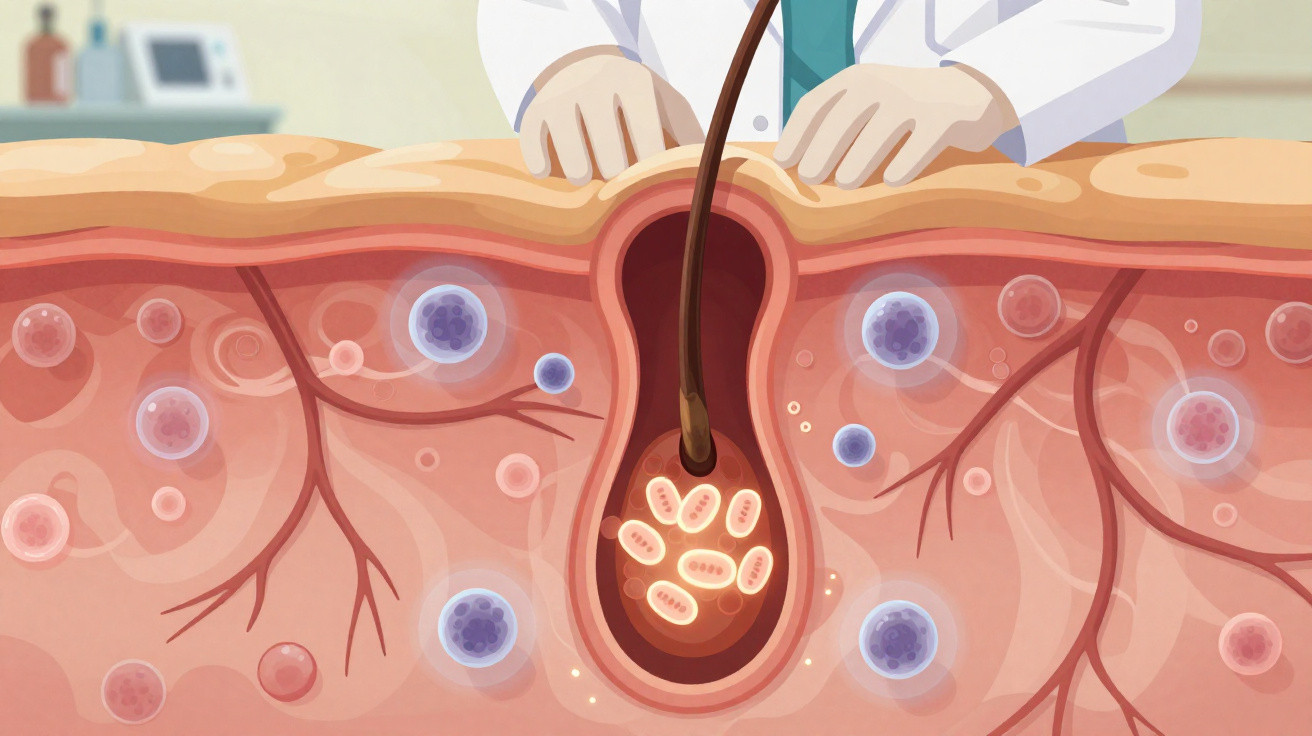
Scientists at the University of California, San Francisco (UCSF) have identified where this pathogen shelters and why the body struggles to remove it. The yeast occupies hair follicles.
Hospital fungus spreads on skin
First identified in 2009, Candida auris has now appeared in patients across every inhabited continent. It is resistant to multiple categories of antifungal medicine, and some isolates withstand every available class.
It causes its greatest harm in hospitals and long-term care homes. Investigations into outbreaks repeatedly identify the same origin: patients carrying the yeast on their skin without showing symptoms.
Both the CDC and WHO rank it among the pathogens under their closest surveillance. There is still no dependable way to eliminate it from the skin of a colonised person.
Silent colonisation spreads infection
Dean Merrill, an assistant professor in the UCSF Department of Dermatology, contributed to the research and answered questions from Earth.com.
“What makes Candida auris particularly challenging is that it can quietly colonize the skin for months without causing any symptoms,” Merrill said. “For most healthy people, that colonization may never cause a problem.”
Those most likely to experience problems are generally already in hospital or living in a care home. Severe disease, central lines and catheters, surgery, and compromised immune defences can all provide the yeast with an entry route into the bloodstream, Merrill explained.
The explanation for its long-term persistence had largely remained unclear. Previously, only two fungal proteins had been identified as helping the yeast adhere to skin.
Earlier research also identified an enzyme enabling the fungus to consume carbon dioxide escaping through the skin surface. However, that work did not establish the precise location on the body where the yeast resides.
Hair follicles anchor the Candida auris fungus
The UCSF researchers tested Candida auris alongside its much better-known relative, Candida albicans, on the shaved, undamaged back skin of mice. Initially, the two yeasts were applied in the same manner.
After that, their behaviour diverged sharply. C. albicans had disappeared after five days, whereas C. auris remained after 30 days. Repeated applications did not alter this result.
Examination of tissue sections revealed the reason. Groups of C. auris yeast cells were found within hair follicles, attached to the hair shaft, follicle opening and follicular cavity. C. albicans, by comparison, remained mostly on the flat skin surface.
A laboratory dish experiment demonstrated this preference clearly. When fragments of human hair were incubated with each yeast, they accumulated considerably more C. auris than C. albicans.
Hair serves as the attachment point. Around 30% of follicles in colonised mice contained C. auris yeast cells, while removing stubble with depilatory cream reduced this to approximately 10 percent. C. albicans did not exceed 5 percent.
Fungus evolved for life on skin
“What surprised us was how perfectly adapted C. auris appears to be for life on mammalian skin,” Merrill said.
“It binds directly to hair, preferentially colonizes hair follicles, senses skin-specific environmental cues, and remodels its cell wall in response to those cues to create a more favorable immune environment.”
The species was recognised as a human pathogen only around two decades ago. Yet Merrill believes these highly specific adaptations point to a far longer period of life on mammalian skin, potentially involving a non-human host.
Immune response helps it survive
Normally, skin combats fungi through a system centred on the signalling molecule IL-17. This recruits immune cells, strengthens the protective barrier and stimulates the release of antifungal peptides.
That response is effective against C. albicans. Mice without IL-17 failed to clear the yeast and developed severe skin damage.
The signal must be received by keratinocytes - the cells that form the barrier and line every follicle - for a response to begin. Mice with keratinocytes unable to detect IL-17 were similarly overwhelmed.
Candida auris triggered an entirely different reaction. Rather than producing an IL-17 response, it stimulated a type 1 response based on interferon gamma, a cytokine usually directed against viruses and infected cells.
This was not an unusual feature of one strain. Clinical isolates representing four C. auris clades, from South Asia, East Asia, Africa and South America, all drove the skin towards the same interferon response.
Hair follicles become a refuge
To establish where this reaction occurred, the scientists created three-dimensional images of whole sections of cleared mouse skin. The map they produced was strikingly orderly.
Type 1 lymphocytes and a dendritic-cell subgroup known as cDC1 clustered around the upper portion of each follicle. Cells that produce IL-17 were located elsewhere, in the dermis between follicles.
This accumulation increased following colonisation. Images showed yeast at hair follicle openings, encircled by cytotoxic T cells, while helper cells and dendritic cells pressed against the outer wall.
Keratinocytes in the follicles detected the signal. Levels of Stat1, a protein activated by interferon, rose sharply in these cells and matched the number of T cells alongside each follicle.
Follicles are not passive sites in this process. They act both as reservoirs for epithelial stem cells and as open gateways to organisms living on the skin surface.
Interferon helps the fungus persist
This response would be less significant if it removed Candida auris from skin. Instead, it has the reverse effect.
Mice genetically bred without interferon gamma carried much less C. auris. Those engineered to produce excess amounts carried far more yeast, concentrated around hair follicle openings.
Blocking antibodies produced the same outcome in normal mice. Removing the interferon receptor only from keratinocytes did so as well, linking the effect to barrier cells rather than immune cells.
Gene-expression results clarified the compromise. In the presence of interferon, follicle keratinocytes reduced activity in genes involved in barrier repair and antifungal defence, while increasing stress-response and antigen-presentation programmes.
This arrangement directly contrasted with the C. albicans response, which activated those same defensive genes. IL-17 still modestly restrained C. auris, but interferon exerted a stronger effect in the opposite direction.
Fungus reshapes immune defences
Merrill said the yeast does more than conceal itself from immune defences.
“Candida auris doesn’t simply evade the immune system, it appears to actively reshape how the immune system responds to it,” he said.
“We found that when C. auris encounters skin-like conditions, it remodels its cell wall and deliberately exposes much more of its own chitin.”
Chitin is the rigid sugar that gives fungal cell walls their strength. For years, it was understood as a structural material hidden beneath the wall’s external layers, rather than something a fungus might deliberately expose.
Limits of the mouse study
All findings on persistence and immune activity in this research come from mice. Mouse skin contains far more hair follicles than most human skin, meaning the scale of this effect in patients remains uncertain.
The human evidence is even more limited. It is based on C. auris attaching to fragments of human hair in a dish, rather than observations from colonised patients.
Interferon is not harmful in every setting. In systemic infection, interferon gamma and IL-17 both contribute to protection against Candida, so broadly blocking either one would involve genuine risk.
“One finding that I think is especially interesting is that the same immune molecule can have completely different effects depending on where the fungus is located,” said Merrill to Earth.com.
In the bloodstream and deeper tissues, interferon gamma is protective. In the skin’s thin outer layer, however, the team found that this same pathway helps C. auris remain in place.
Hospital options and treatments
The practical implication concerns the part of the body where the fungus lives. If follicles act as reservoirs, skin with hair may require closer scrutiny than a fingertip swab.
It also changes how decolonisation is viewed. Antiseptic washes work on the surface, while yeast concealed inside a follicle lies beyond the reach of most of them.
Merrill said a treatment that consistently removes the yeast from skin remains several stages away. The most obvious medicines have already proved inadequate.
Echinocandins, including caspofungin, are effective against most bloodstream infections. However, they penetrate skin poorly and have never eliminated colonisation.
They may also create an additional concern.
“Because echinocandins can trigger compensatory increases in fungal chitin, they may inadvertently reinforce one of the mechanisms that promotes persistent skin colonization,” warned Merrill.
New targets for treatment
Drug developers face the problem from another angle as new antifungal compounds progress through testing. Resistance in this species is already extensive and continues to expand.
Researchers now have a target that was previously unavailable. Interferon signalling in follicle keratinocytes may be a useful lever, and reducing it locally is fundamentally different from suppressing it throughout the body.
Merrill noted that treatments targeting chitin synthesis or cell-wall remodelling are already being investigated. Another possible strategy would focus on the immune response itself.
Locally reducing the type 1 pathway, or enhancing IL-17 barrier immunity, might shift the balance towards clearance. For now, Merrill describes both approaches as speculative.
The broader issue is whether other fungi use the same approach. “Our work suggests that fungi may regulate which components of their cell wall they expose depending on the environment they’re in,” Merrill said.
None of this yet amounts to a treatment. It provides a map of where the fungus persists and what allows it to thrive - more knowledge than existed previously for an organism that no hospital has succeeded in washing away.





Comments
No comments yet. Be the first to comment!
Leave a Comment